


Part of The Underwriter’s Read, a series on the critical questions a credit team works through before they lend.
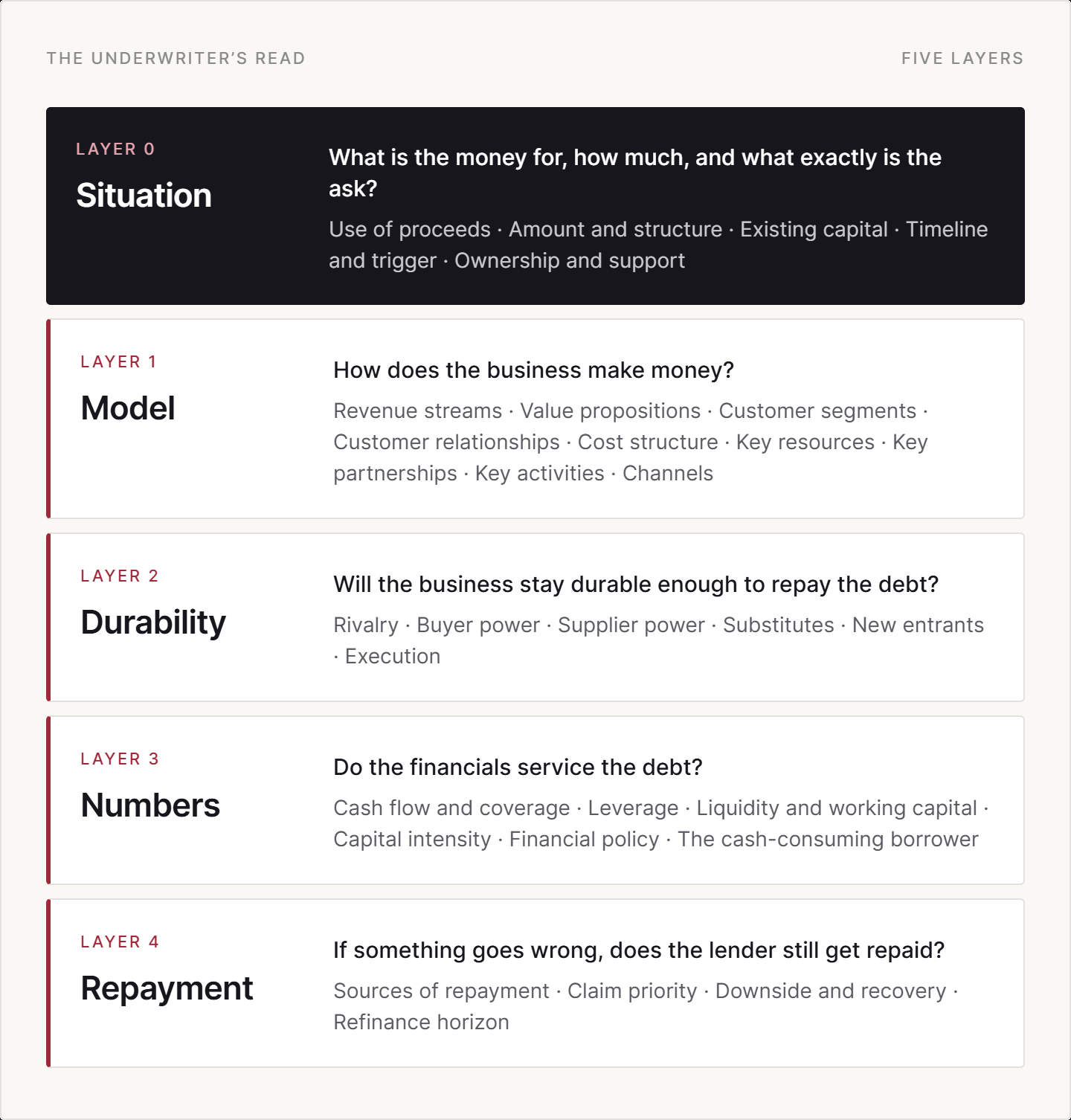
The Underwriter’s Read has covered a large part of what an underwriter wants to understand before making a credit commitment. This post lists every lesson by layer, with a short note on what each layer establishes. The overview explains why a lender reads a business differently from an equity investor and how the layers fit together.
Situation
The situation layer covers what a lender needs to know before diligence starts: what the money is for, how much is being asked for and in what structure, who already has a claim on the business, when the money has to be in place, and who owns and supports the business. These facts decide which parts of the other layers matter most for a given deal.
- Lesson 01: Use of Proceeds: Why the Need Matters as Much as the Amount
- Lesson 02: Amount and Structure: Defining the Ask
- Lesson 03: Existing Capital: Who Is Already in Line
- Lesson 04: Timeline and Trigger: Setting Expectations for the Process
- Lesson 05: Ownership and Support: Who Is Behind the Business
Model
The model layer breaks the business into nine blocks adapted from the Business Model Canvas and establishes how it makes money: what revenue is contracted and what has to be re-won, why customers pay, which customers the revenue depends on, how much of the cost base is fixed, and what the business relies on to operate. Its findings are the base that the durability and numbers work tests.
- Interlude: The Model Layer: How the Business Makes Money
- Lesson 06: Revenue Streams: What Is Contracted and What Has to Be Re-Won
- Lesson 07: Value Propositions: Why Customers Pay, and Whether They Still Would Under Pressure
- Lesson 08: Customer Segments: Who Pays, and How Much Rests on Too Few of Them
- Lesson 09: Customer Relationships: What Keeps a Customer in Place or Coming Back
- Lesson 10: Cost Structure: How Much of the Cost Base Is Fixed
- Lesson 11: Key Resources: What Produces the Cash, and What Can Be Lent Against
- Lesson 12: Key Partnerships: What the Business Leans On and Does Not Control
- Lesson 13: Key Activities: What the Business Does All Day, and Whether It Can Do More of It
- Lesson 14: Channels: The Route to Market, and Who Sits Between the Borrower and the Cash
Durability
The durability layer tests whether the model holds up against pressure from rivals, customers, suppliers, substitutes and new entrants, following Porter’s five forces, and whether management can carry out the plan. Its findings become specific adjustments to the lender’s cash flow, instead of a flat percentage stress.
- Interlude: The Durability Layer: Testing the Resilience of the Business Model Against Internal and External Pressure
- Lesson 15: Rivalry: Whether the Growth Is Taking Share or Being Bought With Price
- Lesson 16: Buyer Power: What Lets Customers Set the Price
- Lesson 17: Supplier Power: What Lets Suppliers Raise the Borrower’s Costs
- Lesson 18: Substitutes: What Else the Customer Could Use Instead
- Lesson 19: New Entrants: What Keeps Other Companies Out of the Borrower’s Market
- Lesson 20: Execution: Whether Management Can Deliver the Plan and Handle What the Other Forces Bring
Numbers
The numbers layer rebuilds management’s figures from the source documents: how much of EBITDA is cash the debt can be paid from, leverage before and after the new loan, how much cash growth ties up, maintenance spending against growth spending, and how management uses cash when it has a choice. A separate lesson covers borrowers that are not yet profitable, where runway against the next funding milestone replaces coverage.
- Interlude: The Numbers Layer: Turning the Model and Durability Work Into Coverage and Leverage
- Lesson 21: Cash Flow and Coverage: How Much of the Reported EBITDA Is Cash the Debt Can Be Paid From
- Lesson 22: Leverage: The Debt Multiple Before and After the New Loan
- Lesson 23: Liquidity and Working Capital: How Much Cash Growth Ties Up
- Lesson 24: Capital Intensity: Maintenance Spending, Growth Spending, and What Is Left
- Lesson 25: Financial Policy: How Management Uses Cash When It Has a Choice
- Lesson 26: The Cash-Consuming Borrower: How a Lender Underwrites a Business That Is Not Yet Profitable
Repayment
The repayment layer establishes how the loan is repaid and what the lender recovers if the main source fails: which sources of repayment the business has and whether they weaken together, where the loan ranks and which entities hold the assets, what the collateral would recover in a default, and whether a new lender would refinance the loan when it matures.
- Interlude: The Repayment Layer: Sources of Repayment, Claim Priority and Refinancing
- Lesson 27: Sources of Repayment: Operating Cash Flow, Refinancing, and Asset Sales or Owner Support
- Lesson 28: Claim Priority: Where the New Loan Ranks, Which Entities Hold the Assets, and Where They Sit
- Lesson 29: Downside and Recovery: What the Collateral Is, Where It Sits, and How Easily It Converts to Cash to Repay the Loan
- Lesson 30: Refinance Horizon: Whether a New Lender Would Refinance the Loan When It Matures
One borrower through the numbers and repayment
Lessons 21 to 30, apart from the lesson on the cash-consuming borrower, follow the same illustrative specialty distributor. The lender’s EBITDA bridge in cash flow and coverage carries through leverage, liquidity, capital spending and financial policy, and into the repayment, recovery and refinancing schedules. A reader can follow one borrower from management’s figures to the lender’s, from the $33.0mm facility at closing to the $18.5mm the lender expects to be refinanced at maturity.
Applying it to a specific financing
The layers and lessons cover, at a minimum, what an underwriter will want to understand before committing to a loan, and that analysis is the same for every borrower. How a particular lender weighs the findings for a specific deal is not. That depends on the lender type, on the terms comparable credits are getting in the current market, on how lenders have treated similar businesses before, and on which findings the borrower can address before the process starts.
---
You can work through these questions for your own business. Knowing how the lenders in your process will weigh the answers, and which of them will set your terms, is the part I do at Synthase Capital Partners.