


Part of The Underwriter’s Read, a series on the critical questions a credit team works through before they lend.
The last block established how much of the cost base is fixed, and with it the revenue level where coverage breaks. This block works on the assets sitting behind the revenue. It answers two separate questions: which resources actually produce the cash, and which of those a lender can take security over.
Four probes sit in this block, and they group together because each one narrows the asset base to a smaller set. The first inventories what produces the revenue. The second sorts that inventory into owned, leased and licensed, because only the owned part can be pledged. The third classifies the owned part by the type of debt it supports. The fourth looks for the single asset or single person the business cannot run without.
This block is what lets a lender test whether the forecast has the assets behind it. Management’s projection carries a revenue number, and the asset register from the first probe says which plant, fleet, warehouse or licensed capacity produces the current one. A lender reads the forecast volume against what that asset base can carry, and where the plan requires capacity the borrower does not hold, the capex or the lease commitment to acquire it has to appear somewhere in the cash flow. The financeability classification then determines how much of the facility is supported by assets rather than by the projection, which is the difference between a shortfall that reduces availability and a shortfall that breaches a covenant.
Two ways to sort the same assets
The business model canvas sorts key resources by what they are: physical, intellectual, human and financial. That sort answers what the business needs in order to deliver what it sells. A credit read sorts the same assets by ownership and financeability instead, because that sort answers what a lender can take security over and what kind of debt it supports. The two are not in conflict and they are not interchangeable. A brand, a trained crew and a proprietary formulation can all be central to how a business earns and still be outside what a lender will lend against.
The work starts with the inventory, before either sort is applied. Revenue gets traced back to the resources producing it, and the result is written down as an asset register tied to revenue generation rather than as a fixed-asset schedule tied to book value.
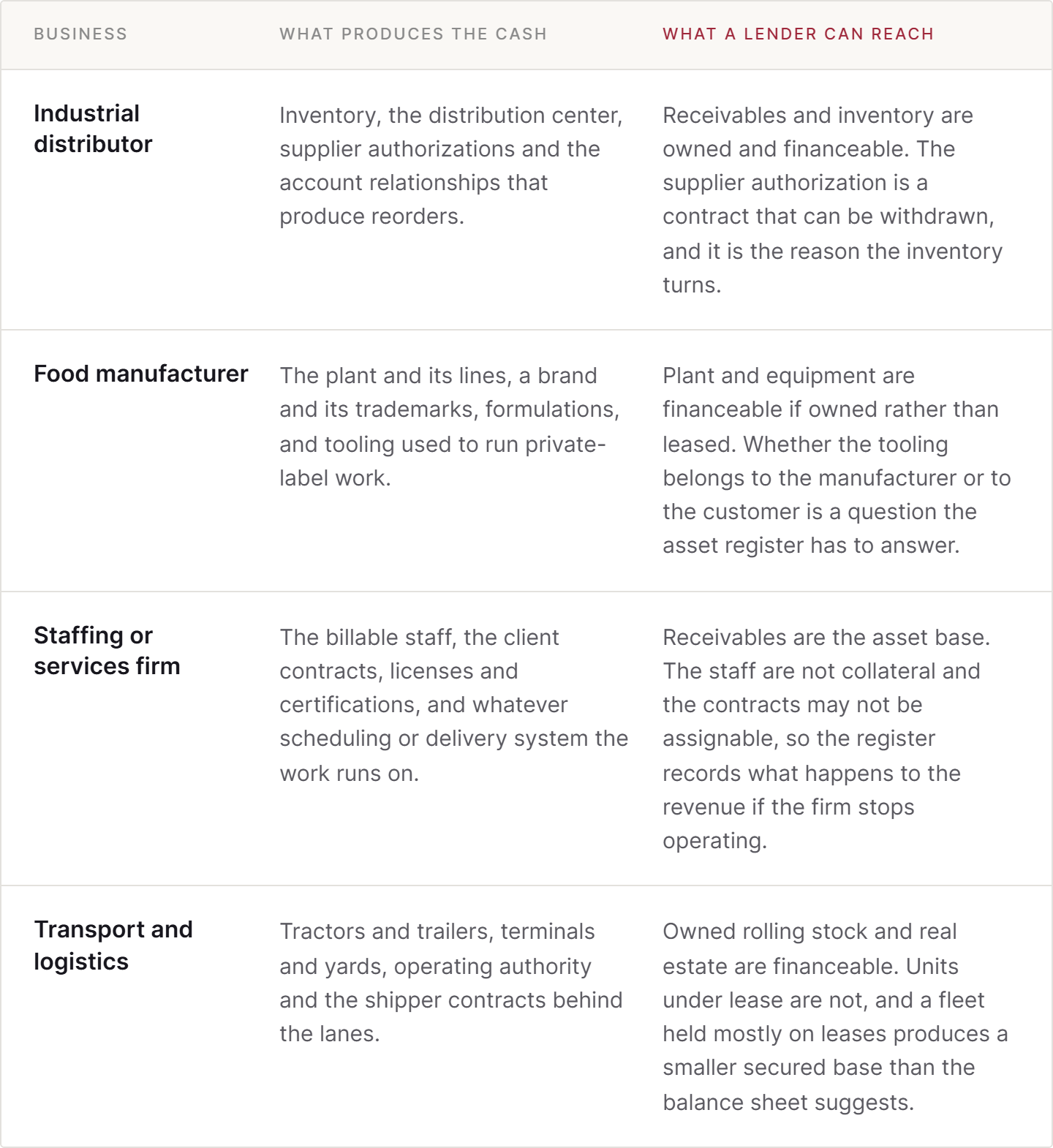
The four probes, and what validates the answer
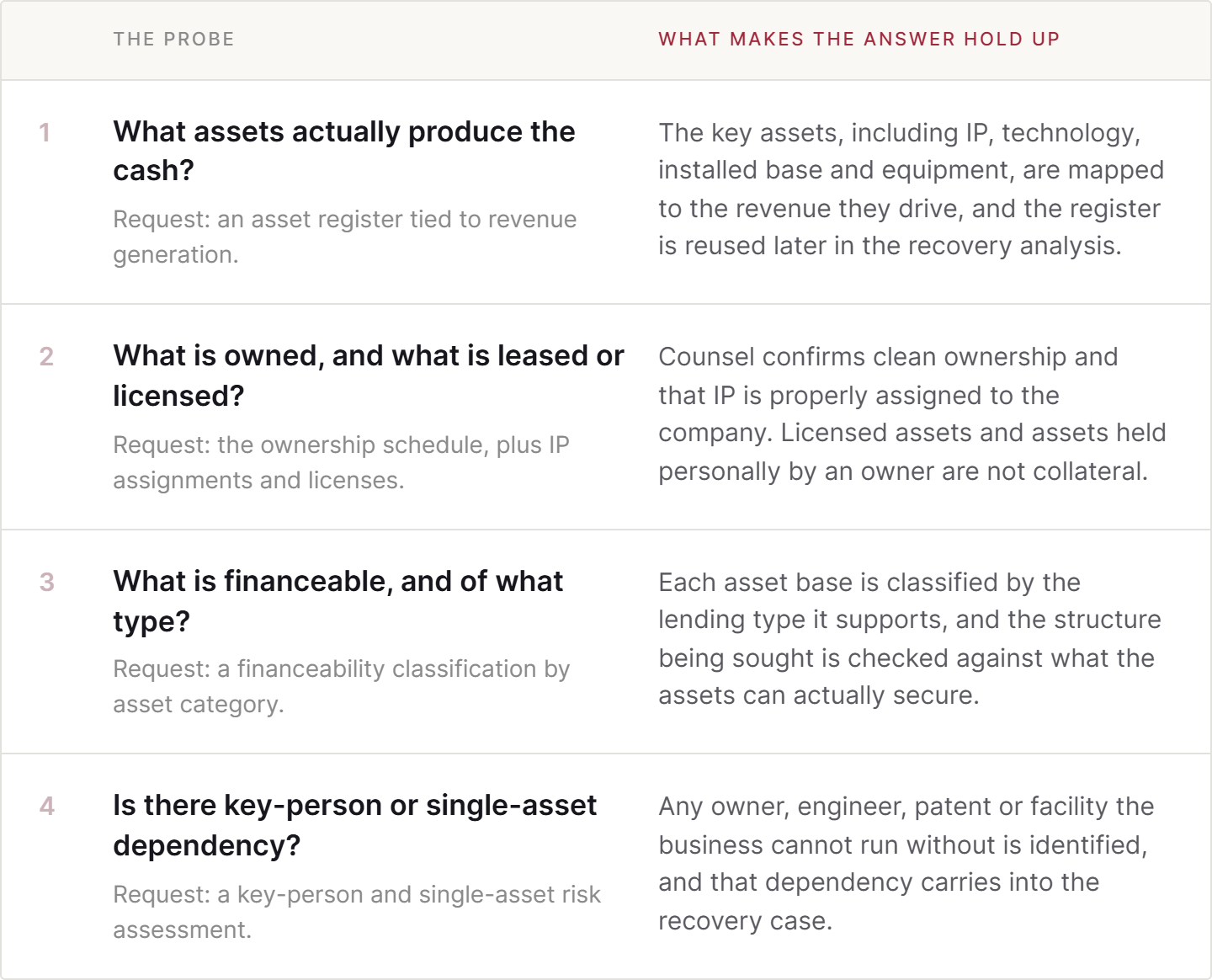
The second probe is where borrowers most often find a gap they were not expecting. A company can hold a piece of equipment on its floor, run it every day, carry it in the fixed-asset schedule and still not own it, because it sits on a capital lease with title retained or because it belongs to the customer whose parts it makes. IP raises the same issue in a different form. A formulation, a design or a piece of software developed by a contractor or by a founder before incorporation belongs to whoever the assignment says it belongs to, and where no assignment was ever signed, it is not the company’s asset to pledge. Both findings come out of documents rather than out of management discussion.
What the asset base supports
The third probe converts the owned asset base into a lending type. This is the point where the resource read meets the structure a borrower asked for, and where the two sometimes do not match.
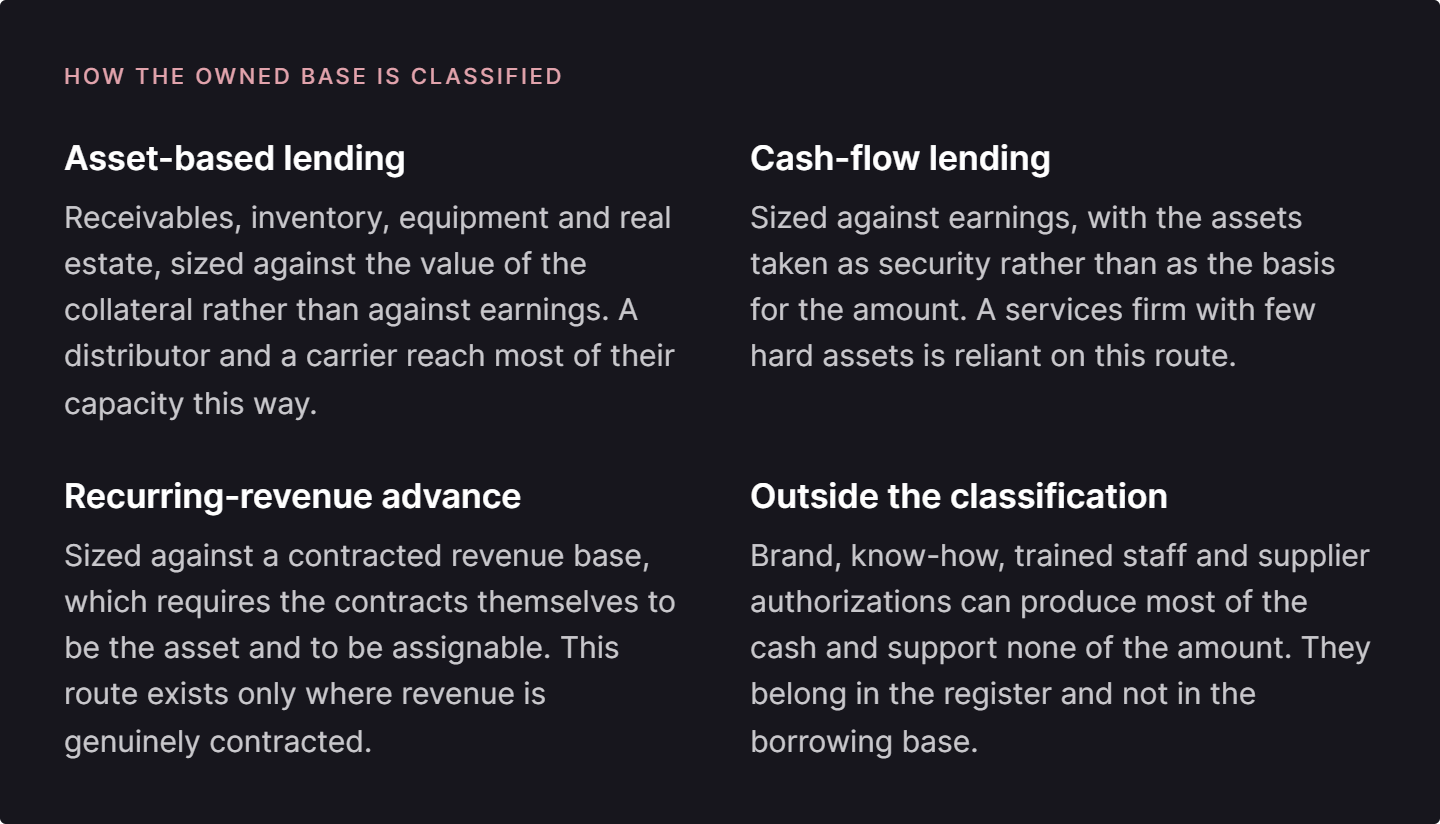
The mismatch worth naming is the asset-light business asking for a facility sized like an asset-heavy one. A staffing firm with receivables and little else can be financed, but the amount follows the receivables and the earnings, not the size of the payroll it runs. The reverse mismatch happens too. A carrier that has moved its fleet onto operating leases over several years has a smaller owned base than its revenue implies, and the structure available to it is not the one that was available at the last refinancing.
Three resources that sit at the edge of the block
The canvas counts financial resources as a category of its own: cash on hand, committed availability, and the capacity to raise more. A credit read handles most of that elsewhere, in the work on existing capital and in the liquidity analysis. One part of it belongs here. Committed availability from an existing lender is secured by something, and what it is secured by comes out of this block’s ownership schedule. A borrower with an undrawn facility against its receivables has already committed the asset base a new lender would look to first.
Resources accessed through someone else are the second edge case. A manufacturer running production at a co-packer, a distributor holding stock in a third-party warehouse, or a fabricator working on tooling owned by its customer all depend on capacity they do not hold. The ownership schedule records that the asset is not theirs, which settles the collateral question. What it does not settle is what happens if the counterparty withdraws the capacity, and that question belongs to the partnerships block rather than to this one.
The third is human resources, which the canvas treats as a resource category and a credit read treats as a cost. A business that delivers through headcount adds cost as volume grows, and a business that delivers through owned plant does not. That distinction was already made in the fixed-cost classification, and reading the two blocks together is how a lender confirms the classification matches the resource base. A services firm reporting a high fixed-cost share and a plant-based manufacturer reporting the same share are describing different things.
The fourth probe closes the block by looking for concentration inside the resource base. One facility producing the majority of output, one patent covering the product, one license or operating authority the business trades under, one owner holding the customer relationships or the technical knowledge. Concentration here does not appear in any ratio. It is found by asking which single item, if it stopped, would stop the revenue, and the answer carries into how the recovery case is built.
What the key resources read produces
At the end of this block a lender has two things. The first is the asset register: what produces the cash, what is owned, and what a security interest would attach to. The second is the financeability classification: which lending type the owned base supports, and therefore which structures are available at all.
Both are reused. The asset register is the input to the recovery analysis, where the assets get valued at distressed rather than book rates, and to the priority work, where existing claims are laid against them. The financeability classification informs the amount and the structure, which is where the process began.
A borrower can build the register, pull the ownership schedule and the IP assignments, and identify which asset categories are financeable. What a particular lender will advance against each category, whether they will credit an asset held through a lease or a license, and how much weight they put on a concentration that has never been tested depends on what they have lent against before.
Next in the series
Key partnerships: who the business leans on
Finding the dependencies a borrower does not control, and whether any one of them is a single point of failure.
You can inventory your assets and sort owned from leased. Reading what a particular lender will advance against each category, and which of your structure options that leaves open, is the part I do at Synthase Capital Partners.