


Part of The Underwriter’s Read, a series on the critical questions a credit team works through before they lend.
Somewhere in the middle of a financing process, a founder gets a question they did not expect. Not a hard question, exactly. Just one from an angle nobody at the company had thought to look from. Something like: what happens to your margin if revenue falls twenty percent? Or: which of your customers could leave next quarter without penalty?
The answer usually exists. It just isn’t written down, isn’t agreed internally, and isn’t supported by anything a credit committee can lean on. So the process slows, the lender gets cautious, and the terms drift.
This series is about seeing those questions before they arrive.
Debt is not equity with a different price
Most operators learn to raise money from equity investors first, and the instincts carry over badly. An equity investor is buying a share of everything that could go right. Their return is uncapped, and one exceptional outcome pays for a portfolio of failures. So they lean into ambition, market size, and the shape of the upside.
A lender has no such asymmetry working in their favor. The best possible outcome is that you pay back exactly what you agreed, on schedule, and nothing surprising happens along the way. There is no version of the deal where the lender does better than that. But there are many versions where they do worse, and a single loss can erase the margin earned on a dozen sound loans.

That is the whole reason lenders sound pessimistic. They are not judging your ambition. They are pressure-testing the floor underneath it. If you have never had to describe that floor out loud, the questions feel adversarial when they are merely structural.
Every credit decision comes down to one question: will the lender be repaid? Everything else is a way of testing it.
The brief, then four layers of diligence
A credit team does not attack that question head-on. Before any of it, they need the brief: what the money is for, how much you want, and exactly what you are asking for. That is the situation. Not diligence, just context, but context that changes what matters in every layer below it. Then four layers of diligence follow, each narrowing the one above.
The layers are not a checklist to be marched through. They interlock. A weakness in the model shows up as a durability question; a durability question becomes a number; a number that will not hold becomes a question about what happens in a downside. Findings move between layers, which is why the same business can look sound on one pass and fragile on another.
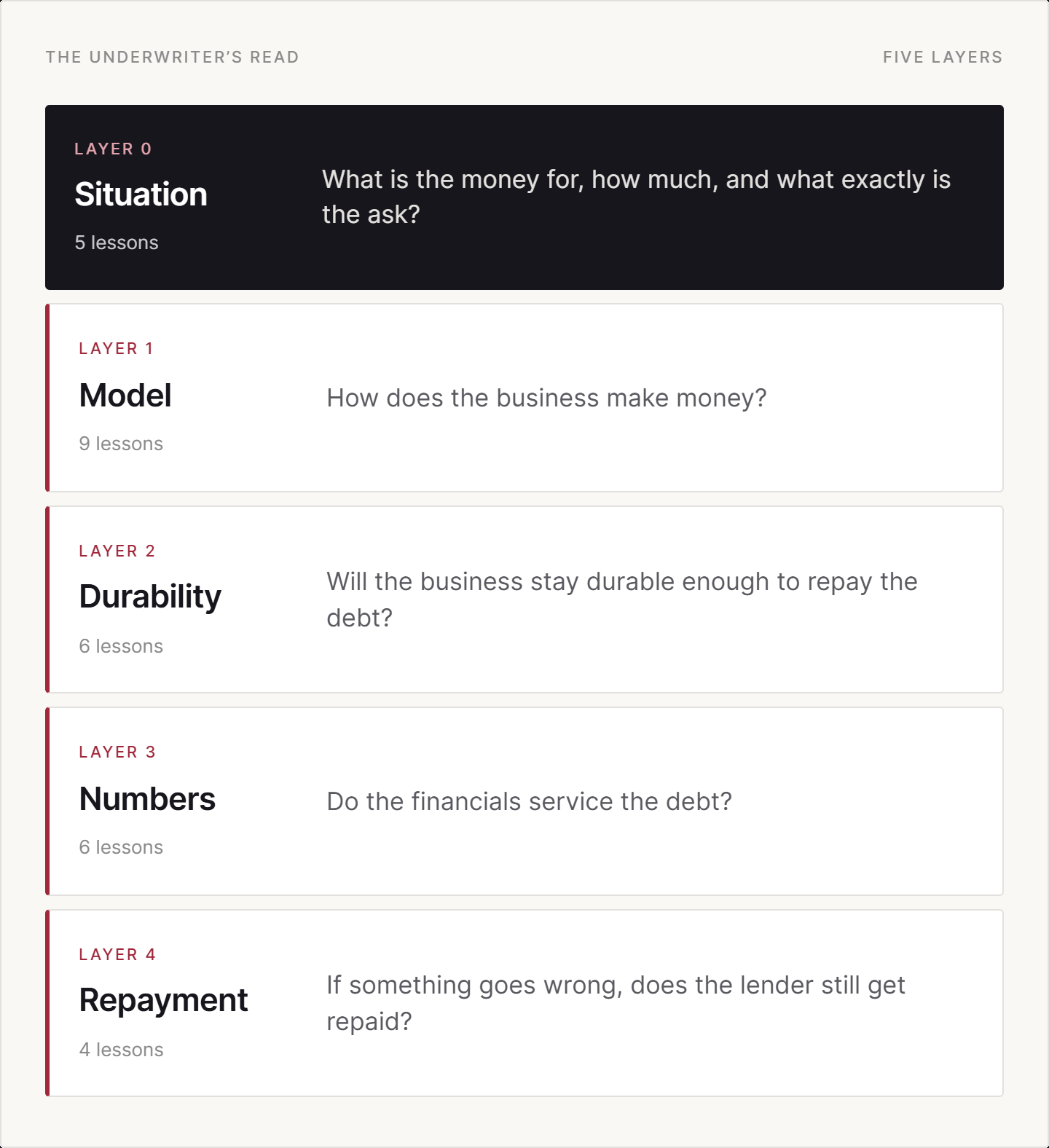
What the series covers
The series works through those five layers: customers, pricing and costs in the model; competition, customer power and execution in durability; coverage, leverage, liquidity and the cash-consuming borrower in the numbers; sources of repayment, claim priority and recovery at the end. Each gets its own piece: what the concept is, why a lender cares, what makes a business more or less exposed on that dimension, and the evidence that actually answers the question.
Each piece stands on its own. You can read straight through for the full logic, or go directly to whichever question is live in your raise this week.
Why I am writing this
I spent sixteen years in credit, twelve at Silicon Valley Bank and four and a half at J.P. Morgan, deciding which loans to approve, on what terms, and living with those decisions through the life of the loan. I have been the person asking the unexpected question, and the person explaining to a committee why a good business was not yet a good credit.
The gap between those two things is almost never the business. It is preparation. Borrowers who understand how they will be read get better terms, move faster, and lose fewer processes, not because their numbers are better, but because nothing about them is a surprise.
That is what this series is for. The questions do the work; you draw the conclusions about your own business.
Next in the series
Use of proceeds: why the need matters as much as the amount
Two companies borrow ten million dollars. One is buying equipment that will generate cash for a decade, the other is covering a shortfall. Same amount, entirely different credit profile.
If you are preparing to raise debt and want a read on where you stand, that is what I do at Synthase Capital Partners.