


Part of The Underwriter’s Read a series on the critical questions a credit team works through before they lend.
The last block sorted the assets a borrower owns from the ones it leases or licenses, and left one question open: what happens when a counterparty withdraws capacity the borrower depends on. This block answers it. The subject is every dependency that sits outside the company, and the work is to find which ones are load-bearing, read what the agreements with them actually secure, and size the cost if one ends.
Four probes sit in this block. The first ranks partners by how much cost or revenue flows through them, because most are interchangeable and a few are not. The second reads the agreements with the few that are not. The third asks whether any critical input has a qualified second source. The fourth sizes the cost and disruption of replacing a partner. They group together because a dependency is only a credit issue when it is concentrated, unsecured by contract, and expensive to replace at the same time.
This block tests the input costs in the forecast. Management’s projection carries a gross margin, and the partner agreements say how much of the cost behind it is fixed by contract and for how long. Where a supply agreement has pricing locked through the facility term, the margin assumption is supported by a document. Where pricing resets annually, or the agreement can be terminated for convenience on ninety days, the forecast margin is an estimate of what a counterparty will agree to next year. A lender reads the forecast against the contract expiry dates, and where a critical agreement runs out before the loan does, the projection past that date is carrying an assumption rather than a term.
Why the partnership exists
The business model canvas sorts partnerships by what they do for the company: deliver scale, reduce risk, or provide access to a resource or activity the company does not hold. That sort is useful for a credit read because each one breaks differently.
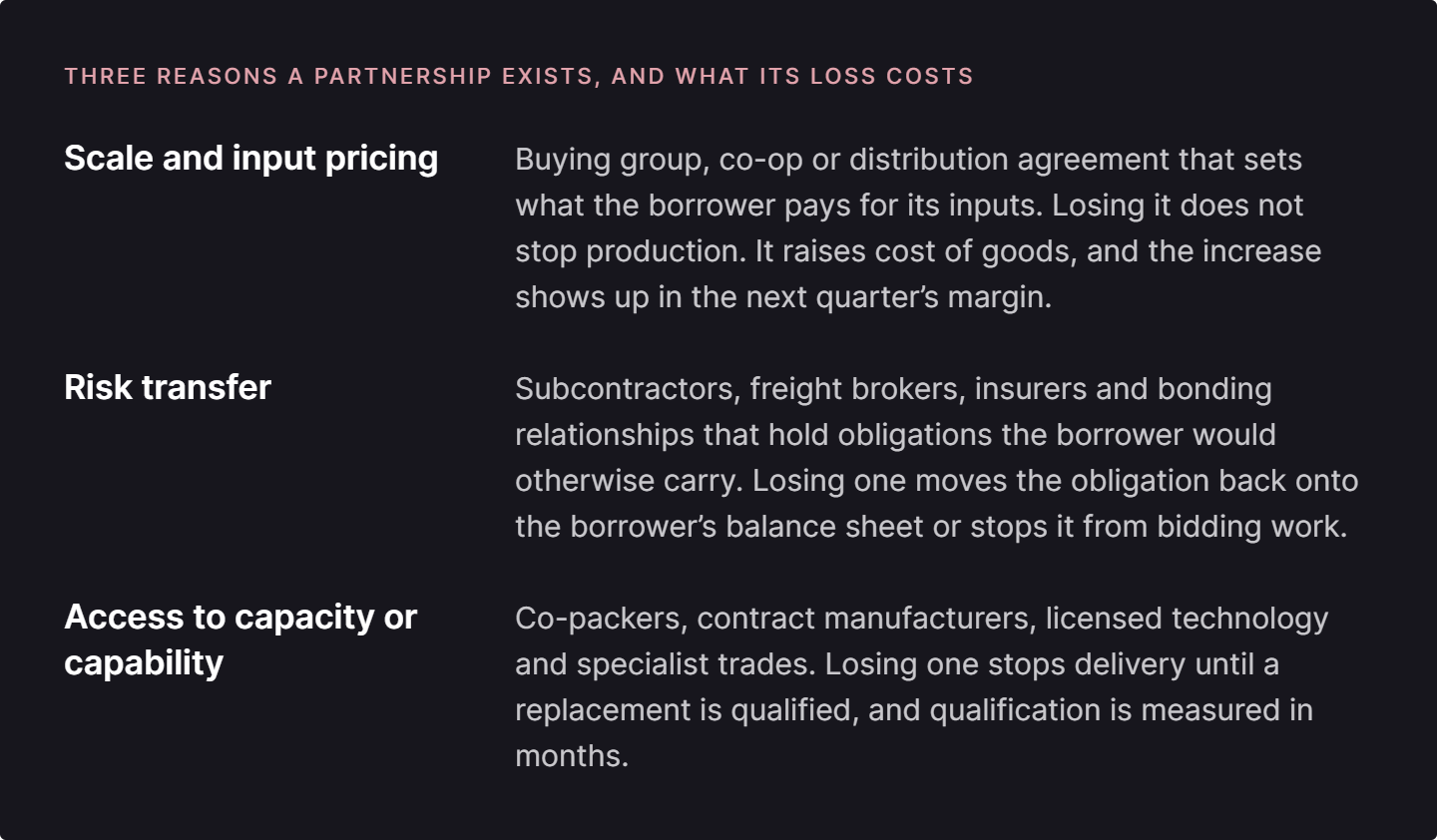
The third category is the one that connects back to the asset base. A food manufacturer that runs its production through a co-packer has low capex and a thin owned asset base, and both facts come from the same decision. The lease-versus-own question in the last block records that the plant is not the borrower’s. This block asks what the co-packing agreement secures, how long it runs, and what a transfer to another facility would cost in requalification and lost shipments. A borrower can be asset-light because it made a sound operating choice and still have less to pledge as a result.
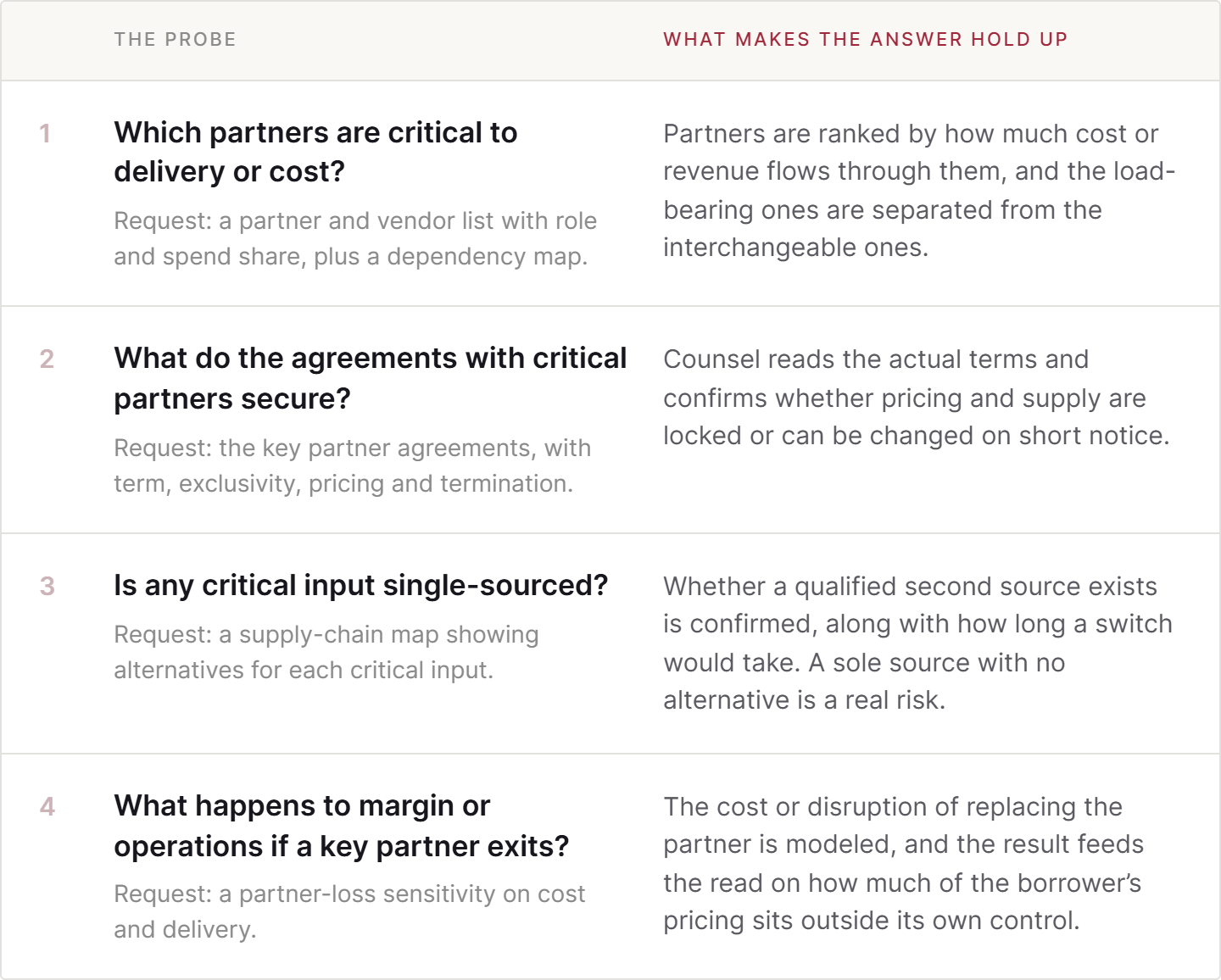
The second probe is where a dependency a borrower describes as settled turns out not to be. Two terms do most of the work. Termination for convenience lets a counterparty end the agreement on notice without cause, which means the remaining term is the notice period rather than the stated expiry. Price adjustment provisions determine whether the cost in the model is fixed or indexed, and to what. A five-year supply agreement with annual price resets and a ninety-day convenience termination secures continuity of relationship and almost nothing about cost.
What replacement actually costs
The third and fourth probes work together. Single-sourcing on its own is common and often unavoidable. What determines whether it matters is how long a switch takes and what it costs while it happens.
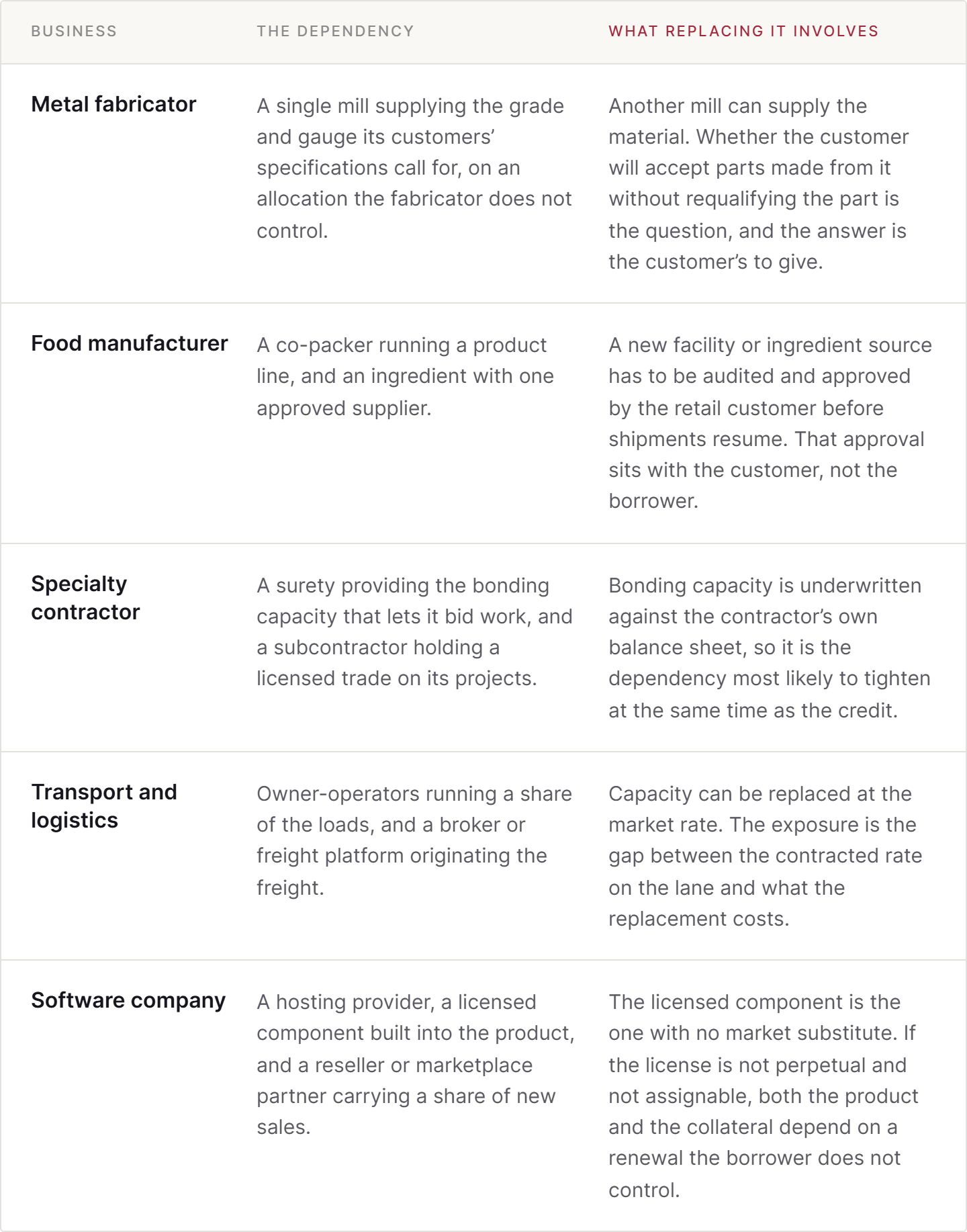
Two patterns run through those. Replacement time is usually set by a third party rather than by the borrower or the partner, because the qualification or approval that has to happen sits with the customer or a regulator. And where a substitute exists at a price, the exposure is the price difference rather than the disruption, which is a smaller and more measurable figure.
Partners on the revenue side
The four probes are written around the supply side, and partners that produce revenue rather than inputs get read the same way. A manufacturer selling through independent distributors, a contractor holding an approved-supplier position through a purchasing group, a software company earning through resellers, and a joint venture that holds the contract all have a partner standing between the borrower and its own revenue. The first probe ranks them by revenue flowing through them, the second reads what the agreement secures, and the fourth sizes the loss.
The distribution economics, margin split and channel structure belong to the channels block rather than to this one. What belongs here is narrower: whether the partner owns the customer relationship, and what the borrower retains if the agreement ends. A distributor holding the account, the contacts and the reorder history can take the revenue with it. A joint venture is the sharper case, because the contract sits in an entity the borrower does not wholly control and the cash comes out as a distribution rather than as revenue.
Who the counterparty is also affects the read, separately from what the agreement says. A sole-source supplier that is financially weak can fail without terminating anything. A partner that competes with the borrower in an adjacent market has an interest in the relationship that the contract does not describe. A partner affiliated with the borrower’s own sponsor or owner is a related-party arrangement, and its pricing has not been set at arm’s length. None of that appears in the contract terms, and all of it changes what the dependency is worth.
What the key partnerships read produces
At the end of this block a lender has a dependency map with a small number of named partners on it, the contractual term and pricing protection behind each one, and a sized cost for losing each. Most of the partner list drops out at the first probe. What remains is usually three or four relationships.
That output feeds the read on supplier power, which asks how much of the borrower’s cost base is set by parties outside it. It also revises the cost structure work, because a partner agreement with locked pricing through the facility term makes that cost fixed in a way an annually repriced one is not. And it carries into the covenant discussion, where a lender that has identified two load-bearing agreements may want notice if either is terminated.
A borrower can build the dependency map, pull the agreements, and have counsel mark the termination and pricing terms. What a particular lender does with a single-source dependency, whether they treat a ninety-day convenience termination as a structural issue or as a fact of the industry, and how much of the replacement cost they build into the downside case depends on what they have seen go wrong before.
Next in the series
Key activities: what the business does all day, and whether it can do more of it
Finding the operational constraint that binds first as volume grows, and what relieving it costs.
You can map your dependencies and pull the agreements behind them. Reading how a particular lender will treat a single-source position, and what that does to the structure available to you, is the part I do at Synthase Capital Partners.