


Part of The Underwriter’s Read, a series on the critical questions a credit team works through before they lend.
Financial policy is how management and the owners use cash when they can choose between paying down debt, paying the owners, and spending on acquisitions. The lessons on cash flow and coverage, leverage, liquidity and working capital and capital intensity measured how much cash the business produces and how much it needs. This component covers what the people who control the business are likely to do with the cash that is left. A lender reads that from the record of past decisions and from the terms of the loan documents.
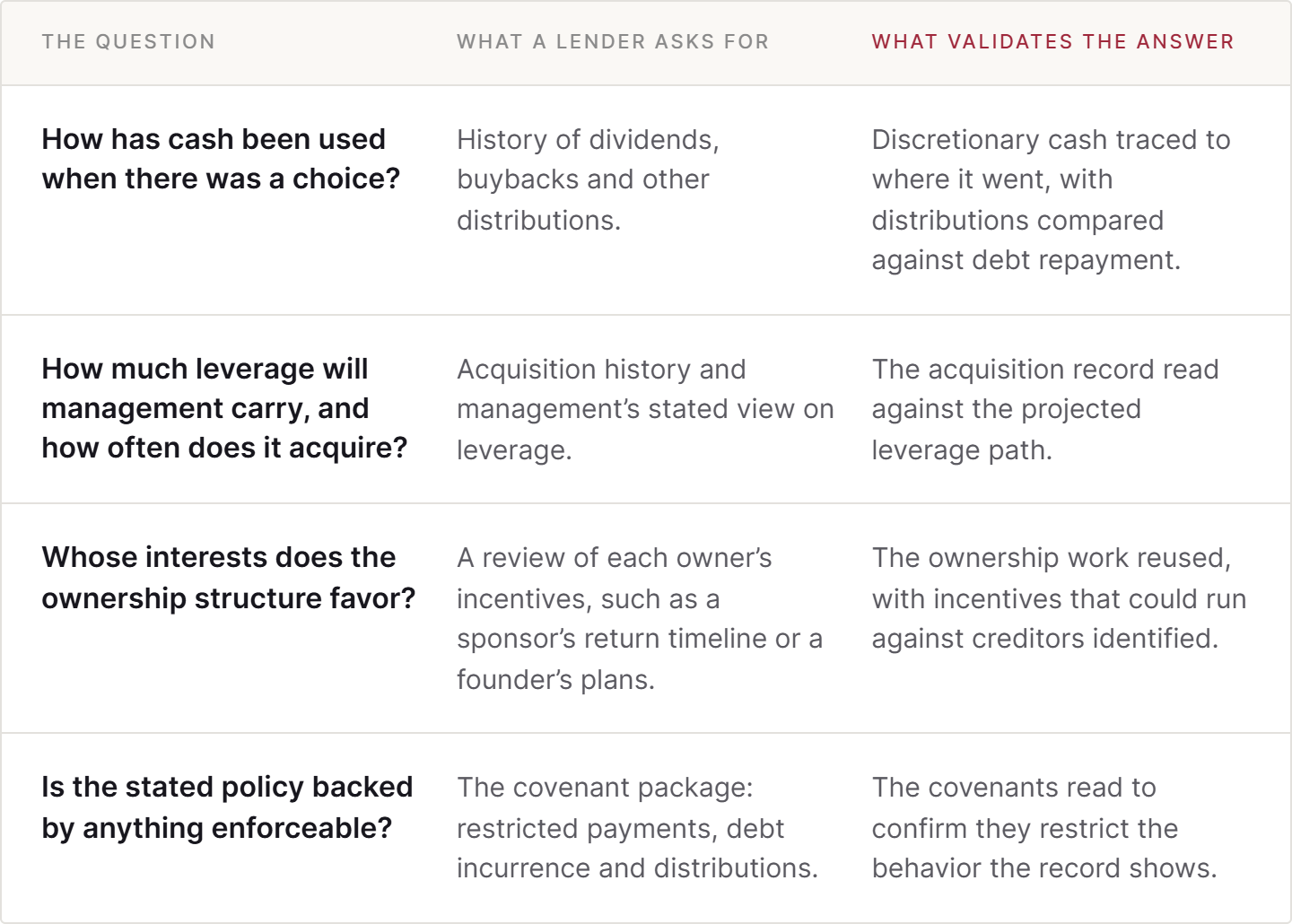
Four probes sit in this component. The first traces how cash has been used when there was a choice. The second establishes management’s tolerance for leverage and its appetite for acquisitions. The third looks at whose interests the ownership structure favors. The fourth tests whether the loan documents enforce the policy management describes.
Management’s projection usually shows leverage falling as free cash flow repays debt. A lender compares that assumption with the borrower’s record of distributions and acquisitions, and with what the covenants allow. That lets the lender establish how much of the projected free cash flow is likely to go to debt service and repayment, and how much could go to the owners or to the next acquisition instead.
The four probes, and what validates the answer
How cash has been used
The first probe traces how cash has been used when there was a choice. A lender asks for the history of dividends, buybacks and other distributions to owners, and sets it against free cash flow and debt repayment in the same years. Past decisions are the best evidence available of future ones. A borrower that has paid out most of its free cash flow to its owners, or paid distributions in years when debt was rising, is likely to do the same after closing unless the documents prevent it.
Leverage tolerance and acquisitions
The second probe establishes how much leverage management is willing to carry and how often it acquires. A lender asks for the acquisition history, how each acquisition was funded, and management’s stated view on leverage. It reads them against the leverage path from the lesson on leverage, which shows leverage falling as debt is repaid. A borrower that has funded acquisitions with debt may borrow again once leverage comes down, and the path then stops falling.
Ownership and incentives
The third probe looks at whose interests the ownership structure favors. A lender reuses the ownership work from the lesson on ownership and support and reviews the incentives of each owner. A private equity sponsor works to a fund life and a return target, and a sponsor near the end of its hold period may favor a dividend or a sale. A founder or family owner may want regular distributions, may be planning a succession, or may be preparing the business for sale. Each of these can run against a lender’s interest in cash being retained to repay the loan.
An illustrative schedule
The schedule below continues the specialty distributor from the earlier lessons in this layer. The business is owned by its founder and his family. Two years ago it bought a smaller competitor for $13.5mm: $8.0mm in cash, a $3.0mm seller note, a $1.5mm earnout and $1.0mm of deferred purchase price, the obligations set out in the lesson on leverage. Management states a policy of keeping funded leverage at or below 2.50x. The founder has said he plans to sell the business within three to five years.
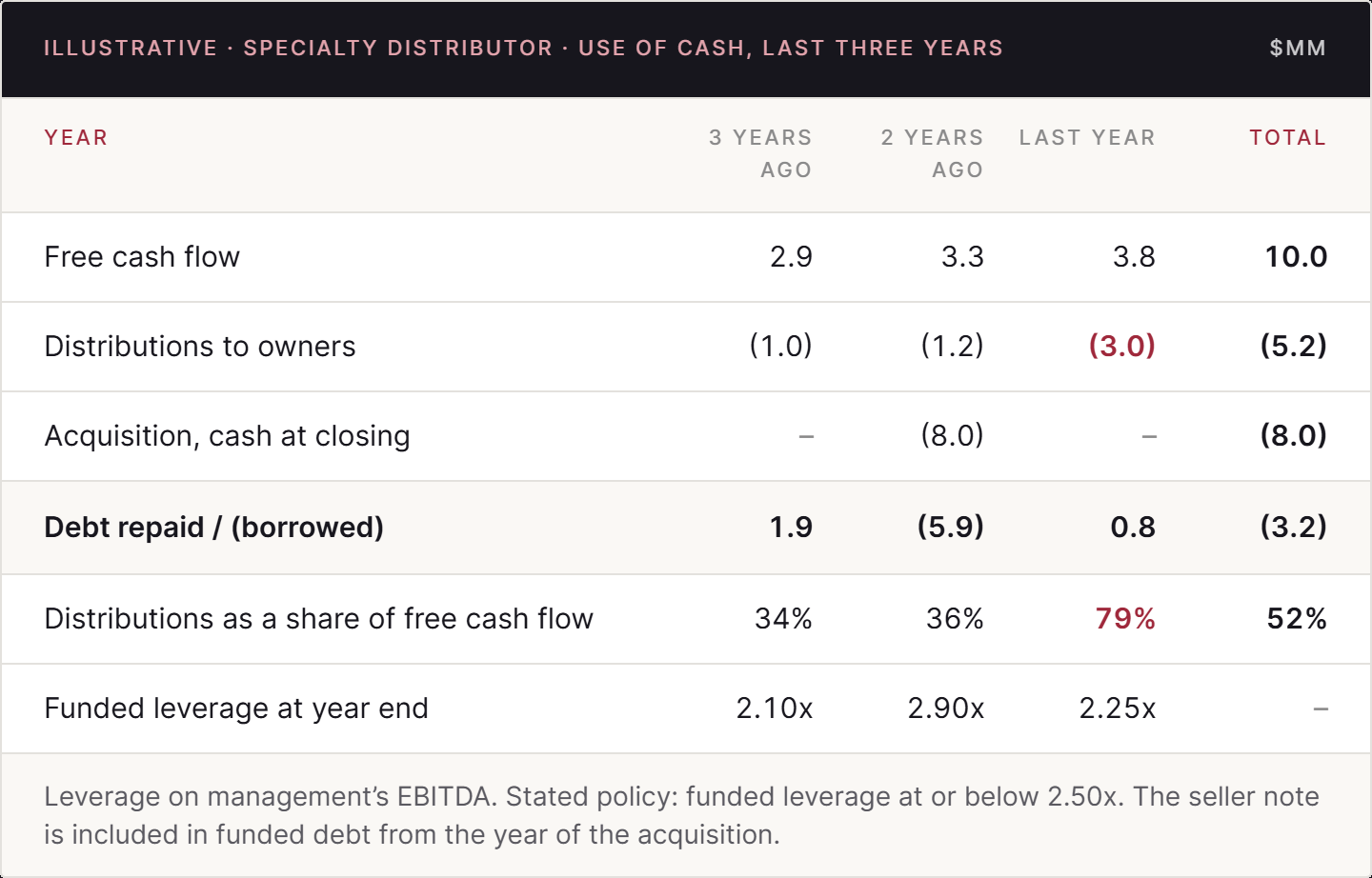
Over three years the borrower generated $10.0mm of free cash flow, paid $5.2mm to its owners, spent $8.0mm in cash on the acquisition and borrowed a net $3.2mm to cover the difference. The acquisition took funded leverage from 2.10x to 2.90x, above the stated policy of 2.50x. Last year leverage came back down to 2.25x, and distributions rose to $3.0mm, 79 percent of that year’s free cash flow.
Management’s leverage path in the lesson on leverage falls from 3.00x at closing to 1.44x in three years, and about 70 percent of the fall comes from repaying debt. That path assumes free cash flow goes to debt. The record shows the borrower paying out most of its free cash flow once leverage is inside its stated policy. The founder’s plan to sell within three to five years falls inside the term of the new facility, and a lender considers whether distributions are likely to rise ahead of a sale.
What the documents enforce
The fourth probe tests whether the policy management describes is backed by the loan documents. A stated policy on distributions or leverage is not binding. A lender reads the restricted payments covenant, which limits dividends, distributions and buybacks, and the debt incurrence covenant, which limits new borrowing. Both are often written as a condition: the payment or the new debt is permitted only if leverage after it stays below a stated level and no default is outstanding. The lender confirms that the covenants restrict the behavior the record shows, instead of relying on the owners’ goodwill.
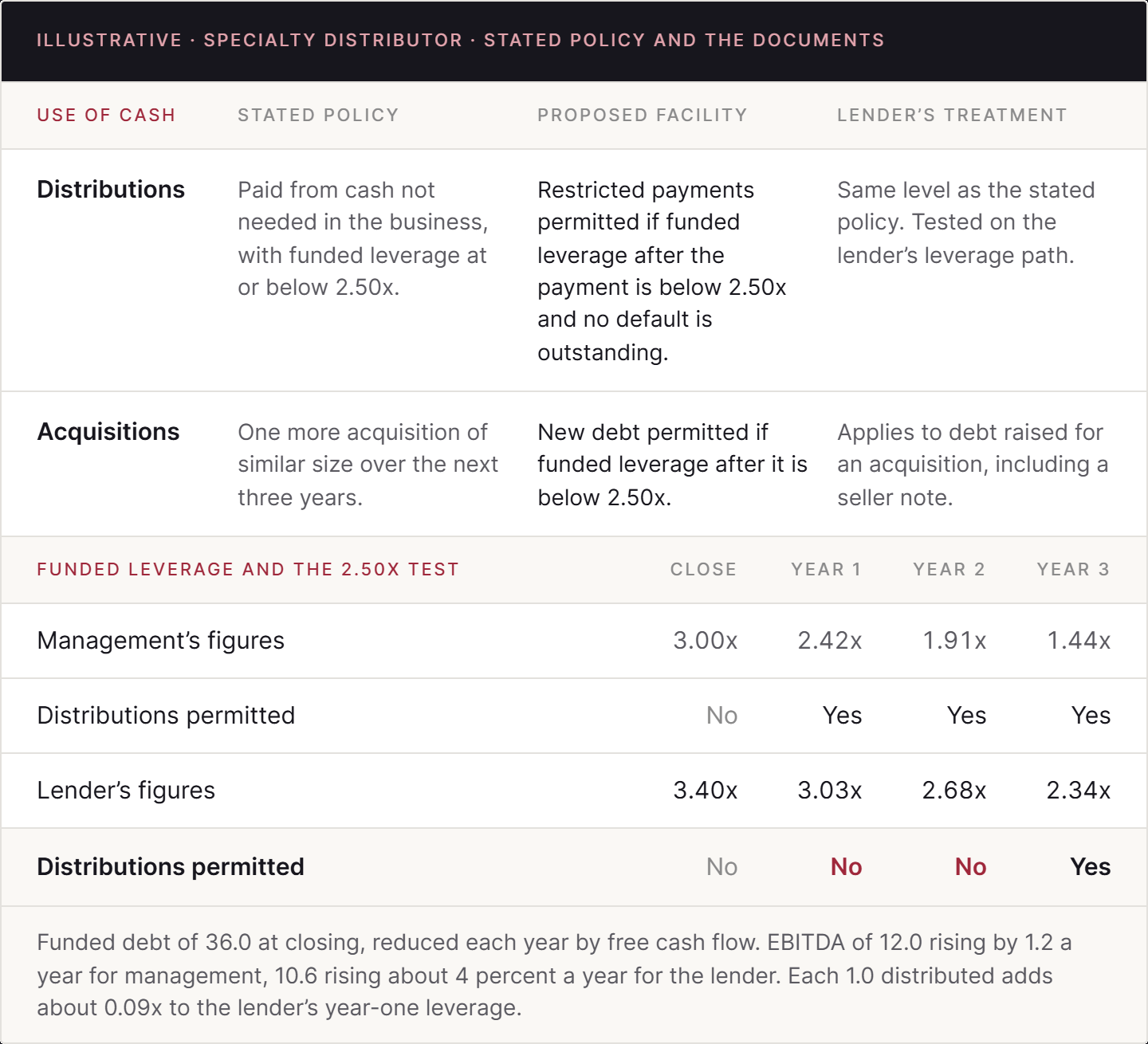
The restricted payments test in the proposed facility is set at 2.50x, the same level as management’s stated policy, so the documents turn the policy into a condition of the loan. On management’s figures, leverage passes the test at the end of the first year and distributions would be permitted from then. On the lender’s figures, leverage stays above 2.50x until the end of the third year. Each $1.0mm distributed leaves funded debt $1.0mm higher than the path assumes, about 0.09x of leverage on the lender’s year-one EBITDA.
The debt incurrence test applies the same level to new borrowing, including a seller note. An acquisition of the size management describes, funded mainly with debt, would be limited until leverage falls below 2.50x, or would need more equity from the owners. Which EBITDA figure the tests use is set by the covenant definitions, and the gap between the two paths above comes from the difference between management’s EBITDA and the lender’s.
For a borrower that is consuming cash
For a borrower that is consuming cash, distributions are rarely at issue, because there is no spare cash to distribute. A lender reads financial policy through spending and through the equity: whether management spends to the plan the lender underwrote, and whether the investors will fund the next round before runway runs out. A performance-to-plan covenant measures results and spending against that plan, and a minimum cash covenant sets the cash the borrower must hold at all times. Lenders to these borrowers often take warrants, which give the lender a share of any increase in the value of the equity. The lesson on the cash-consuming borrower covers this case in full.
What the financial policy read produces
At the end of this component a lender has the record of how cash has been used when there was a choice, a view of management’s leverage tolerance and acquisition appetite read against the leverage path, the incentives of each owner, and a read of whether the restricted payments and debt incurrence covenants limit the behavior the record shows.
The analysis draws on the ownership work from the situation layer and on the leverage path. Its output connects to the structure terms covered in the lesson on amount and structure, and to the order in which claims are paid, which the repayment work later in the series covers.
A borrower can assemble its own distribution and acquisition history and compare it with its stated policy before a lender asks. How a particular lender will read that history, and which restricted payments and incurrence tests it will ask for, depend on how it has lent to similar businesses and owners before.
Next in the series
The cash-consuming borrower: how a lender underwrites a business that is not yet profitable
Runway, the burn trend, and the covenants a lender uses instead of coverage.
You can compile your own distribution record and compare it with your stated policy. Knowing how the lenders in your process will read that record, and which restricted payments and incurrence terms they will accept, is the part I do at Synthase Capital Partners.