


Part of The Underwriter’s Read, a series on the critical questions a credit team works through before they lend.
Capital intensity is the amount a business has to spend on vehicles, equipment, facilities and systems to keep producing its cash flow. Capital spending, or capex, falls into two kinds. Maintenance capex replaces the assets the business already uses. Growth capex adds capacity the business does not yet have. The free cash flow in the lesson on cash flow and coverage is measured after all capex, and a lender needs to know how much of that capex the business could stop and how much it could not.
Four probes sit in this component. The first separates maintenance capex from growth capex. The second establishes the reinvestment needed to keep the asset base at its current size. The third measures the free cash flow left after the growth plan. The fourth tests how much of the capex plan could be deferred if cash gets tight.
Management’s projection usually shows capex as one line, or labels part of it growth and treats that part as optional. A lender rebuilds the split from the asset register and each asset’s replacement cycle, then runs the cash flow net of the full capex plan. That lets the lender establish how much cash the business generates after the spending needed to keep its current assets, and whether debt service is still covered once the growth plan is paid for.
The four probes, and what validates the answer
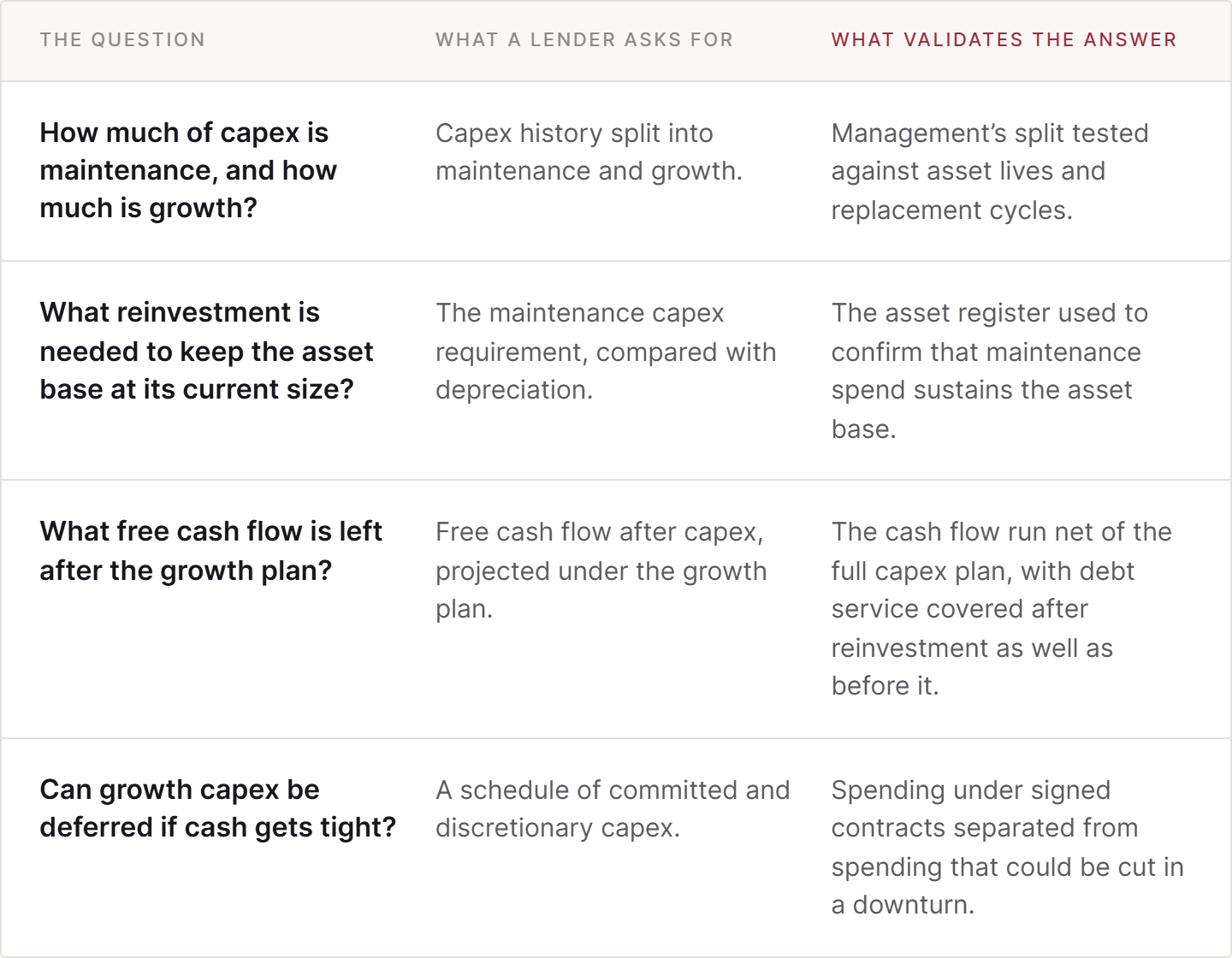
Maintenance and growth
The first probe separates the two kinds of capex. A lender asks for the capex history split into maintenance and growth. Only growth capex is discretionary. A business can stop growth capex without affecting the assets it already runs, while maintenance capex can be delayed for a time but is still needed later.
Management’s split often understates maintenance, because a lower maintenance figure makes the free cash flow before growth spending look larger. A lender tests the split against asset lives and replacement cycles. Spending that replaces an asset at the end of its life is maintenance, even where the replacement is larger or newer than the original.
The cost of keeping the current asset base
The second probe establishes the maintenance capex needed to keep the asset base at its current size and condition. A lender reuses the asset register reviewed in the lesson on key resources, which lists each major asset with its age and expected life. The replacement cycle of each asset gives an annual requirement. A lender compares that requirement with actual maintenance spend and with depreciation. Depreciation is an accounting charge based on the historical cost of the assets, so a lender uses it as a reference point and relies on the asset register for what replacement will cost.
Maintenance spend that stays below the requirement for several years moves cost into later years. A lender treats the shortfall as spending still to come.
An illustrative schedule
The schedule below continues the specialty distributor from the lessons on cash flow and coverage, leverage and liquidity and working capital. The borrower spent $2.0mm on capex over the last year, the capex figure in the free cash flow walk. Management classifies $1.2mm of it as maintenance and $0.8mm as growth.
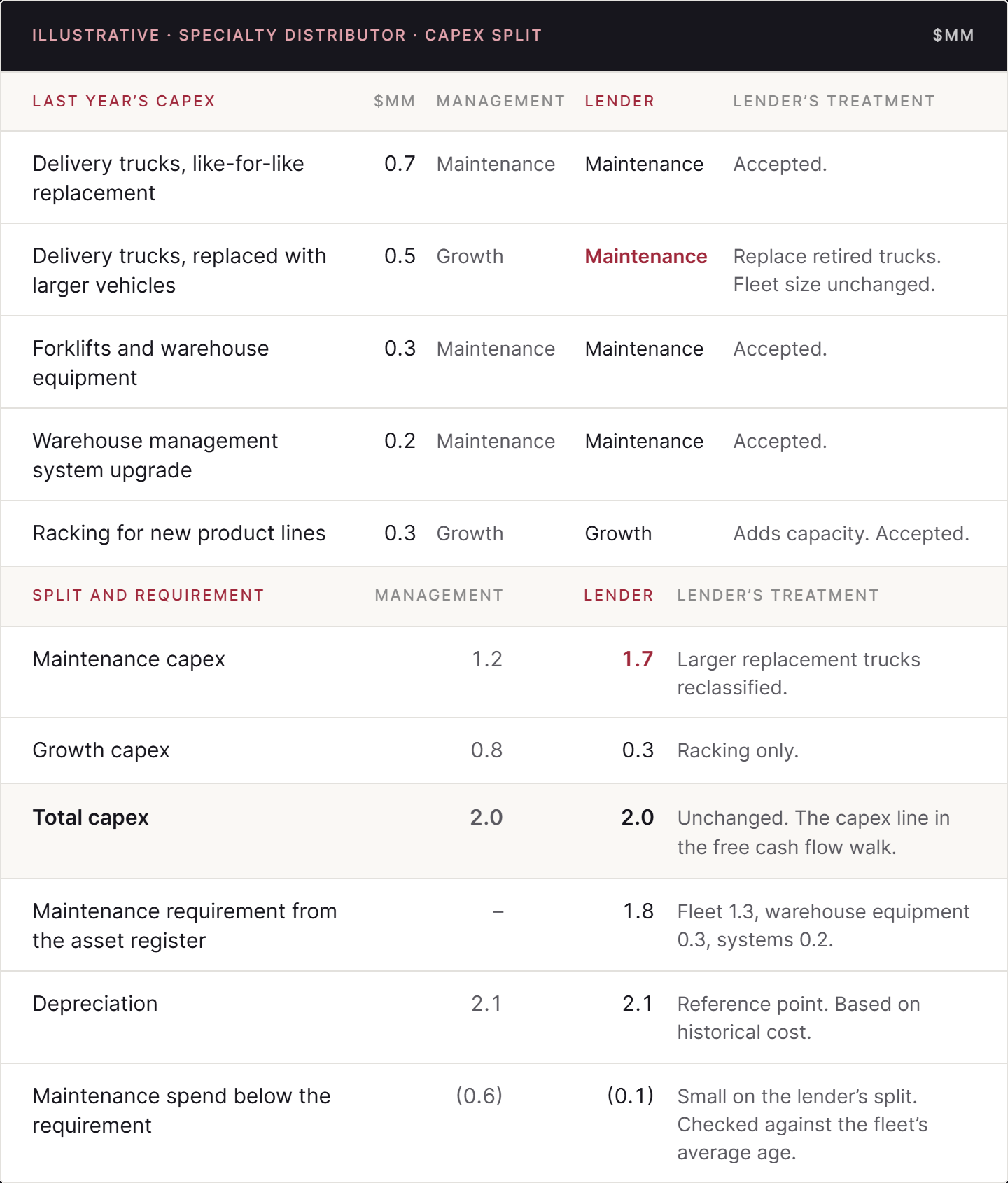
The lender reclassifies $0.5mm of truck purchases from growth to maintenance. The larger trucks replaced vehicles that had reached the end of their lives, and the fleet did not grow. That takes maintenance capex to $1.7mm and leaves $0.3mm of growth capex, the racking for new product lines. Total capex stays at $2.0mm, so the free cash flow in the cash flow lesson does not change.
The asset register gives a maintenance requirement of $1.8mm a year, $0.1mm above the lender’s maintenance figure, so current spending broadly keeps the asset base at its present size. Management’s $1.2mm is $0.6mm below the requirement, which would mean either that the asset base is running down or that the split is wrong. The reclassified trucks account for most of that gap.
Free cash flow after the growth plan
The third probe measures the free cash flow left once the full capex plan is paid for. Growth capex competes with debt service for the same cash. A lender runs the cash flow net of all capex, including any expansion in the plan, and confirms that debt service is covered after reinvestment as well as before it. For the distributor, the growth plan includes the new branch: $5.0mm of fit-out and equipment and $3.0mm of opening inventory, funded by the $8.0mm drawn on the facility between February and August.
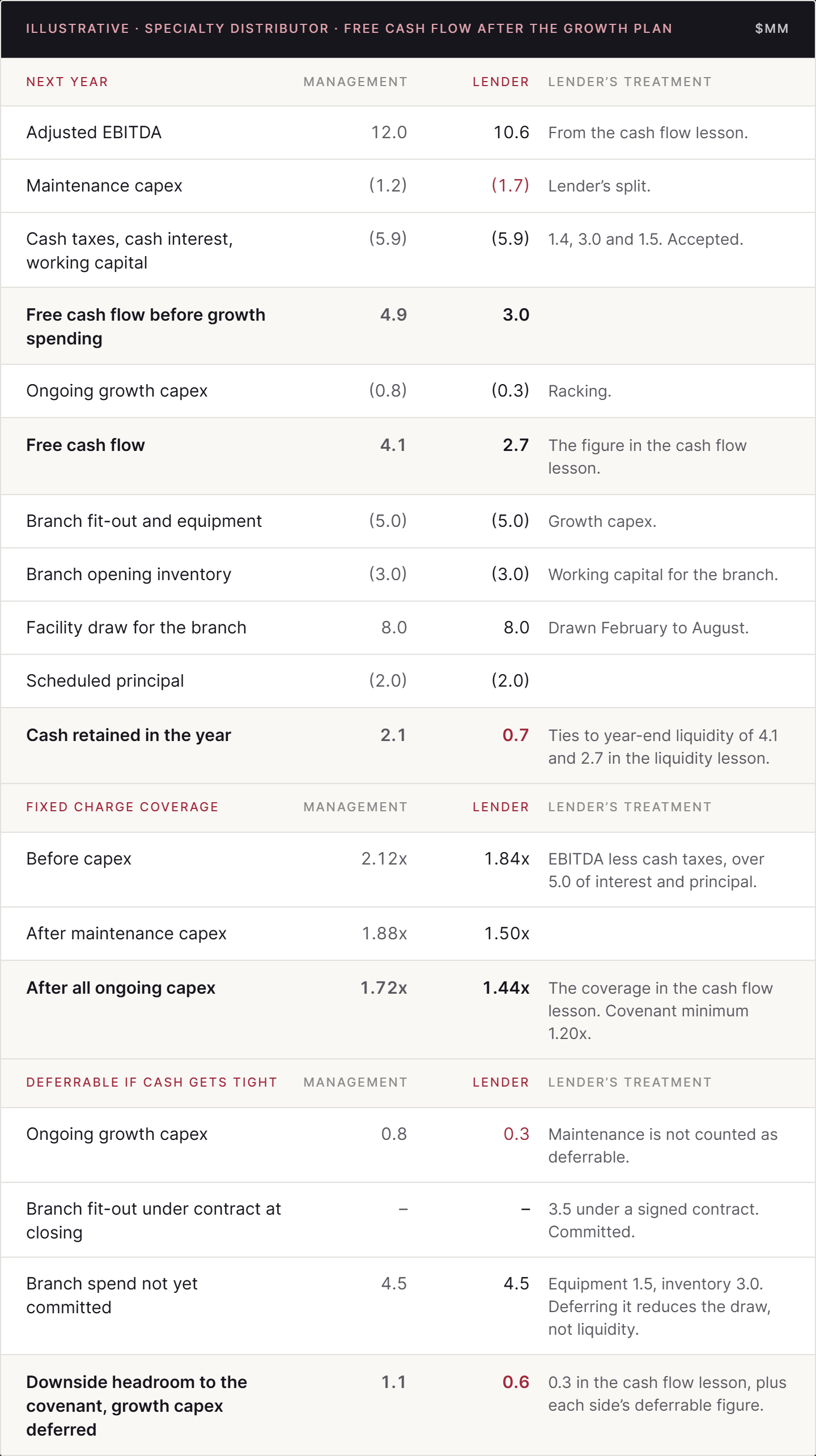
Before growth spending, the lender’s free cash flow is $3.0mm against management’s $4.9mm. After the $0.3mm of racking it is $2.7mm, the figure in the cash flow lesson. The branch costs $8.0mm and the facility draw pays for it, so the branch uses no operating cash in the year, but the $8.0mm of debt it adds is serviced from operating cash. After $2.0mm of scheduled principal, the borrower retains $0.7mm of cash in the year on the lender’s figures and $2.1mm on management’s. Those amounts tie to the year-end liquidity in the lesson on liquidity and working capital.
On the lender’s figures, fixed charge coverage is 1.84x before capex, 1.50x after maintenance capex and 1.44x after all ongoing capex, against a covenant minimum of 1.20x. The lender uses the figure after maintenance capex as the coverage the business produces without any growth spending.
What can be deferred
The fourth probe tests how much of the capex plan the borrower could defer if cash gets tight. A lender asks for a schedule that separates committed spending, under signed contracts or already ordered, from discretionary spending that has not been committed. Discretionary growth capex is a lever in a downturn. Committed spending cannot be stopped, and maintenance capex can only be delayed by moving the cost into later years.
For the distributor, the lender counts $0.3mm of ongoing capex as deferrable, against the $0.8mm that management’s split implies. In the lender’s downside case from the cash flow lesson, cash flow sits $0.3mm above the level that breaches the coverage covenant. Deferring $0.3mm of growth capex raises that headroom to $0.6mm; management’s split would suggest $1.1mm. On the branch, $3.5mm of fit-out is under a signed contract at closing. The remaining $4.5mm of equipment and opening inventory could be held back, but deferring it reduces the amount drawn on the facility and leaves liquidity unchanged, because the undrawn commitment can only be used for the branch. The August low point of $1.4mm in the liquidity schedule stays where it is.
For a borrower that is consuming cash
For a borrower that is consuming cash, capex is part of the burn. A lender separates the capex needed to reach the next funding milestone, such as a production line that has to be running before a product launch, from capex that can wait until after it. Runway is calculated with the committed capex included. A performance-to-plan covenant, which measures results and spending against the plan the lender underwrote, is the usual way a lender tracks capex that runs ahead of plan. The lesson on the cash-consuming borrower covers this case in full.
What the capital intensity read produces
At the end of this component a lender has capex split into maintenance and growth on its own classification, a maintenance requirement from the asset register compared with actual spend and depreciation, free cash flow after the full capex plan with coverage measured after reinvestment, and a schedule of committed and deferrable spending.
The analysis draws on the asset register reviewed in the model layer and the cash flow built in the lesson on coverage. Its output is used in three places. The maintenance figure sets the capex line in the free cash flow walk. The free cash flow after the growth plan shows whether the business can fund its growth from its own cash or will need more debt or equity. The deferrable amount is a lever a lender tests in the case where a refinancing takes longer than planned.
A borrower can prepare its own capex split and maintenance requirement from its asset register before a lender asks for them. How a particular lender will classify replacement spending, and how much weight it will give deferrable capex in its downside case, depend on how it has lent to similar businesses before.
Next in the series
Financial policy: how management uses cash when it has a choice
Distributions, acquisitions and leverage tolerance, and what the covenants restrict.
You can split your own capex and tie maintenance to your asset register. Knowing how the lenders in your process will classify your replacement spending, and how much of your capex plan they will treat as deferrable, is the part I do at Synthase Capital Partners.