


Part of The Underwriter’s Read, a series on the critical questions a credit team works through before they lend.
Porter’s third force is the bargaining power of suppliers. It is the mirror of buyer power: suppliers with leverage can charge higher prices, limit quality or service, or shift costs onto the companies that buy from them. Porter’s analysis asks what gives a group of suppliers that leverage over an industry. He included labor in the definition, so a workforce with skills that are hard to replace, or one that bargains collectively, is a supplier in the same sense as a raw material vendor.
This lesson reads the borrower’s suppliers against Porter’s conditions, then uses four probes to establish what that means for the borrower: which inputs are large enough to move the margin, how much power the suppliers of those inputs hold, whether the borrower has passed past cost increases through to its own customers, and what an input price increase does to debt service coverage.
Management’s plan usually carries input costs at current levels or rising with general inflation, and holds gross margin steady. Where the suppliers of a major input are concentrated, hard to replace and not dependent on the borrower’s industry for their revenue, Porter’s framework says they will raise prices when they can, and a plan that holds input costs flat is assuming they will not. The supplier power read lets a lender set the input cost assumption in the downside case from the suppliers’ position, and the share of any increase the borrower recovers from its own record of passing costs through.
What gives suppliers leverage
Porter set out the conditions under which a group of suppliers is powerful. Each can be established from the borrower’s purchasing records and the structure of the supplying industry.
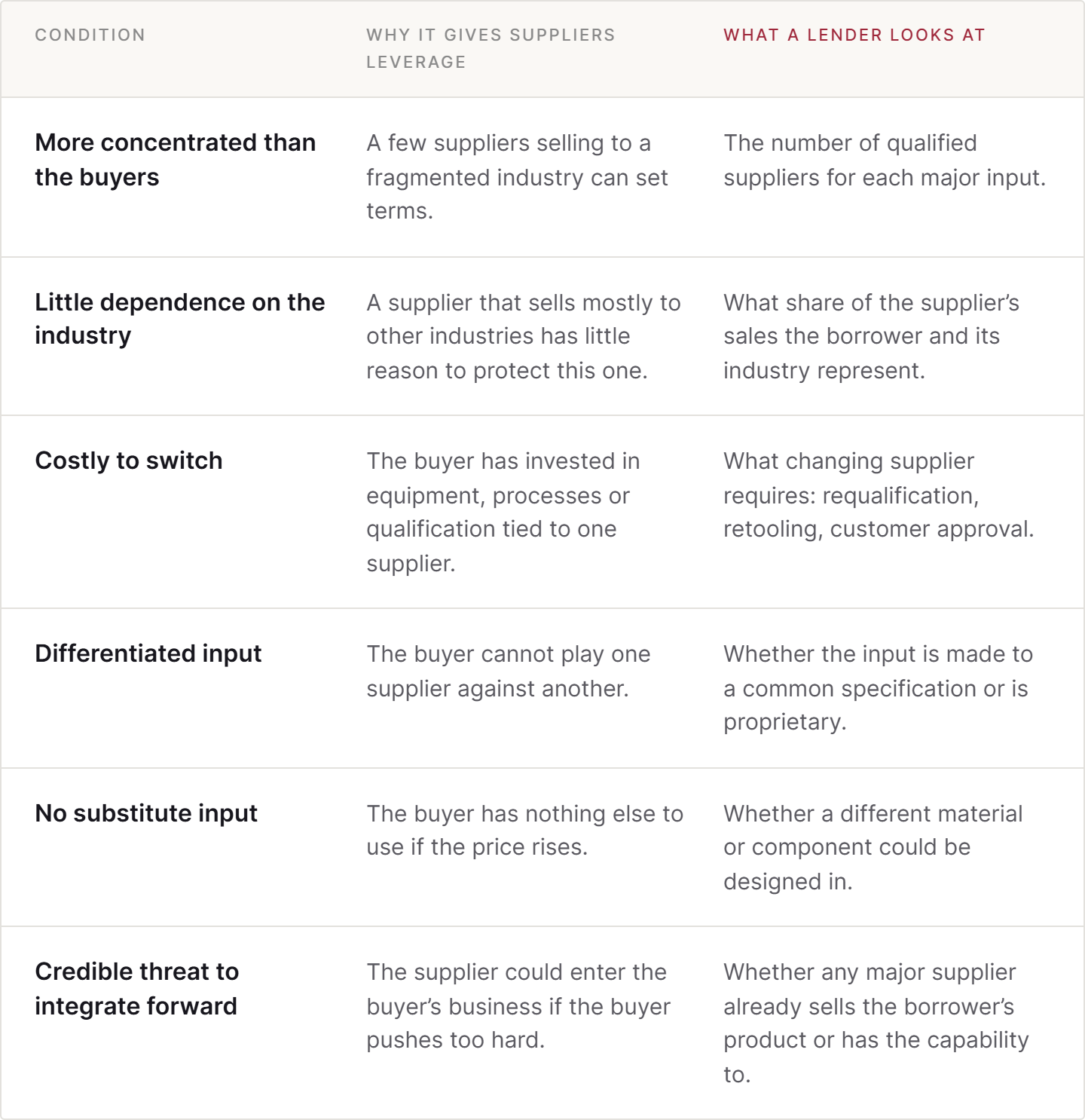
Dependence is the condition borrowers most often overlook. A specialty chemical supplier selling a small share of its output to a coatings manufacturer will allocate supply to its larger customers when capacity is tight, and the coatings manufacturer has no leverage to prevent it. The same supplier selling half its output to the coatings industry has a reason to keep that industry supplied and priced competitively.
Switching costs on the supply side often come from the borrower’s own customers. A fabricator whose customer has approved a specific steel mill or resin grade cannot change suppliers without the customer’s requalification, and that approval sits outside the borrower’s control. The partnerships read identified these dependencies; Porter’s conditions establish how much pricing leverage each one gives the supplier.
Testing the finding against the borrower’s costs
Four probes take the suppliers’ position and establish what it means for the borrower’s margin and its debt service.
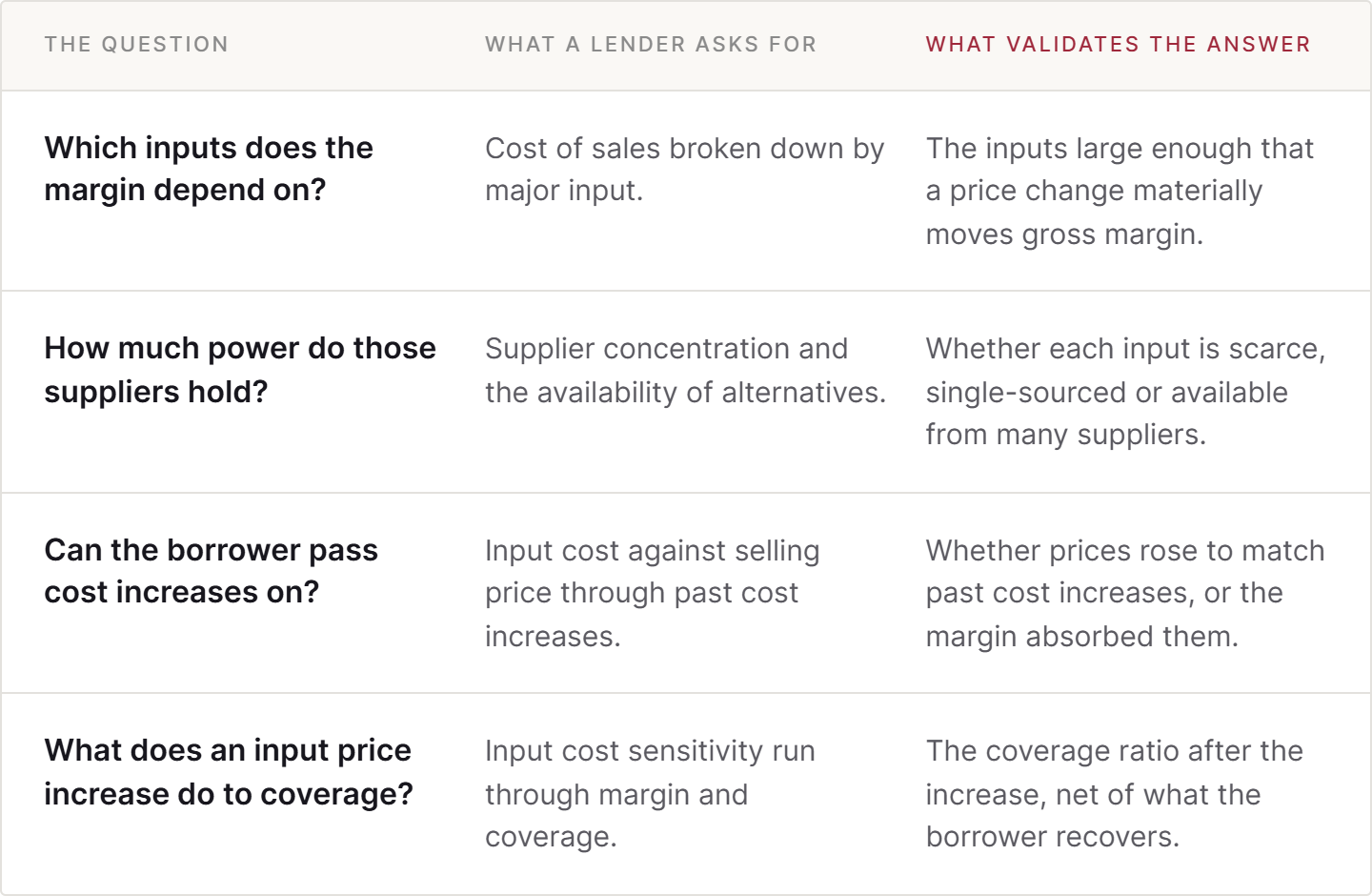
The first probe narrows the analysis to the inputs that matter. It reuses the cost classification from the cost structure read and isolates the inputs whose price, if it moved, would change gross margin by an amount a lender would notice. For a food manufacturer that is usually one or two commodities and packaging; for a specialty contractor it is often skilled labor and one or two materials. Porter’s conditions are then applied only to those inputs.
The second probe applies Porter’s conditions to the suppliers of each major input. It reuses the dependency map from the partnerships read. The distinction a lender draws is between an input bought from many suppliers at a market price, an input bought from a few suppliers who can coordinate price, and an input with one qualified source. Each carries a different degree of leverage, and the last carries the most.
The third probe links supplier power to buyer power. A borrower facing a powerful supplier is protected if it can pass the increase on to its own customers, and the ability to do that depends on the leverage those customers hold, which was the subject of the lesson on what lets customers set the price. The evidence is the record: input cost and selling price over the last period in which the input rose sharply. A distributor that raised its prices within a quarter of its supplier’s increase has shown it can pass costs through. A manufacturer whose margin fell for a year before prices caught up has shown it absorbs them first.
The fourth probe turns the finding into a number. It runs an input price increase through the financial model to margin and to debt service coverage.
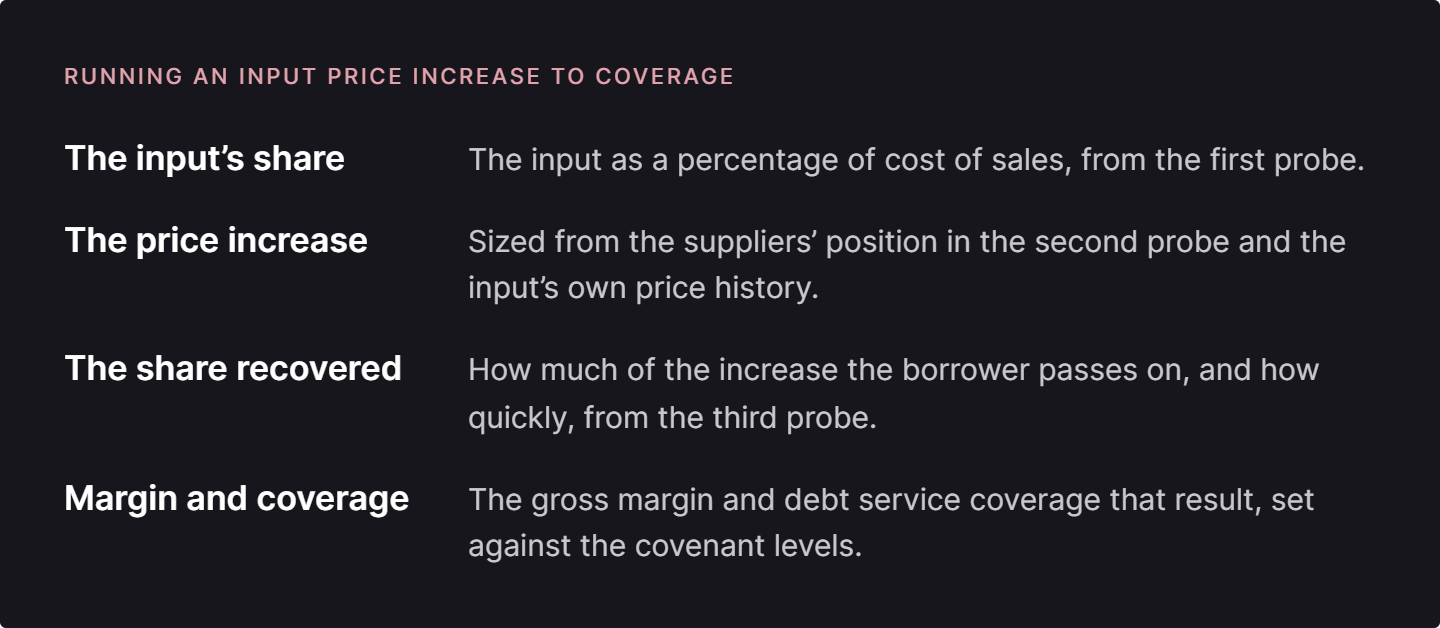
The value of the stress is that it converts Porter’s qualitative conditions into the measure a lender is actually underwriting. A single-sourced input that is two percent of cost of sales is a supply risk, and the partnerships read covers it as one. A concentrated input that is thirty percent of cost of sales, bought by a borrower that absorbs increases for a year, is a coverage risk.
What the supplier power read produces
At the end of this component a lender has the inputs the margin depends on, a finding on how much leverage the suppliers of each one hold, the borrower’s record of passing cost increases through, and a coverage figure after an input price increase.
That output is used in three places. The input price increase and the recovery share set the cost assumptions in the downside case. The pass-through record tests the gross margin in the plan. And the finding on supplier leverage feeds the view on whether the business will be financeable at maturity, since supply agreements that expire before that date will be renegotiated with the same suppliers.
A borrower can map its major inputs against Porter’s conditions and produce its pass-through record. Whether a particular lender sizes the input price increase from the last cycle or a worse one, and whether it treats the result as a covenant level, a reserve or a pricing point, depends on what they have lent against before.
Next in the series
Substitutes: what else the customer could use instead
Products outside the borrower’s industry that meet the same need, and whether their price and performance are improving over the term of the loan.
You can map your major inputs against Porter’s conditions and produce your pass-through record. Reading how a particular lender will size the input stress, and what it does to the covenants you are offered, is the part I do at Synthase Capital Partners.