


Part of The Underwriter’s Read, a series on the critical questions a credit team works through before they lend.
Porter’s fourth force is the threat of substitutes. He defined a substitute as a product that performs the same or a similar function as the industry’s product by a different means. Plastic containers substitute for glass, a staffing agency substitutes for a company’s own hiring, and a customer doing the work in-house substitutes for buying it. Substitutes come from outside the borrower’s industry, which is why they are easy to miss: they do not appear on a list of competitors, and the borrower may not track them.
Porter’s central point is that substitutes place a ceiling on the price an industry can charge. If the industry raises its price too far above what the substitute costs for the same result, customers move. The threat is high when two conditions hold: the substitute offers an attractive trade-off between price and performance, and the customer’s cost of switching to it is low. This lesson establishes where that ceiling sits for the borrower, then uses four probes to test whether it is moving: what need the customer is paying to meet, what alternatives could meet it, whether a change in technology is making those alternatives better, and whether the borrower’s switching costs hold substitution off until the loan matures.
Management’s plan usually carries price increases and stable or growing volume in the borrower’s category. Where a substitute is improving in price or performance, the ceiling is falling, and the plan’s price increases are limited by it regardless of how the borrower compares with its direct competitors. The substitutes read lets a lender test the price assumption in the plan against the ceiling, and size the volume that could move to the substitute over the term in the downside case.
What counts as a substitute
Porter noted that substitutes take more forms than a competing product. Each of the forms below meets the customer’s need without buying from the borrower’s industry.
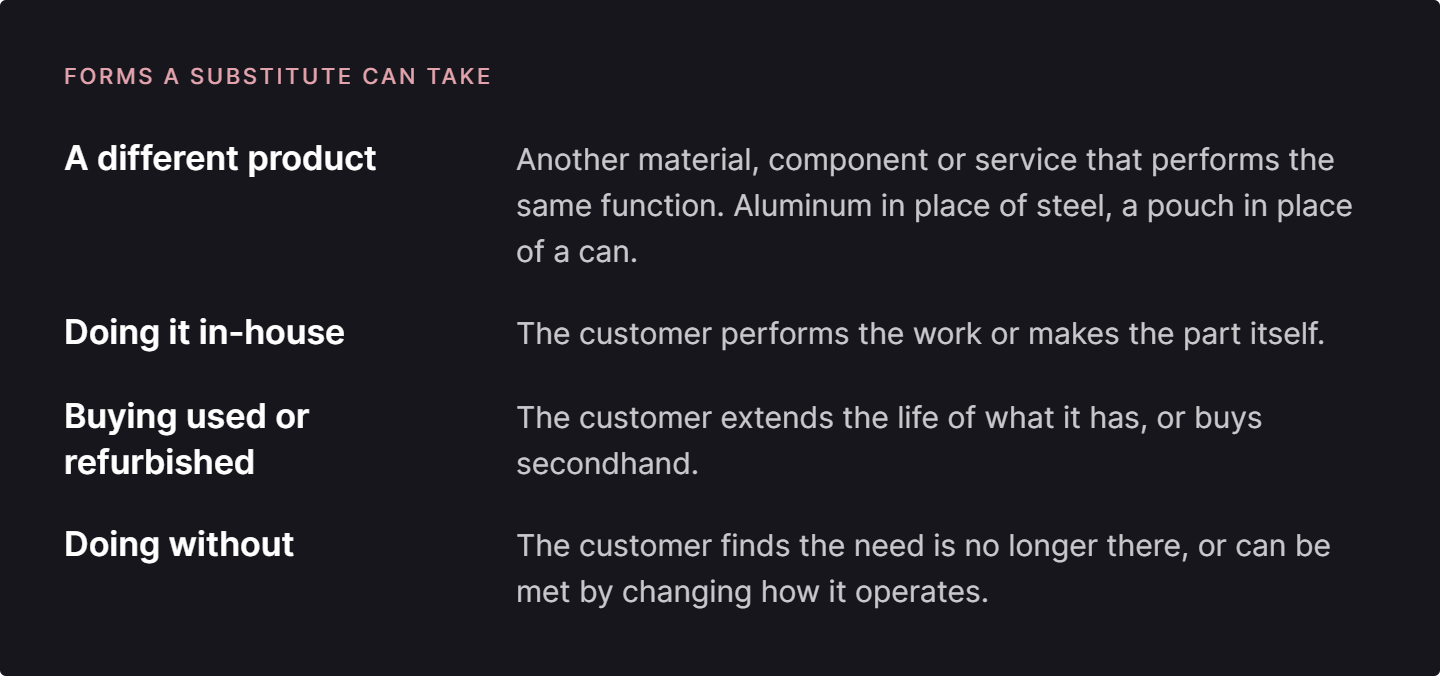
The forms apply differently across businesses. A specialty contractor’s substitute is often the customer’s own maintenance crew. An equipment distributor’s is the customer running existing machines longer or buying used. A packaged-goods supplier’s is a different format or a store brand that meets the same need. A fabricator’s is a change in the customer’s design that uses a different material or removes the part. In each case the borrower may be the strongest company in its own industry and still lose volume, because the customer has left the industry rather than changed supplier within it.
Porter also noted that substitutes can change because of developments in unrelated industries. A cost reduction in a different material, a new process at a customer, or a regulatory change affecting an alternative can move the price ceiling without anything changing in the borrower’s industry. That is why the substitutes read looks outside the borrower’s competitive set.
Testing the threat over the term
Four probes establish which substitutes apply to the borrower and whether they could take volume or cap price before the loan matures.
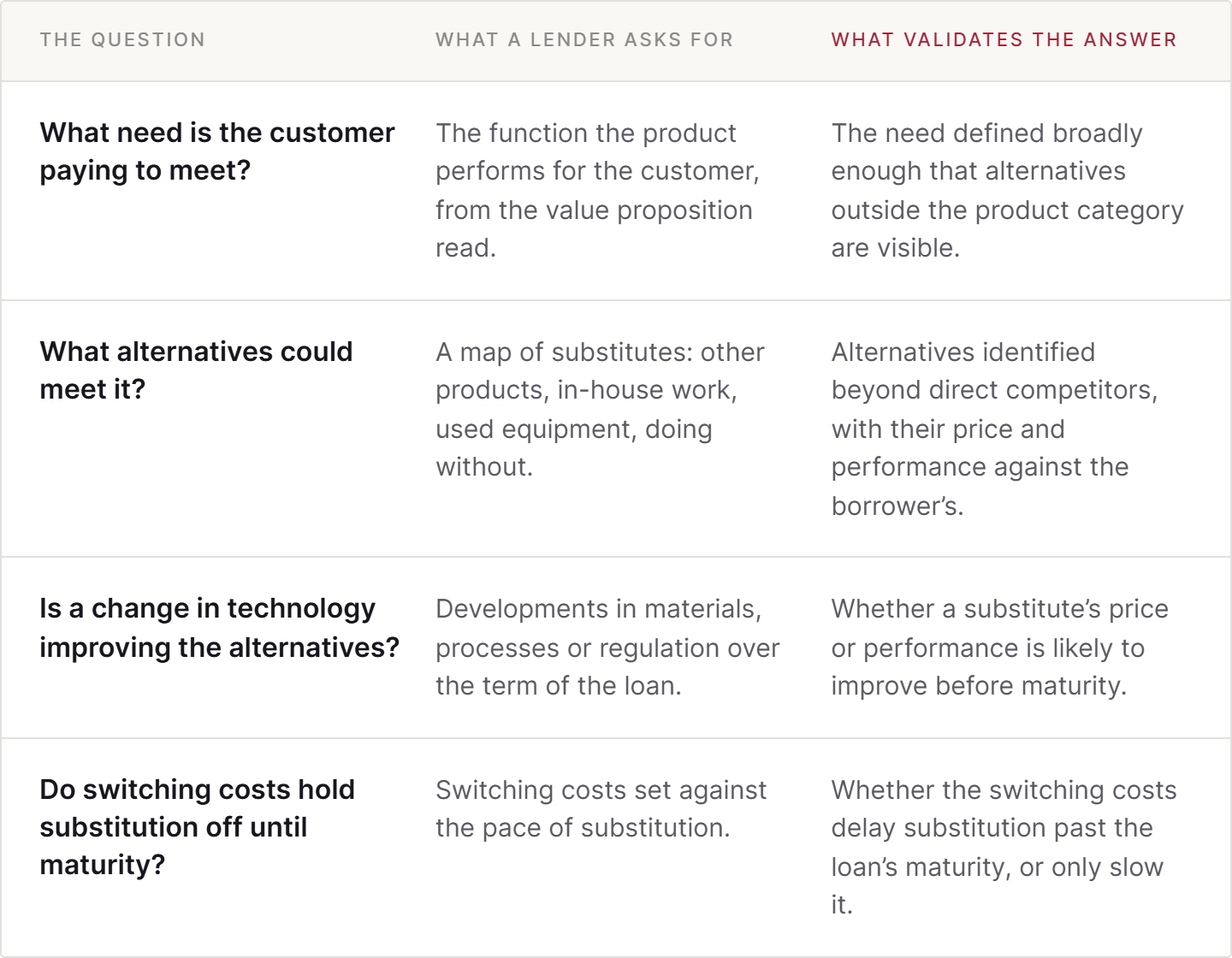
The first probe sets the terms for the rest. It reuses the value proposition read and restates what the product does for the customer in terms of the function rather than the product. A borrower that makes steel fuel tanks for agricultural equipment is meeting the need to store fuel on a machine; stated that way, a plastic tank is a substitute, and the question becomes whether equipment makers are moving to it. Where the need is defined as narrowly as the product, no substitutes appear.
The second probe maps the alternatives against the defined need, using the forms Porter described. For each one, a lender wants its price and performance relative to the borrower’s product, because Porter’s first condition is that trade-off. A substitute that is cheaper but worse sets a floor under what customers will tolerate; one that is cheaper and comparable sets the ceiling. In-house production deserves particular attention for any customer large enough to do it, and it overlaps with the in-house threat covered in the lesson on what lets customers set the price.
The third probe asks whether that trade-off is moving within the term. This is where Porter’s point about unrelated industries applies. A lender is looking for developments that would make a substitute cheaper or better before the loan matures: a new material reaching cost parity, a process change at customers, a regulation that favors one alternative. A substitute improving steadily can reduce a category’s volume while the borrower keeps its share of what remains.
The fourth probe compares the pace of substitution with the loan’s maturity. Porter’s second condition is the customer’s cost of switching to the substitute, and the switching costs established in the buyer power lesson apply here as well: a part qualified into a customer’s product, or equipment built around a particular input, slows the move. The question for a lender is whether the switching cost delays substitution past maturity or only slows it within the term. A switching cost that holds customers for three years supports a three-year loan and does less for a seven-year one.
What the substitutes read produces
At the end of this component a lender has the customer’s need stated as a function, a map of the alternatives that could meet it with their price and performance against the borrower’s, a view on whether any of them is improving within the term, and a comparison of the switching costs with the loan’s maturity.
That output is used in three places. The price and performance of the closest substitute tests the price increases in the plan. The pace of substitution sets the category volume assumption in the downside case. And the comparison with maturity feeds the view on whether the business will be financeable at that date, since a lender refinancing the borrower then will look at the same substitutes after several more years of improvement.
A borrower can define the need its product meets and map the alternatives. Whether a particular lender treats an improving substitute as a reason to shorten the tenor, increase amortization, or accept it as a slow change in a category it knows depends on what they have lent against before.
Next in the series
New entrants: what keeps other companies out of the borrower’s market
The barriers that protect the borrower, who has entered recently, and how far they got.
You can define the need your product meets and map what else could meet it. Reading how a particular lender will weigh a substitute against the term you are asking for is the part I do at Synthase Capital Partners.