


Part of The Underwriter’s Read, a series on the critical questions a credit team works through before they lend.
The revenue work established the composition of what a borrower collects today: how much is contracted, how much has to be re-won, and who it comes from. This block establishes why any of it arrives. A lender reads the two together, because a contracted base and a discretionary product are a different combination from a contracted base and a product the customer cannot operate without.
Four probes sit in this block, and they group together because each one attacks the same claim from a different side. A borrower will state why customers buy. The first probe tests that against what customers themselves say, including the ones who chose someone else. The second places the product inside the customer’s operations and budget. The third tests the claim against the alternatives a customer would actually consider. The fourth tests it against a period when the customer was cutting costs.
Those probes are also what let a lender read the forecast. Every projection assumes customers keep buying at something close to current rates, and the value proposition is the evidence for that assumption. A lender working the criticality question can put the borrower’s forecast under a case where the borrower’s customers are themselves under budget pressure, and form a view on what happens to the revenue line and to cash flow available for debt service. Without it, the downside case is arbitrary, and the borrower’s forecast is the only version on the table.
Mission-critical or discretionary
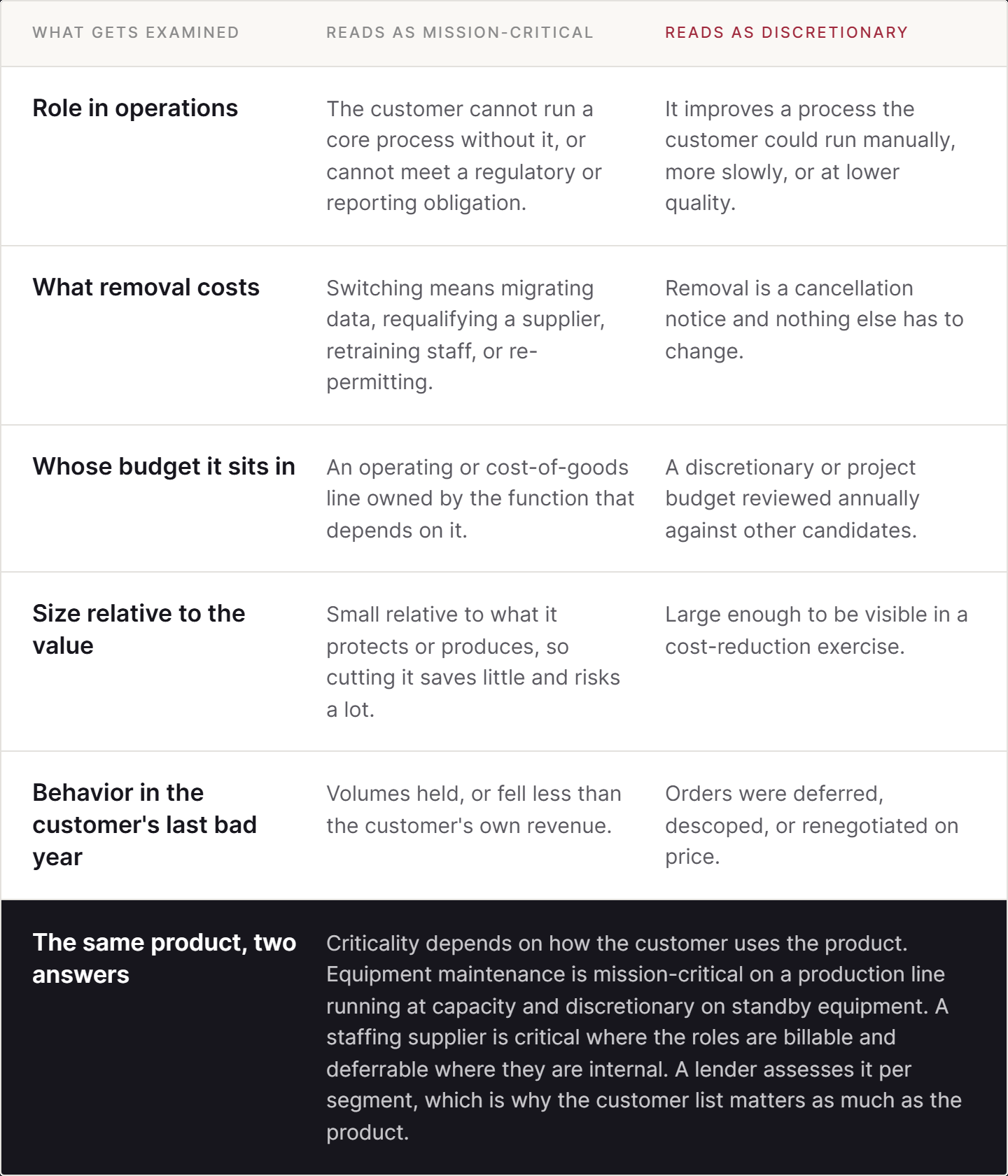
Mission-critical is a system of record, discretionary is a line item to trim. Borrowers describe themselves in the first category almost without exception, so a lender establishes it from the product’s role in the customer’s operations rather than from the description. Five things get examined.
The four probes, and what validates the answer
This block is harder to evidence than revenue. Composition can be traced to contracts and invoices. Criticality has to be established from testimony, from the customer’s own operations, and from history, which is why the validation column matters more here than anywhere else in the model layer.
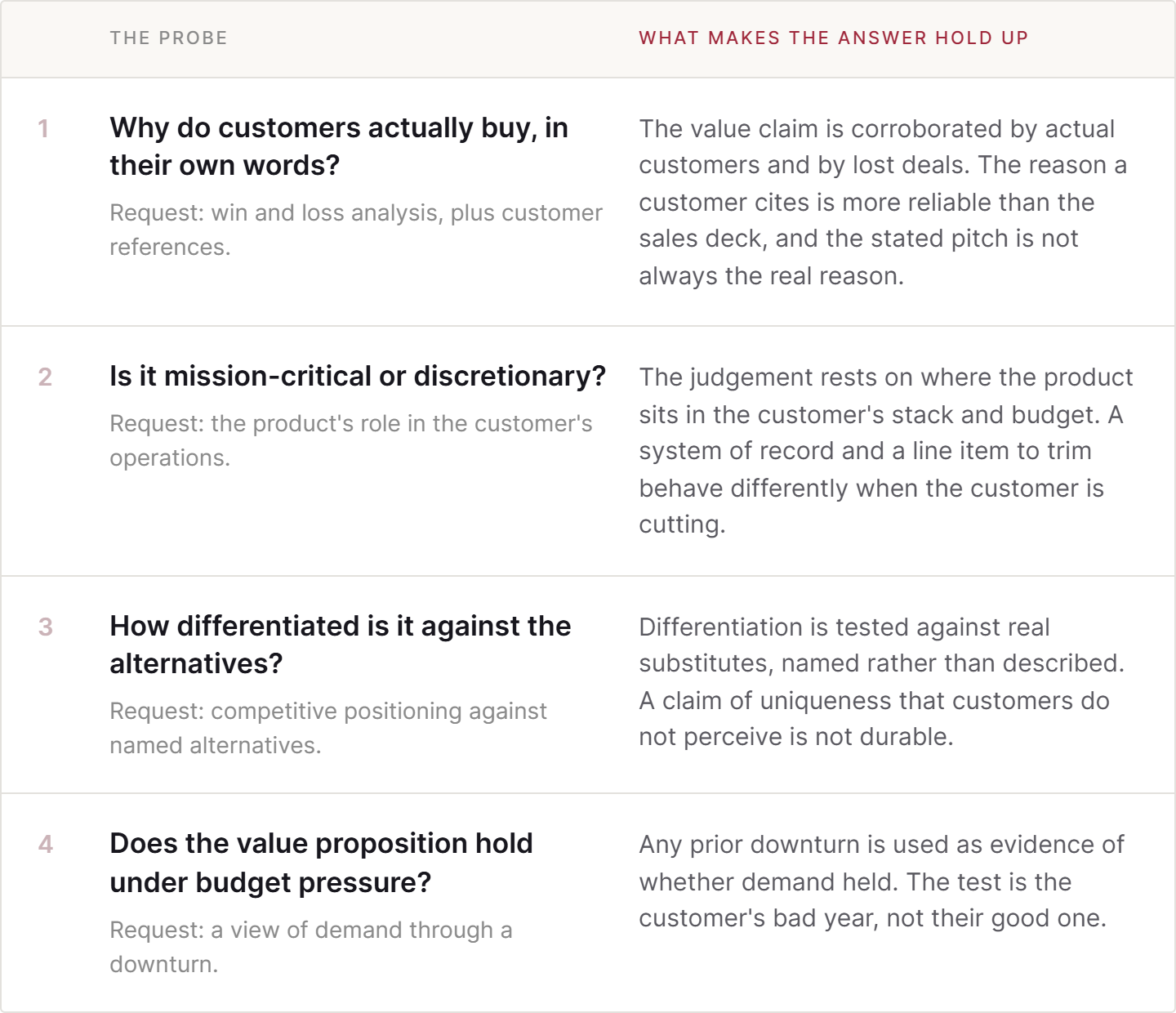
Probe one is the one borrowers most often decline, and declining it is itself informative. Customer references are a normal request in a credit process, and lost deals are the more useful half: a customer who evaluated the product and chose an alternative will say plainly what the alternative was and why. Where a borrower will not open that list, a lender falls back on inference from the contract terms and the retention record, and a lender working from inference is a lender making conservative assumptions.
Probe four is limited by history. A business founded after the last downturn in its market has no downturn record, and neither do its customers in their current form. A lender will look for a partial substitute: a segment that went through a bad period while the rest did not, a customer that cut spending for its own reasons, a product line that was descoped. Where no such episode exists, the criticality read stays a judgement rather than a finding, and it gets treated accordingly in the structure.
Differentiation is pricing power
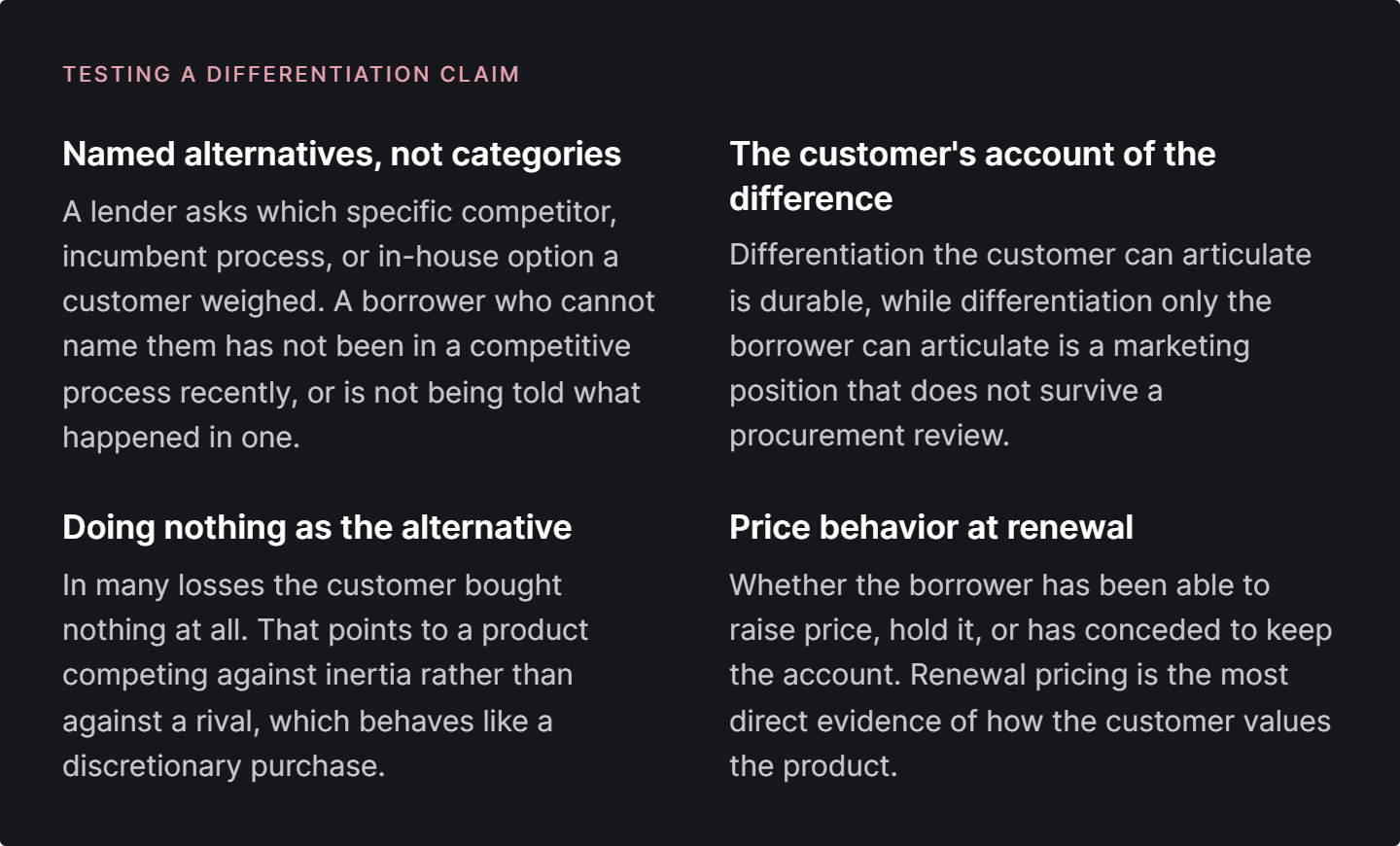
Probe three connects the value proposition to margin. A product a customer perceives as substitutable is priced against its substitutes, whatever the borrower’s own view of its differentiation. That shows up later in the analysis as pricing pressure, and it shows up in this block as the gap between what the borrower claims and what customers describe.
What the criticality read produces
At the end of this block a lender has a view on how much of the revenue base is buying something they cannot stop buying. That view is not uniform across the business. It is usually strong in one or two segments and weak elsewhere, which is why the finding is recorded per segment rather than as a single characterization of the company.
The read carries further than any other finding in the model layer. It is the root input to the later work on how much pricing power customers hold and on what substitutes exist, so a weak answer here weakens several conclusions at once rather than one. It also sets the severity of the downside case a lender runs, which is what determines headroom in the covenants they propose.
A borrower can assemble most of the evidence themselves: the win and loss record, the renewal pricing history, references willing to speak, and whatever downturn history exists. What a specific lender will credit from that evidence, and how much of the gap between the borrower’s account and a customer’s account they will treat as material, depends on their sector experience and on what they have seen behave badly before.
Next in the series
Customer segments: who pays, and how much rests on too few of them
Seeing through a revenue total to the names beneath it, and how a lender assesses the creditworthiness of the accounts the base depends on.
You can gather the evidence on why your customers pay. Reading how a particular lender will weigh it against what they have seen fail, and what that does to the downside case they run, is the part I do at Synthase Capital Partners.