


Part of The Underwriter’s Read, a series on the critical questions a credit team works through before they lend.
The last two pieces looked at the new money: what it is for, and what shape the request takes. Both of those are decisions the borrower gets to make. This one is not. How much a borrower can raise, which lenders are able to look at it, and what it will cost are all limited by the debt already on the books, and those limits are set before the first meeting.
Two companies want a $10mm senior secured term loan. Same sector, same earnings, same collateral base. One has no debt. The other has an $18mm senior facility with a blanket lien on all assets, a debt incurrence covenant capped at 3.0x, and a maturity fourteen months out.
The first company is negotiating a term sheet. The second is not asking for a term loan at all, whether they realize it or not. They are asking someone to either refinance the whole structure, come in behind an existing lender who has already claimed the collateral, or wait for the incumbent’s permission. Three very different conversations, with three different sets of lenders, and the borrower’s own paperwork decided which one they are having.
A credit team works through the existing stack before it gets to the plan. Three things come out of it.
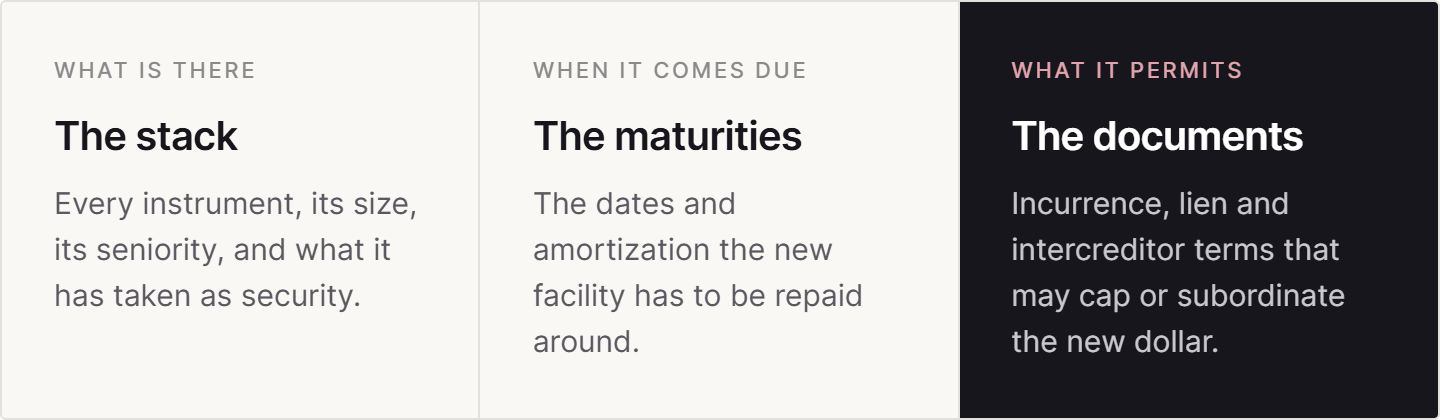
The stack: what position is available
Every dollar of existing debt occupies a position, and those positions are taken. A borrower can only offer what is left.
Borrowers routinely offer positions they do not have. A first lien on the receivables cannot be granted twice. A senior position is not available to a second lender while a senior facility is outstanding, unless the incumbent agrees to share it or is repaid. A blanket lien, which most bank facilities take, means there is no unencumbered asset left to pledge, including assets nobody had in mind at the time.
A new lender is not pricing the borrower’s earnings. It is pricing those earnings minus everything senior to the new claim, tested against a downside. The same business supports very different amounts of new debt depending on how much of it is already committed elsewhere.
The position that is left is not always the one the borrower believes they hold. A facility described internally as a working capital line may carry a blanket lien nobody remembers granting. An equipment financing signed three years ago may have taken the one asset a new lender wanted. Neither is unusual. Documents get signed one at a time, to solve whatever problem the company had that quarter.
Borrowers negotiate over the position they want. Lenders underwrite the position that is actually left.
The maturities: where the walls are
A new lender needs to be repaid, and repayment competes with every other obligation coming due. The question is not whether the business can service the new loan. It is whether the business can service the new loan while also repaying or refinancing whatever comes due first.
This is why a maturity sitting inside the proposed tenor of the new facility is a problem rather than a detail. If a five-year term loan is being asked for and an existing facility comes due in year two, the new lender is being asked to fund a business that has to refinance something else halfway through their loan, in a market they cannot forecast. They will either want the existing debt taken out at close, or they will want to be repaid before it.
Amortization matters for the same reason and is easier to overlook. Scheduled principal payments consume cash flow that would otherwise cover the new facility. A stack that looks manageable on total leverage can look tight when the actual cash demands are laid out year by year, and that is the view a credit committee builds.
Time remaining on the existing facility
The maturity clock is the only item in the stack that changes the borrower’s negotiating position on its own. The business can perform exactly to plan and the position still weakens.
Three years out, a borrower can run a process, decline terms, and walk. Eighteen months out, they are still credible but visibly on a clock, and every lender they speak to knows the alternative to a deal is a problem rather than nothing. Inside twelve months, the incumbent knows there is not enough runway to replace them, and the market knows it too. The business is the same at all three points. The terms available are not.
That timing drives a decision with no general answer.
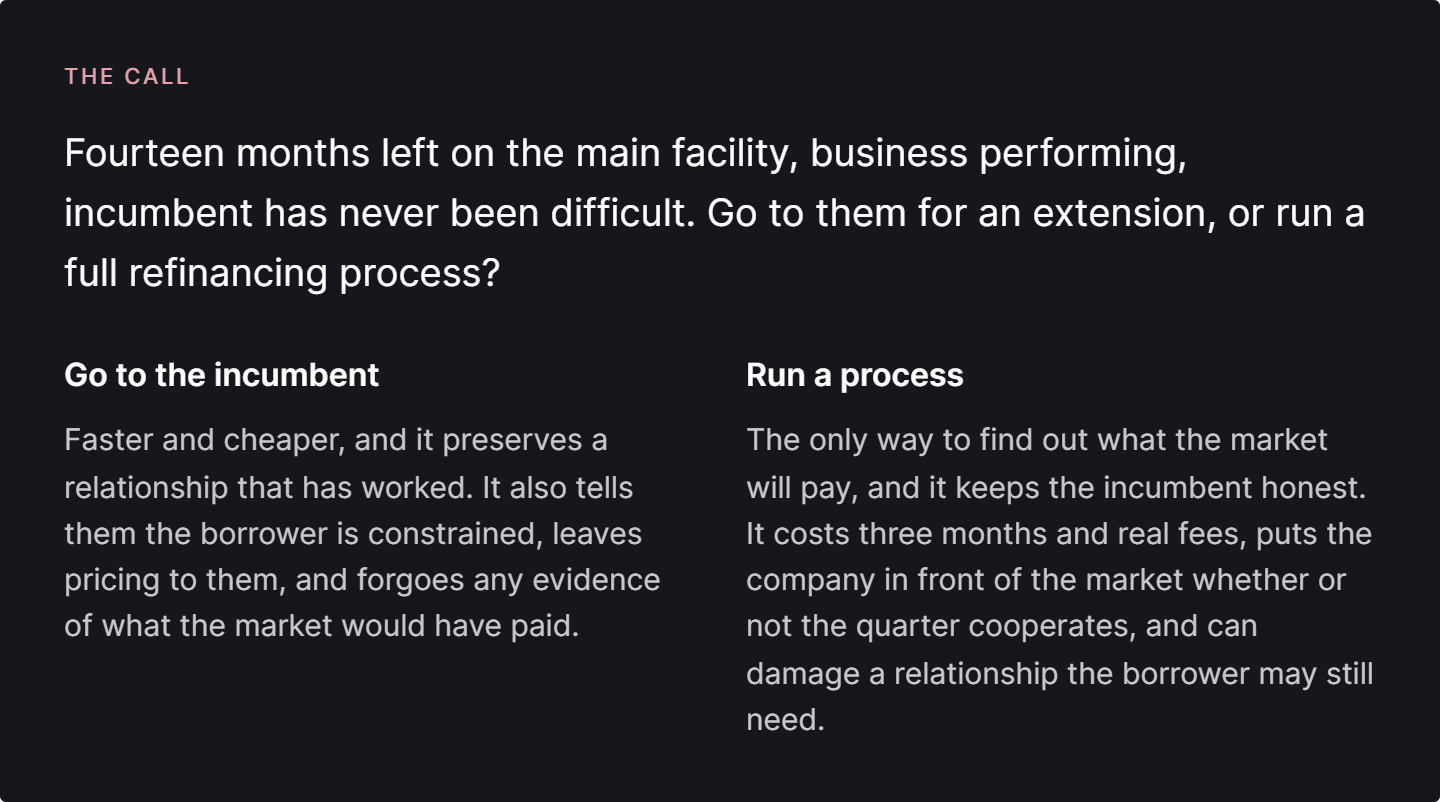
Both answers are defensible, and experienced people disagree on this regularly. What decides it is how the incumbent behaved the last time a quarter came in soft, whether the trailing numbers will hold up with four lenders reading them at once, whether the owners will fund a gap if one opens, and what the market is paying for this profile now. None of that is in the credit agreement.
One part is not a judgement call. A borrower who mapped this at thirty-six months has both options. At fourteen months, only one of them is realistic.
The documents: the incumbent may have a vote
This is the part that surprises borrowers most. An existing credit agreement frequently limits, and sometimes prohibits, exactly what is being contemplated. The constraint is not the new lender’s appetite. It is a document already signed.
Three provisions do most of the work. **Debt incurrence** covenants cap how much additional debt can be taken on, often as a leverage multiple, and sometimes with a hard dollar basket. **Negative pledge** and lien covenants restrict what further security can be granted, which can make a secured facility impossible without consent. **Change of control and prepayment** terms determine what taking out the existing debt actually costs, including any make-whole or prepayment premium.
Where more than one lender is already in place, an intercreditor agreement governs how they relate to each other: who controls enforcement, who gets paid in what order, and what a junior lender is permitted to do when things go wrong. A new lender entering that structure is agreeing to those terms, and will read them before agreeing to anything else.
The practical consequence is that the incumbent lender is a participant in the raise whether the borrower involves them or not. A consent that needs to be obtained is a timeline item, a negotiating position for the incumbent, and occasionally a repricing of the facility they already hold.
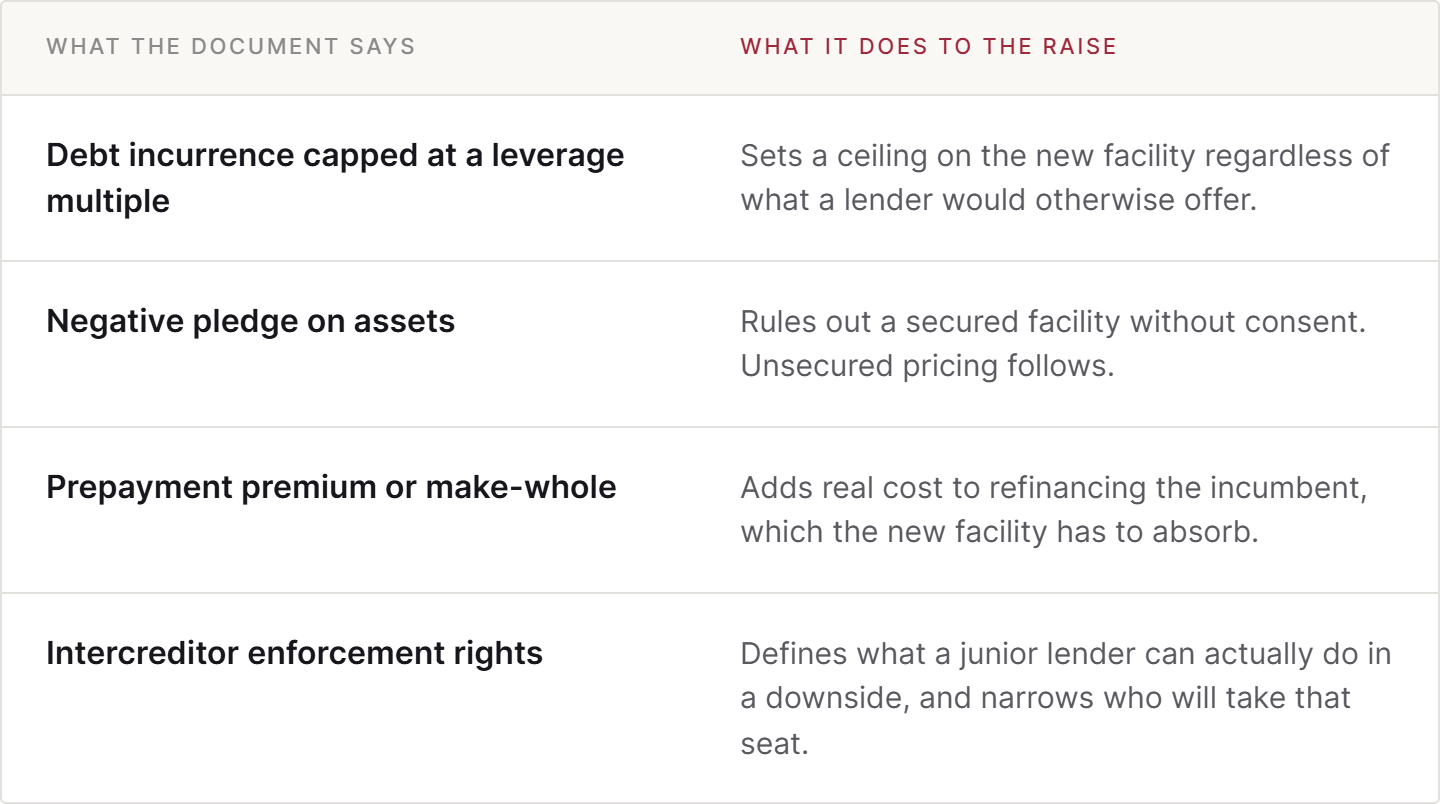
Most of these constraints have a price
Some of those provisions are hard limits. Most are not. Negative pledges get waived. Incurrence baskets get amended. Prepayment premiums get negotiated, or shopped against a lender willing to absorb them. An incumbent asked at the right time, with a reason that serves them, frequently agrees.
The price varies, and it is not published. It depends on how the incumbent views the credit today, what else they want from the relationship, how much of their own capacity is committed, and whether they believe the borrower has alternatives. Two borrowers can ask the same lender for the same waiver in the same month and get materially different answers.
So the question is rarely whether the document allows something. It is what it will cost to change the document, and whether that is cheaper than working around it. That depends on the lender, not on the document.
The claims that are not on the debt schedule
Not everything ahead of a new lender appears on the debt schedule. Capital leases and equipment financings are debt in substance and usually secured on the specific asset. Convertible notes carry maturities and conversion mechanics that change the picture depending on how they resolve. Preferred equity with a liquidation preference behaves like a claim in a downside whatever it is called on the cap table. Seller notes from a prior acquisition, earnouts still owed, deferred purchase price, unfunded pension obligations, and drawn letters of credit all sit somewhere in the order of payment.
A credit team builds this list whether or not the borrower hands it over, and an item found rather than disclosed costs more credibility than the item is worth.
Which conversation the borrower is in
The practical output of all this is knowing which of three conversations the existing structure has already put the borrower in. Each one goes to a different set of lenders, on a different timeline, at a different cost. Most borrowers assume they are in the first.
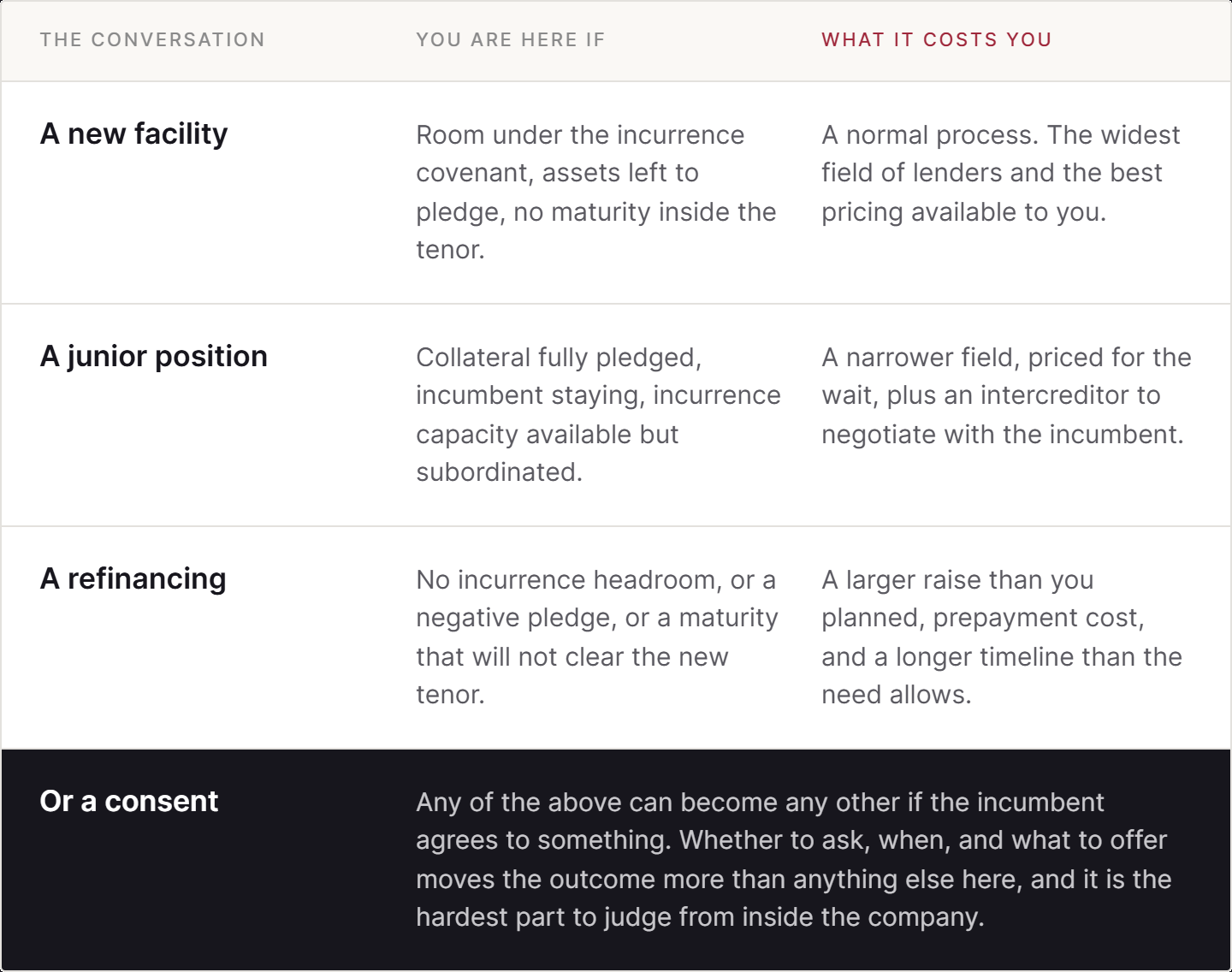
Use of proceeds and the shape of the ask are arguments a borrower makes. Existing capital is a constraint a borrower inherits. Reading that constraint is work a borrower can do with their own documents. Deciding what to do about it, which lender will take the seat that is left, what the incumbent will accept and when to ask, takes a view on what the market is paying for that position today. That is a view on the market, not on the documents.
Next in the series
Timeline and trigger: setting expectations for the process
What is prompting the raise, and the date the borrower has in mind. The trigger points to events that could shape the deal. The timeline determines how much diligence is possible before a lender has to decide.
Reading your own stack is work you can do. Knowing which seat the market will actually offer, and what the incumbent will accept, is the part I do at Synthase Capital Partners.