


Part of The Underwriter’s Read, a series on the critical questions a credit team works through before they lend.
The first question in any credit conversation is some version of “how much do you need?” It feels like the important one. It is not. The amount tells a lender the size of the exposure. What the money is for tells them whether there is a credible way to get it back.
Consider two companies, both asking for ten million dollars over five years.
The first is buying manufacturing equipment. The equipment has a useful life of ten years, it will produce measurable output, and if the business fails, the equipment can be sold. The loan is shorter than the asset’s life, the asset generates the cash that services the debt, and there is something tangible standing behind the claim.
The second is covering an operating shortfall. Revenue has not kept pace with the cost base, and the ten million funds the gap for the next several quarters. Nothing is acquired. No new cash-generating capacity is created. The money buys time, and the repayment thesis rests entirely on something changing before the time runs out.
Same amount, same tenor, same industry. Entirely different credits.

This is not a judgment about which company is better run. Plenty of good businesses need bridge capital, and plenty of weak ones buy equipment. The point is narrower: the use of proceeds determines whether a lender can build a repayment story at all, and how much of that story depends on things nobody controls.
Why a lender starts here
Every loan has a hierarchy of repayment sources. Most often the primary source is operating cash flow, but not always: an asset-based facility looks first to the collateral, a bridge looks to the event that repays it, and a real-estate loan looks to the operating income the property produces. Behind the primary source sits a secondary one, usually a refinancing, and sometimes a tertiary source such as an asset sale or a sponsor’s support. Use of proceeds is what tells a lender which of those sources the deal actually depends on.
Money that funds a revenue-producing asset can strengthen the primary source, whether that source is the cash flow or the asset itself. Money that funds a shortfall consumes it. Money that refinances existing debt does not change the business at all; it changes who holds the claim and when it comes due, which pushes the entire question onto the secondary source. Which source the deal leans on is a question in its own right, and one we come back to later in the series.
The amount tells a lender what is at risk. The use of proceeds tells them how it gets repaid.
There is a second reason this question comes first. Use of proceeds routes everything downstream. If you are buying equipment, a credit team will spend its time on the asset, the vendor, the installation timeline, and whether the projected output is realistic. If you are funding a shortfall, they will spend it on burn, runway, and what specifically changes before the money is gone. Two completely different diligence exercises, decided by one answer.
It also routes the rest of the read. A growth story sends a credit team into the durability layer, where the question becomes whether the repayment source holds long enough to matter. A distress story sends them to the repayment layer, where the question becomes what can be recovered if the repayment source erodes.
The six uses, and what each one signals
Most requests fall into one of six categories. None of them is disqualifying, but each one moves the conversation somewhere different.
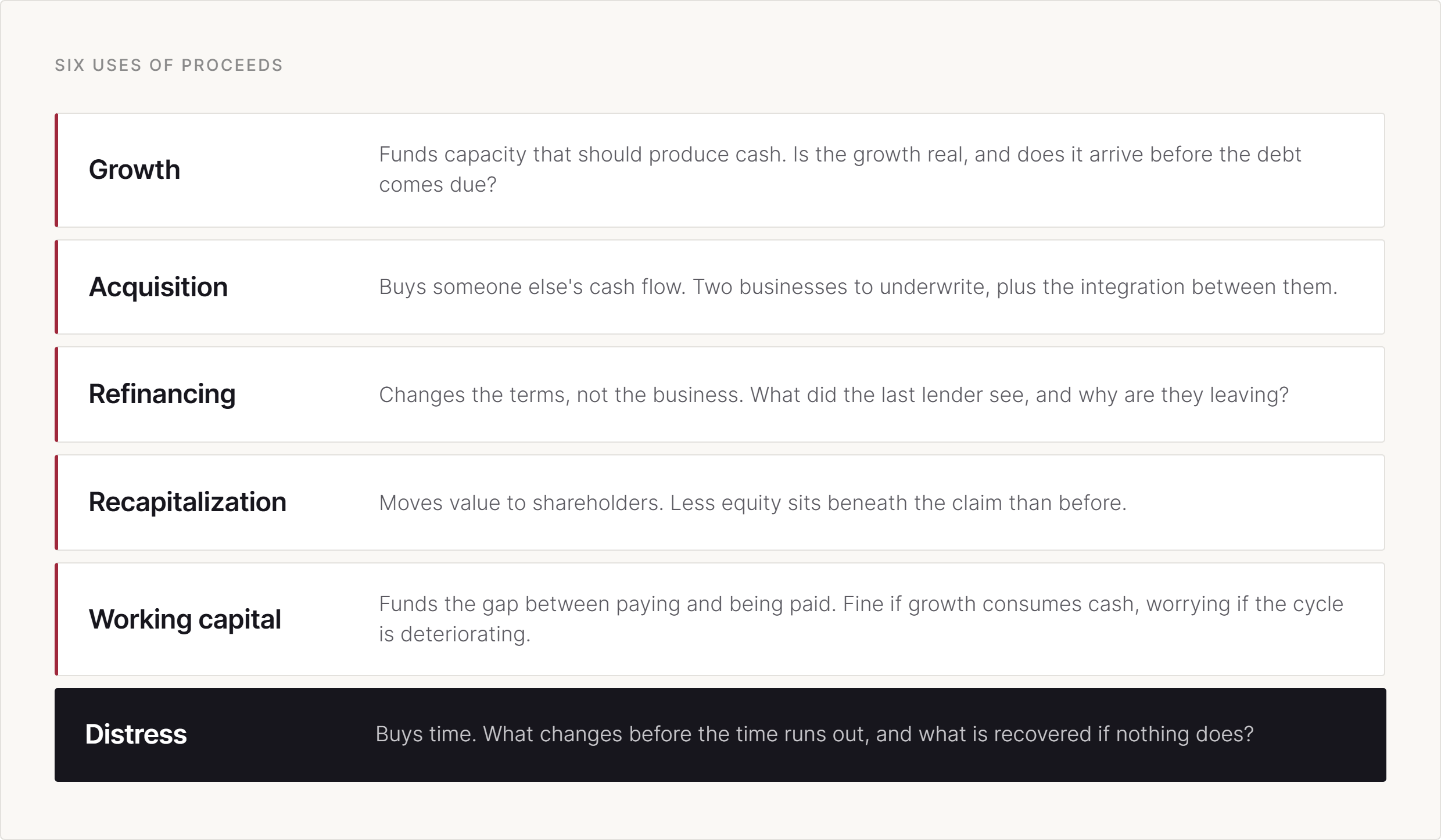
Two things are worth noticing about that list. First, the further down you go, the more the repayment story depends on the future rather than the present. Second, a request often belongs in more than one category, and how you describe it matters. “Growth capital” that is really covering a shortfall does not survive diligence, and the discovery is expensive: it costs credibility at exactly the moment you need it.
Does the structure match the use?
The last part of this question is one borrowers rarely ask themselves: does the money you are requesting have the right shape for what you are doing with it?
Long-lived assets should be funded with long-dated money. Seasonal working capital should be funded with a revolver that draws and repays, not a term loan that sits on the balance sheet for five years. A mismatch is not merely inefficient. It creates a refinancing event that has nothing to do with how the business is performing, and lenders read it as a sign that the borrower has not thought the request through.
Getting this right is one of the cheapest credibility wins available. It costs nothing but clarity.
What to have ready
A sources and uses table. Where every dollar goes, adding to the amount you are asking for. If you cannot produce this in one page, the request is not defined yet.
The honest category. Name the use plainly, including the uncomfortable part. A lender will find it anyway, and finding it themselves costs you more than telling them.
The link to repayment. One or two sentences connecting what the money does to the cash that services it. If that link runs through a hoped-for event, say so.
A structure that fits. Tenor matched to asset life, revolver for working capital, amortization that tracks the cash the use actually generates.
None of this requires a better business. It requires being precise about the one you have.
Next in the series
Amount and structure: defining the ask
How much, for how long, and on what terms. The shape of the ask decides who might be interested in providing the capital, how much it will cost, and what the consequences are if things do not go according to plan.
If you are preparing to raise debt and want a read on where you stand, that is what I do at Synthase Capital Partners.