


Part of The Underwriter’s Read, a series on the critical questions a credit team works through before they lend.
The earlier layers of the series covered what the borrower is asking for, how the business makes money, what could change that over the term of the loan, and whether the cash flow services the debt. The repayment layer asks whether the lender still gets repaid if the business does not perform to plan, and from what.
Most of the work in this layer reuses findings from earlier lessons. A lender takes its own cash flow, debt schedule, asset register and durability read, and uses them to establish where repayment will come from, where the new loan ranks against other claims, what the lender recovers if the business fails, and whether another lender will refinance the loan at maturity.
Four components, and what each one tests
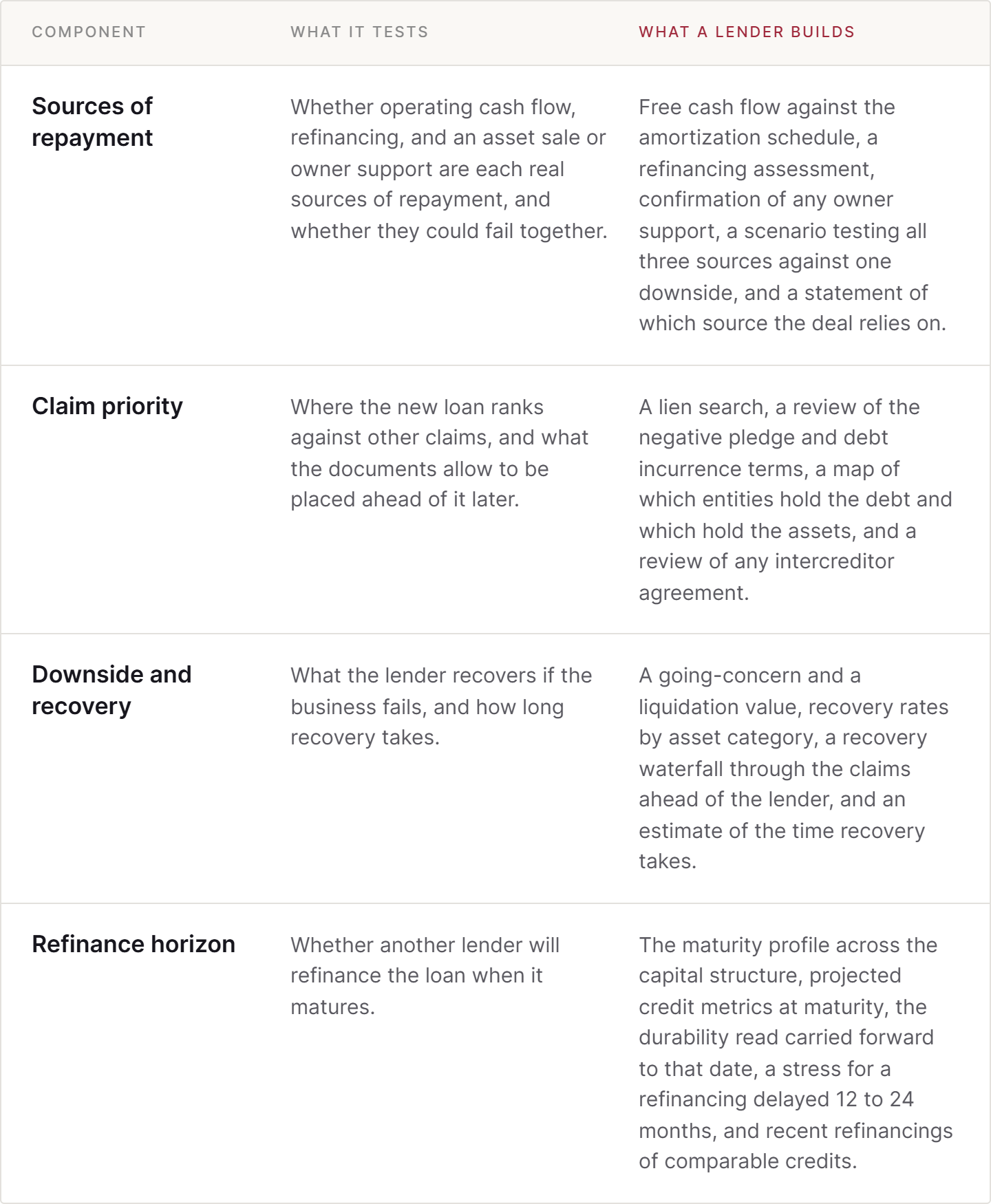
The lessons publish in the order the builds depend on each other: sources of repayment, claim priority, downside and recovery, refinance horizon. The sources of repayment work names which source the deal relies on. Claim priority produces the ranking of claims that the recovery waterfall runs through. Refinance horizon comes last because it draws on the cash flow, the leverage path and the durability read together.
Where the inputs come from
Each component draws on findings from earlier lessons.
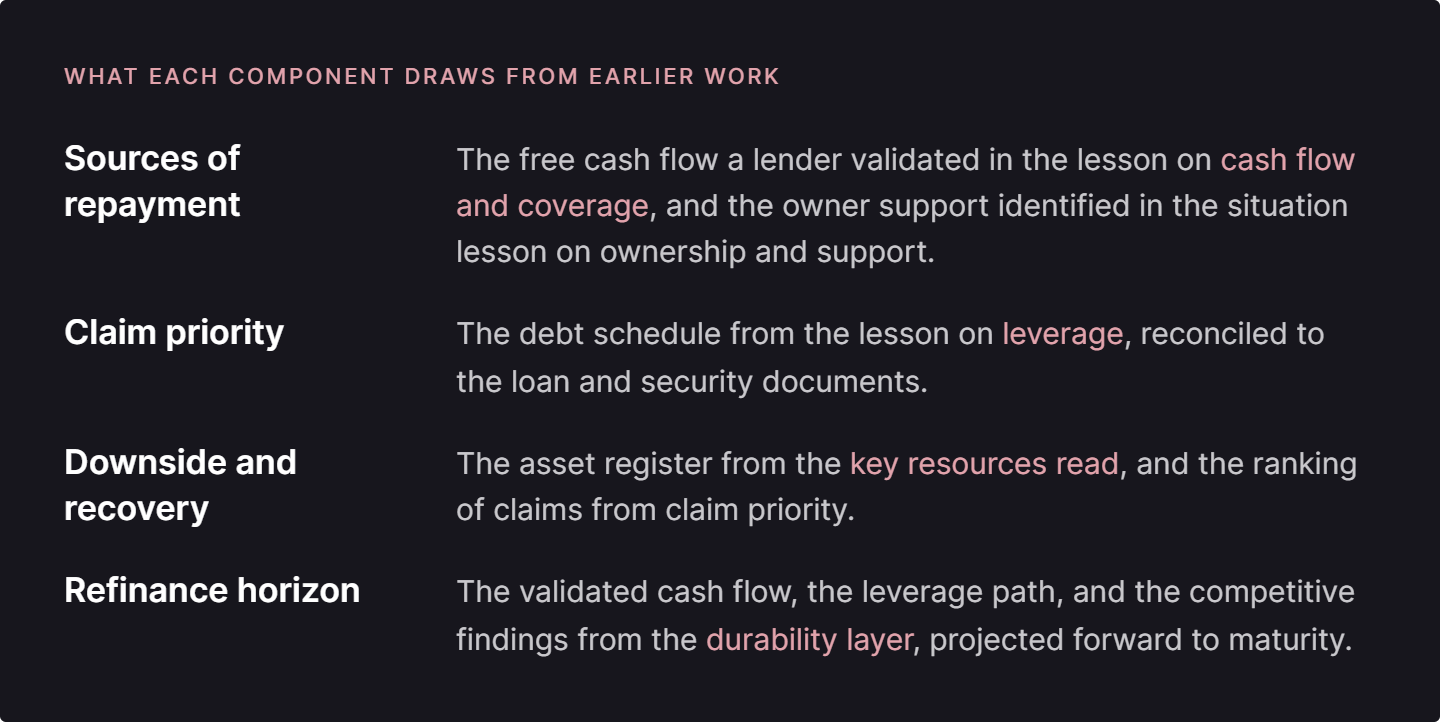
Most of this layer is analysis of material a lender already holds, and it adds few new document requests. The exceptions are legal: a lien search, the security agreements, the legal entity chart with any guarantees, and the intercreditor agreement where one exists.
Which source the deal relies on
Every loan has three possible sources of repayment: operating cash flow, refinancing, and an asset sale or support from the owners. Operating cash flow is the only one fully in the borrower’s control. Most debt is repaid by refinancing rather than amortization, so for many loans the real source of repayment is a lender that has not yet been identified. A lender states which source the deal relies on. If the repayment case is refinancing in year five, the credit depends on the refinance horizon work, and a lender says so in the credit memo.
A lender also tests whether the sources could fail together. A downturn that reduces cash flow can also close the refinancing market and lower the value of the assets, so three sources can behave like one. When cash flow is thin, more of the analysis shifts to where the loan ranks and what it would recover.
Borrowers with few hard assets
For a borrower with few hard assets, such as a services business or a distributor that owns little beyond receivables and inventory, recovery and refinancing depend on the same thing: whether the customer base holds up. A buyer of the business in a downside is paying for contracts and customers that transfer, and a lender refinancing it at maturity is lending against the same base. The durability read from the earlier layer is the main input to both components for these borrowers.
For a borrower that is still consuming cash, the sources of repayment are the four covered in the lesson on the cash-consuming borrower: cash on the balance sheet, the next equity raise, a sale of the company, and reaching breakeven before maturity. Claim priority and recovery apply as written.
What the layer produces
At the end of this layer a lender has a statement of which source repays the loan, a ranking of every claim against the business including any that the documents allow later, an estimate of what it recovers and how long recovery takes, and a view of whether the credit will be refinanceable at maturity. The negative pledge and debt incurrence findings go into the structure terms covered in the situation lesson on amount and structure.
A borrower can list its own sources of repayment and map the liens already recorded against it. Which source a particular lender will treat as the real repayment case, and how it will value the assets in a downside, depend on the lender type and on how it has recovered on similar credits before.
Next in the series
Sources of repayment: operating cash flow, refinancing, and asset sales or owner support
How a lender tests whether each source is real, and whether they could fail at the same time.
You can list your own sources of repayment and map the liens against your business. Knowing which source the lenders in your process will treat as the real repayment case is the part I do at Synthase Capital Partners.