


Part of The Underwriter’s Read, a series on the critical questions a credit team works through before they lend.
Porter’s second force is the bargaining power of buyers: the ability of customers to force prices down, demand more quality or service for the same price, and play sellers against each other. As with rivalry, his analysis is of the industry. It asks what gives a group of buyers leverage over the companies that sell to them, and what makes those buyers care about price. A lender applies that to the borrower’s customers to set the price the borrower can expect to hold at renewals and rebids over the term of the loan.
Porter separated two conditions. Bargaining leverage is whether buyers are in a position to negotiate price down. Price sensitivity is whether they want to. A customer with leverage may not use it if the purchase is a small part of its costs or affects the quality of its own product. This lesson reads the borrower’s customers against both conditions, then uses five probes to test the finding against what has happened with the borrower’s accounts: what the switching cost is, what the contracts commit, what happened to price at renewals, why past customers left, and whether customers would keep buying in their own downturn.
Management’s plan usually carries price increases at renewal and stable volume from existing customers. Where buyers are concentrated, face low switching costs and spend a large share of their own costs on the borrower’s product, Porter’s framework says they will resist those increases, and a plan that assumes otherwise is assuming the borrower’s customers behave differently from the rest of the industry’s. The buyer power read lets a lender set the renewal price assumption from the borrower’s actual renewal history, and the volume assumption in the downside case from whether customers keep or cut the purchase when their own business slows.
What gives buyers leverage
Porter set out the conditions under which a group of buyers holds bargaining leverage. Each can be established from the customer list, the product and the way customers buy.
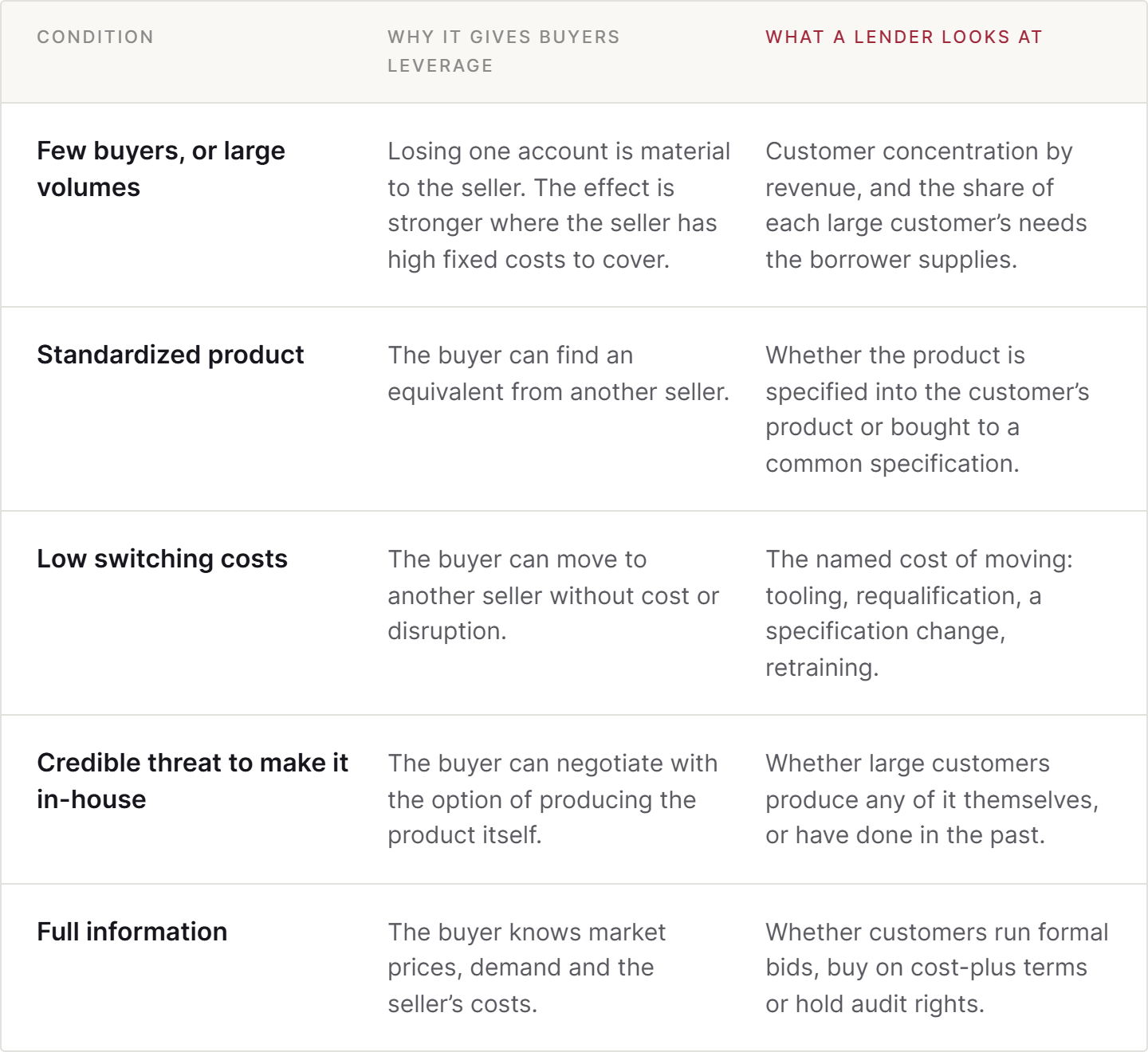
Concentration is the condition most lenders check first, and it carries over from the read on who pays. Porter’s framing adds the seller’s side of the same fact: a customer that takes a large share of the borrower’s output has leverage in proportion to how much the borrower needs that volume to cover its fixed costs. A food manufacturer selling forty percent of its volume to two national retailers, running plants that need that volume, is in that position at every category review.
Porter also noted that intermediate buyers, such as distributors and retailers, gain leverage when they can influence what the end customer buys. A retailer that controls shelf placement or a distributor that recommends one brand over another holds power that a direct customer of the same size would not. The channels read established who holds the customer; this condition establishes what that position is worth in a price negotiation.
What makes buyers care about price
Leverage alone does not set the price. Porter’s second set of conditions describes when buyers are sensitive to price and will use the leverage they have.
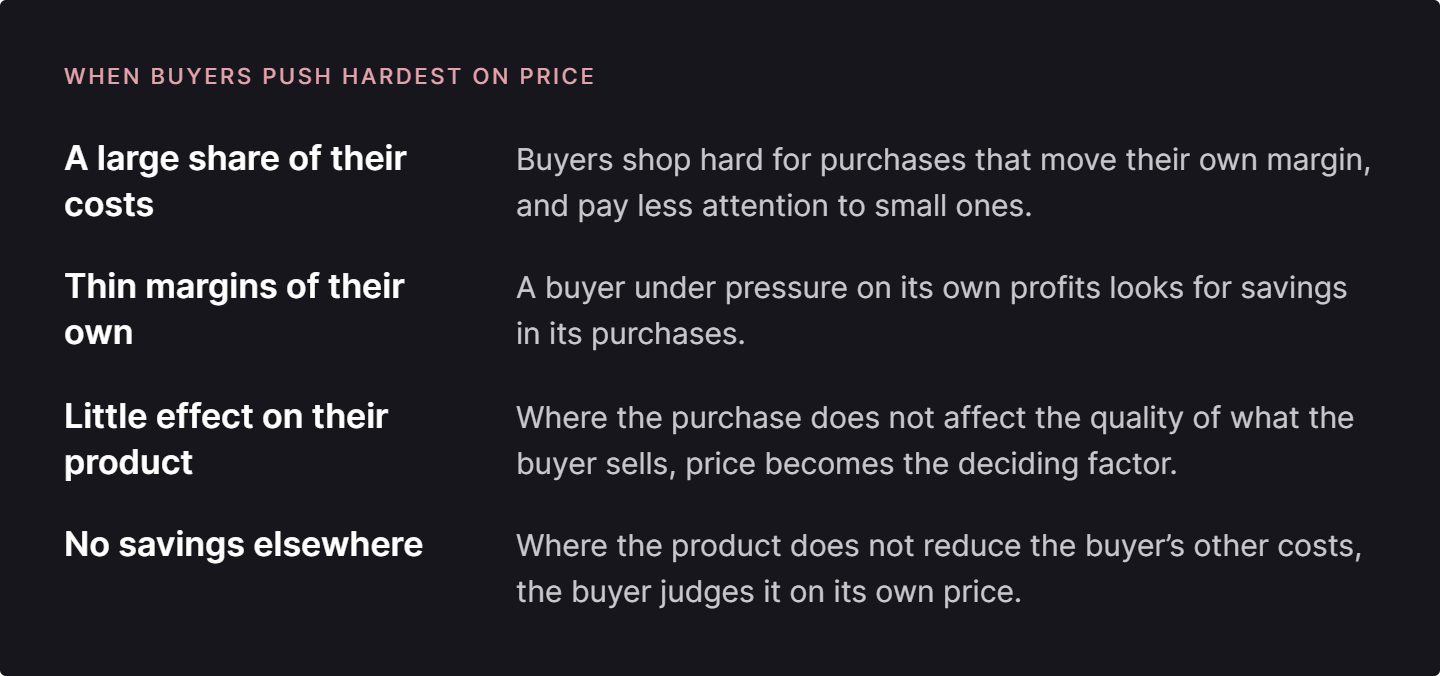
These conditions explain why two customers of the same size behave differently. A contractor buying fasteners that are a small part of the project cost and that could delay the project if they fail will pay for reliability. A packaged-goods company buying corrugated boxes that are a meaningful share of its cost of goods, have no effect on the product and are made to a common specification will rebid them regularly. The first customer has leverage and does not use it; the second has leverage and uses it at every contract.
Thin margins at the customer are the condition most likely to change within the term of a loan. A customer industry going into its own downturn becomes more price-sensitive at the same time its volumes fall, so the borrower sees pressure on price and volume together.
Testing the finding against the borrower’s accounts
Five probes test whether the leverage and sensitivity the industry read predicts are showing up in how the borrower’s customers have actually behaved.
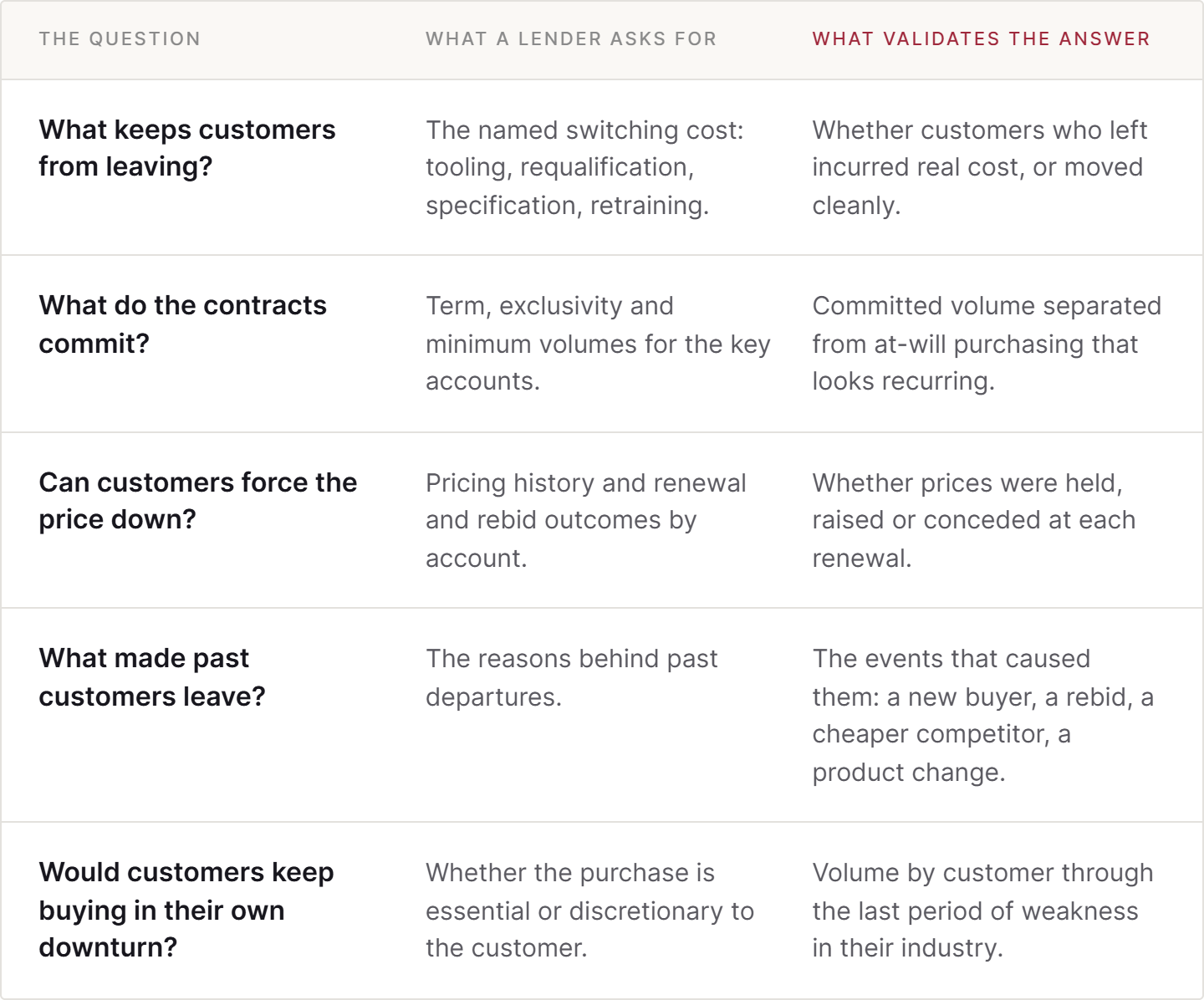
The switching cost probe tests Porter’s third leverage condition with evidence. Most borrowers can describe a switching cost; fewer can show that customers who left paid it. A fabricator whose part is qualified into a customer’s assembly can point to the requalification a competitor’s part would need. If customers have moved to competitors without going through that requalification, the switching cost is lower than described. The customers who left are the best evidence a lender has of what leaving costs.
The contract probe reuses the contract read from the lesson on what keeps customers. The question here is narrower: whether the contracts limit the buyer’s leverage during the term. A supply agreement with committed volumes and a fixed price schedule limits it until expiry. A master agreement with no minimum volume sets terms without committing the customer to buy, and leaves the customer’s leverage intact. The expiry dates of the largest contracts are compared with the loan’s maturity.
The renewal pricing probe is the direct test of whether buyers are using their leverage. It uses the same transaction data as the price and volume split in the rivalry lesson, grouped by account and renewal date. Prices held or raised at renewal with the largest customers are evidence that leverage is limited in practice. Prices conceded at renewal, or volume moved to a second supplier after a rebid, show where the power sits regardless of what the concentration figures suggest.
The departure probe asks what caused customers to leave in the past. Porter’s conditions describe a standing position; the departures show what changes it. In most businesses the causes are specific: a new purchasing manager who rebids the category, a customer acquired by a company with its own supplier, a competitor offering a lower price, a change in the customer’s product that removes the borrower’s part. Knowing which of these has caused departures before tells a lender what to watch for over the term.
The downturn probe connects to Porter’s price sensitivity conditions and to the value proposition read. A product that is essential to the customer’s operation, or whose failure would be costly, tends to keep its volume when the customer cuts spending. A discretionary purchase is among the first to go. The evidence is volume by customer through the last period when the customer’s own industry was weak.
What the buyer power read produces
At the end of this component a lender has a finding on how much leverage the borrower’s customers hold and how sensitive they are to price, a named switching cost tested against past departures, the contract commitments set against the loan’s maturity, the renewal price history for the largest accounts, and a view on how customer volume behaves in a downturn.
That output is used in three places. The renewal price history sets the price assumption for existing customers in the base and downside cases. The downturn finding sets the volume assumption in the downside case. And the verdict on how much leverage customers hold feeds the view on whether the business will be financeable at maturity, since the largest contracts that expire before that date will be renegotiated with the same buyers.
A borrower can describe its customers against Porter’s conditions and produce the renewal history by account. Whether a particular lender treats concentrated buyers as a concentration limit in the borrowing base, a covenant on the largest customers, or a normal feature of an industry they lend into depends on what they have lent against before.
Next in the series
Supplier power: what lets suppliers raise the borrower’s costs
How concentrated the suppliers are, what it costs to switch, and whether the borrower can pass cost increases on.
You can read your customers against Porter’s conditions and produce your renewal history by account. Reading how a particular lender will treat what that shows, and what it does to the advance rate and covenants you are offered, is the part I do at Synthase Capital Partners.