


Part of The Underwriter’s Read, a series on the critical questions a credit team works through before they lend.
The revenue work established the composition of what a borrower collects, and the criticality read established why customers pay. This block establishes who they are. A borrower’s cash flow inherits the credit of its customers, so a lender looks through the revenue total to the accounts underneath it and assesses them individually.
Five probes sit in this block, and they group together because concentration on its own is not a finding. The first establishes the level: what share of revenue the top one, five and ten accounts carry. The second establishes whether those accounts are good credits. The third reads their contracts. The fourth establishes the direction, whether growth is broadening the base or deepening reliance on the same names. The fifth converts all of it into a number, by running the loss of the largest account through to coverage.
Those probes are what let a lender test the forecast at the account level. A projection is built on total revenue growing, and this block establishes how much of that total depends on renewal decisions made by a small number of identifiable parties. Where three accounts carry half the revenue, the forecast is a set of assumptions about three companies, and a lender can assess each one directly: their sector, their own performance, their contract, and the notice they would need to give. That produces a view on capacity to generate cash flow for debt service that does not rest on management’s aggregate growth assumption.
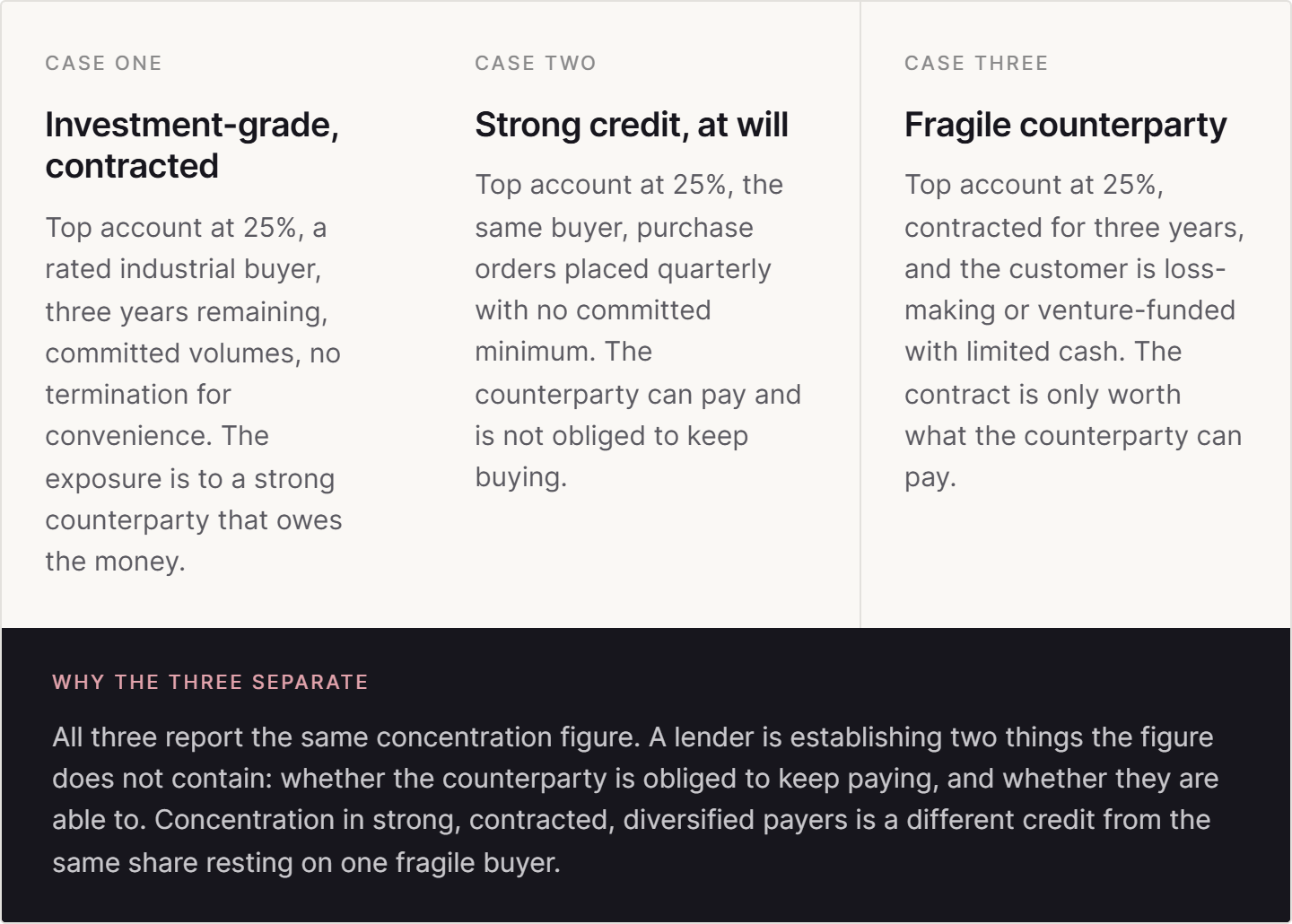
The same concentration, read three ways
Concentration is not automatically bad. A top account at 25% of revenue can be a manageable feature of the business or the single item that determines the structure, and the difference comes from who that customer is and what the contract says.
The five probes, and what validates the answer
The first four probes describe the base and the fifth prices it. Most of the work sits in the requests themselves, since the billing data and the contracts for the top accounts contain the answers and a borrower’s own reporting rarely presents them in this form.
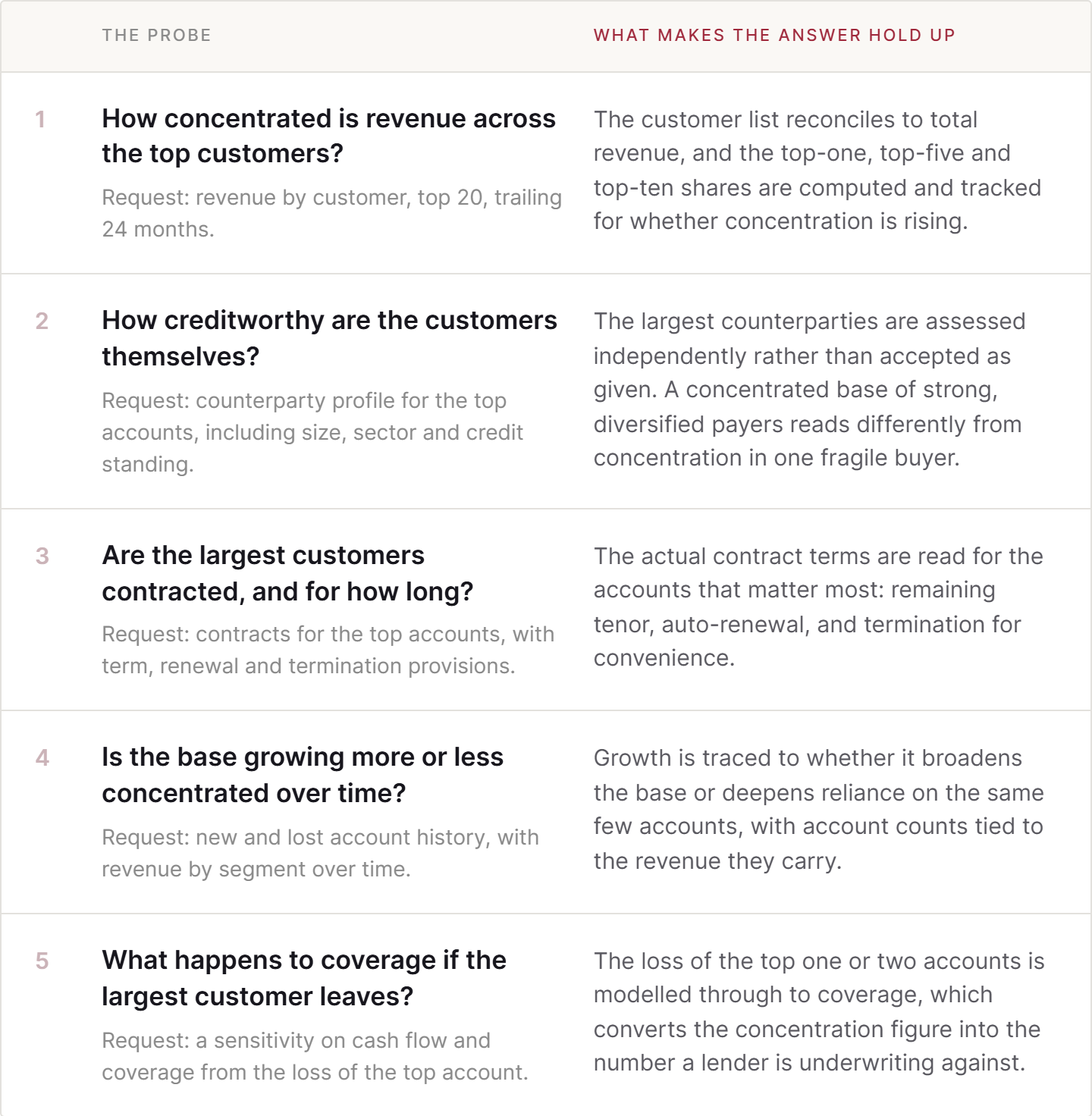
Probe one produces a reconciliation problem more often than a concentration problem. Revenue by customer frequently does not tie to reported revenue, because the same buyer appears under several legal entities, divisions or billing addresses. Consolidating those into one counterparty is the first thing a lender does, and it usually raises the top-account share above what the borrower reports. A parent company buying through four subsidiaries is one credit exposure.
Probe two is where the analysis moves outside the borrower’s own data. A lender assesses the top counterparties as credits in their own right, which for public or rated buyers is straightforward and for private ones means reading whatever is available: filings, payment history, days outstanding by account, and how the customer’s own sector is performing. Deteriorating payment behavior from a large account is an early indicator, and it is visible in the borrower’s aged receivable detail before it appears in revenue.
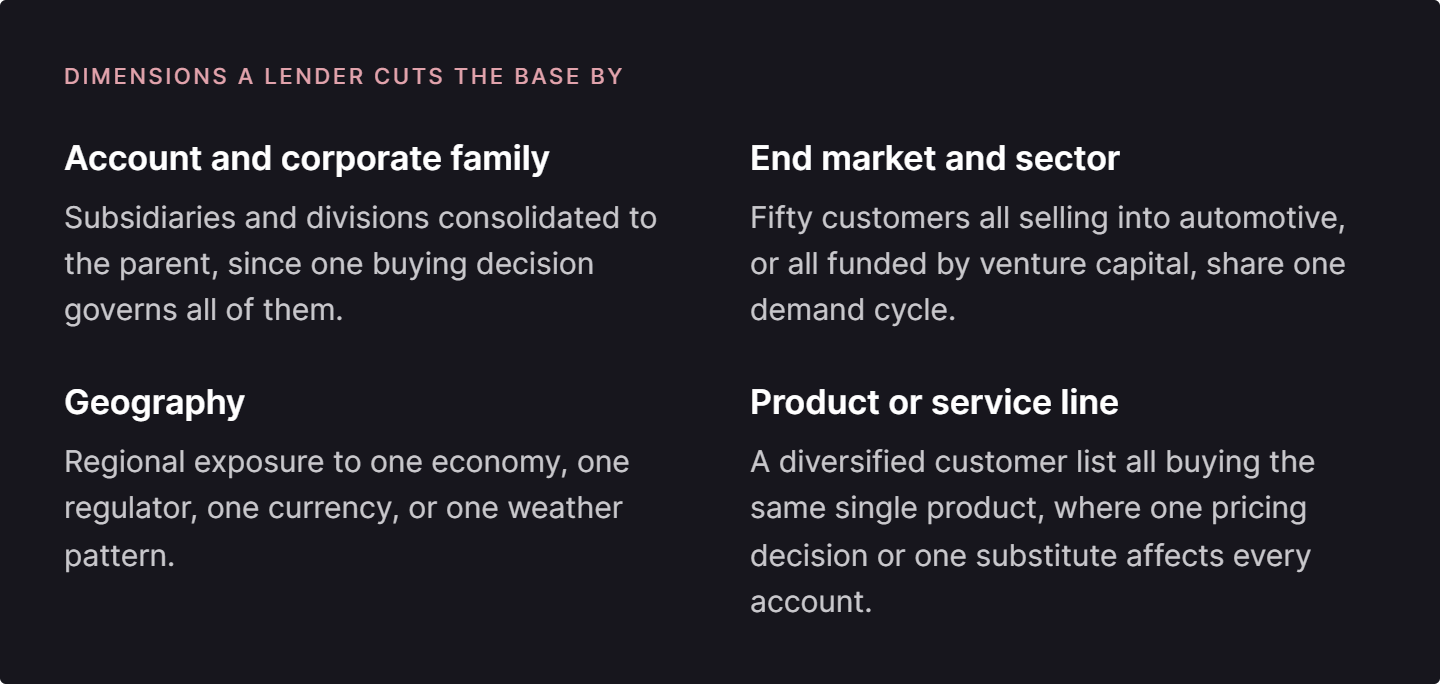
Concentration is not only about customers
A base can be well diversified by account and concentrated in ways the customer list does not show. A lender examines the same revenue along several dimensions, because correlated exposure across a hundred accounts behaves like a single position when the thing they have in common moves.
Probe four reads the direction across all of these. A borrower adding accounts while the top-five share rises is growing and concentrating at the same time, which happens when expansion within existing large customers outpaces new business. That combination is a common finding, and it changes what a lender expects the base to look like by the end of the loan term rather than at closing.
What the segment read produces
At the end of this block a lender has the single-name shock: what happens to cash flow and to coverage if the largest account goes away, and how long it would take to replace. That number is what the concentration figure was standing in for, and it is the form the finding takes when it moves into the rest of the analysis.
It carries into the structure directly. The contract read on the top accounts feeds the later work on how much pricing power those customers hold. The single-name sensitivity is run through the same coverage model that sizes the facility. Payment terms by account inform the working capital analysis, and where receivables are the collateral, counterparty quality determines what an advance rate can be.
A borrower can build the concentration table and the single-name sensitivity from their own billing data. What a specific lender will accept as sufficient diversification, how they will assess a private counterparty they do not know, and whether a concentrated base moves them from a cash flow structure to an asset-based one depends on their own exposure elsewhere and on what they have seen behave badly before.
Next in the series
Customer relationships: what holds a customer in place at renewal
Whether retention rests on contract, on switching cost, or on habit, and what a lender reads to tell the three apart.
You can build the concentration table and run the single-name sensitivity yourself. Reading how a particular lender will treat your largest counterparty, and whether concentration changes the structure they will offer, is the part I do at Synthase Capital Partners.