


Part of The Underwriter’s Read, a series on the critical questions a credit team works through before they lend.
The five situation questions established what the borrower is asking for and what balance sheet the request lands on. None of them described the business. Repayment comes out of the operations, so the next thing a credit team builds is a picture of how the business makes money, before any of it is quantified.
The tool I use for that is the Business Model Canvas, published by Alexander Osterwalder and Yves Pigneur in 2010. It was designed for founders and for the investors backing them: nine blocks that describe how a business creates and captures value, on one page. It was not built for lenders and it says nothing about debt.
Two properties make it useful for credit work. It covers the demand side, the delivery side, and both sides of the income statement, so nothing structural gets left out by accident. And it describes mechanics rather than prospects, which keeps it usable for a lender. Most credit analysis begins with the financial statements, which are the output of the model rather than the model itself. A lender forming a view on whether the cash flow continues needs a description of what produces it.
I keep the nine blocks as published and change the question asked of each one.
Nine blocks, two different questions
A borrower who has raised equity has answered the left column already. The right column is what a credit team works through, and for most businesses the two sets of answers come from different data.
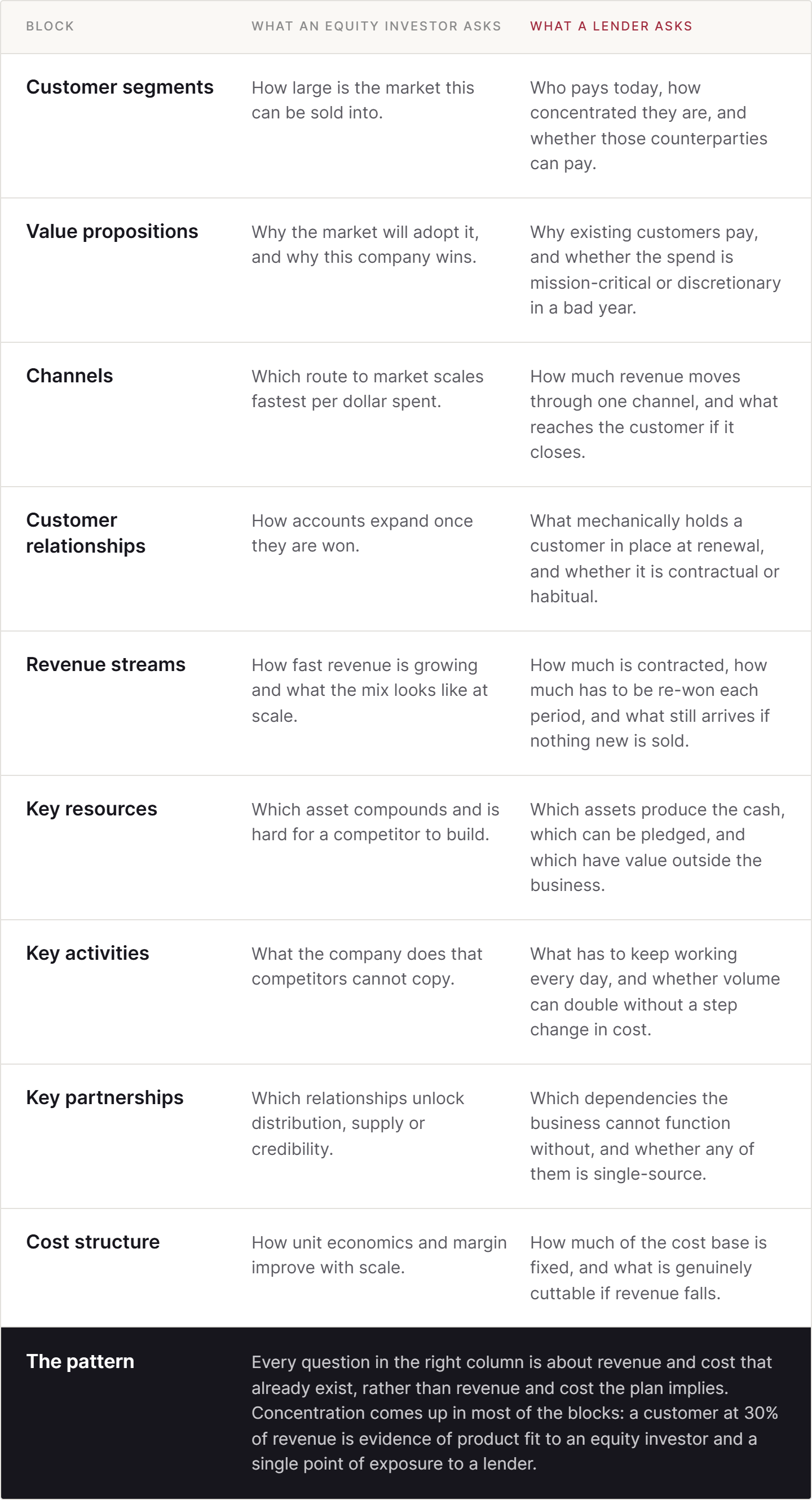
The value propositions block carries more weight than the other eight. Whether the product is mission-critical or discretionary determines what a lender expects to happen to revenue when a customer’s budget tightens, and most of the durability work later takes it as an input. Evidence for criticality is usually renewal behavior, contract length, or the customer’s own switching cost, not the sales narrative.
A credit team does not fill it in block order
The canvas is drawn as a nine-cell grid, which implies the blocks are equal and can be worked through in sequence. In credit work they are neither. A lender starts where the cash is, establishes why it recurs, and then works outward to the things that could interrupt it.
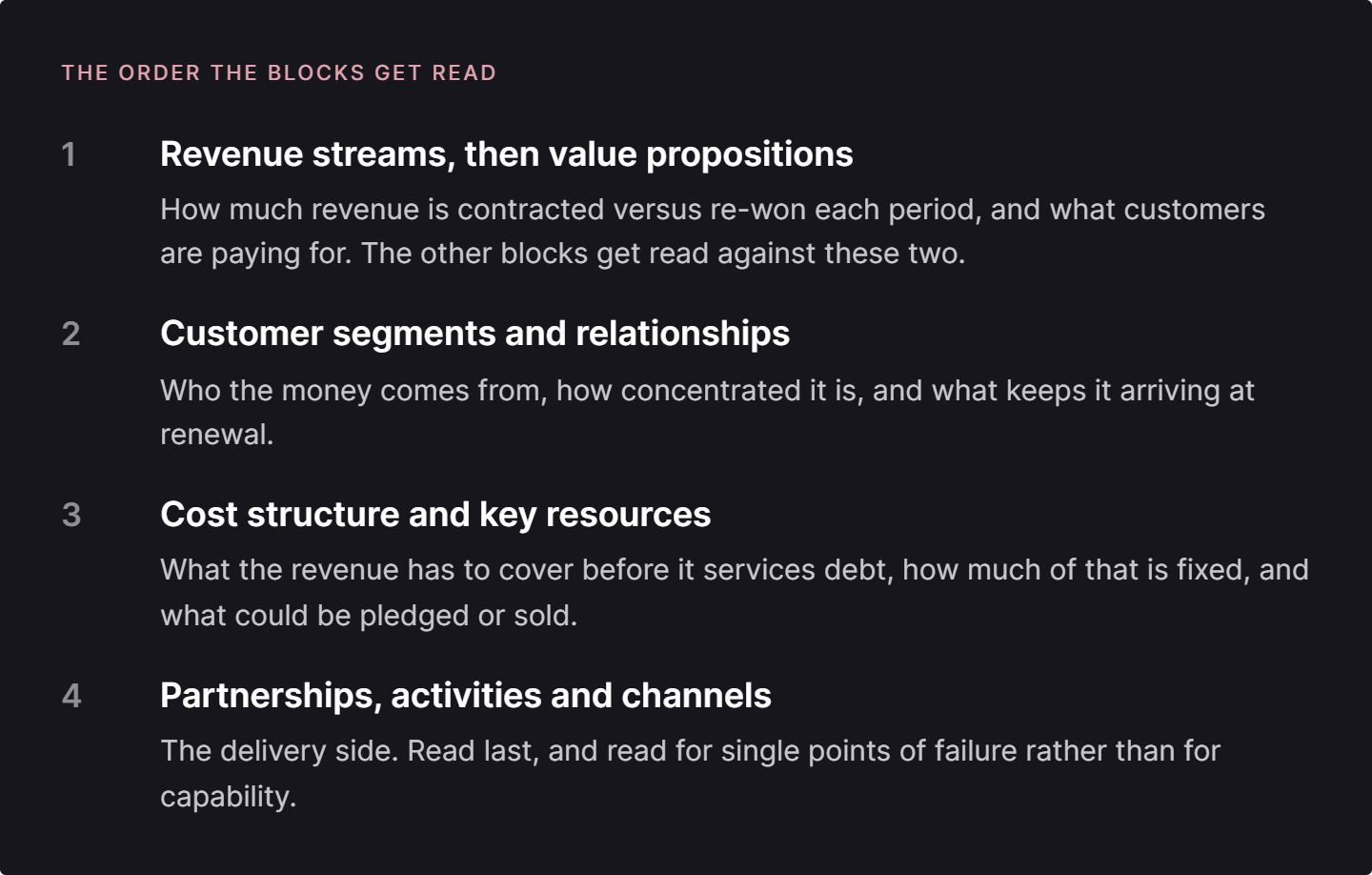
A borrower presenting the business will usually open with the value proposition and the market. A credit team starts from the revenue schedule and works back to whether the value proposition explains it. Where the two accounts do not reconcile, that gap goes on the diligence list.
What the layer does not settle
The canvas describes the model. It does not test whether the model holds up against competition, it does not quantify anything, and it says nothing about where a new lender would sit relative to the existing debt. Those are the three layers that follow, and each of them takes its inputs from these nine blocks.
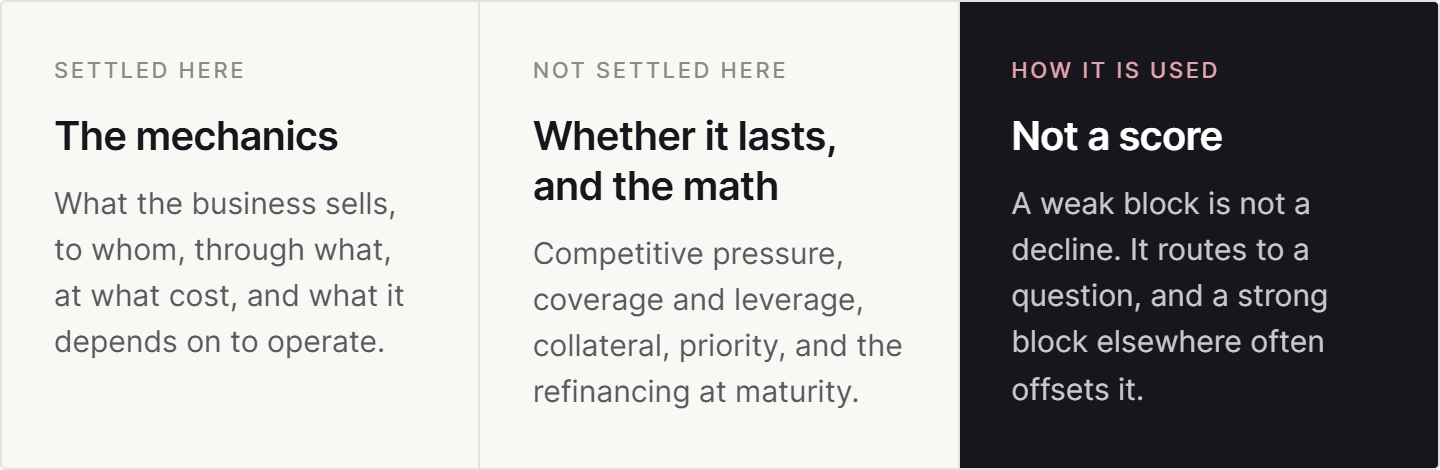
Blocks also offset each other. Single-channel distribution is a real dependency, and it matters less in a business whose revenue is contracted three years out than in one that re-wins its revenue every quarter. A lender reads the nine blocks together, which is why questions keep coming back to a block a borrower considers already answered.
Which version of the business to put in front of lenders
Most borrowers arriving at a debt process already have materials describing the model. Those materials were built for equity investors, and they answer the left column of the table above. The decision is whether to rebuild them.
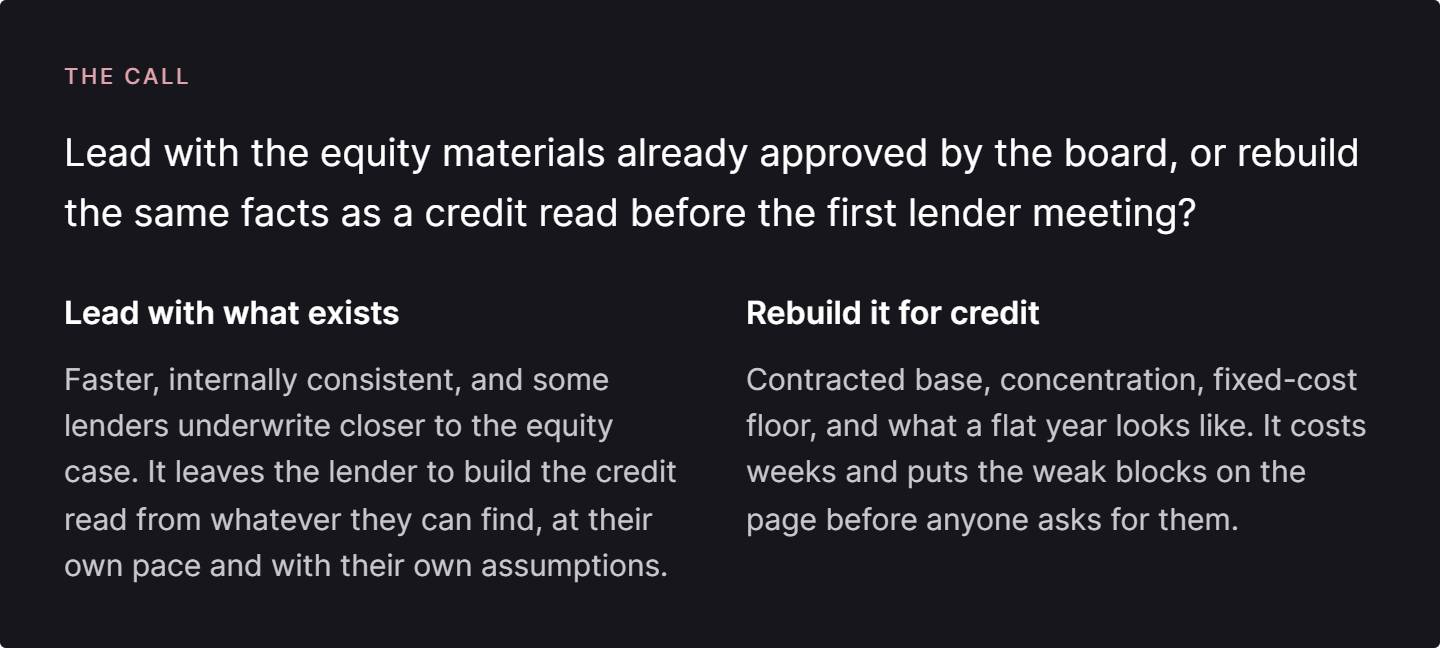
The determining facts sit outside the business: which lender types are in the process, whether any of them has lent into the sector recently enough to hold its own view of the model, how the numbers look under a lender’s assumptions rather than management’s, and how much time the timeline allows.
Next in the series
Revenue streams: what is contracted and what has to be re-won
The block a credit team reads first. How much of the revenue arrives under contract, how much has to be sold again each period, and what documents establish the difference.
You can fill in the nine blocks for your own business. Which blocks a particular lender will weight, and which weak block will cost you pricing, is the part I do at Synthase Capital Partners.