


Part of The Underwriter’s Read, a series on the critical questions a credit team works through before they lend.
Every loan has three possible sources of repayment: operating cash flow, refinancing, and an asset sale or support from the owners. The introduction to this layer set out why a lender tests each one. This component establishes whether each source is real, whether the three could fail together, and which one the loan actually relies on.
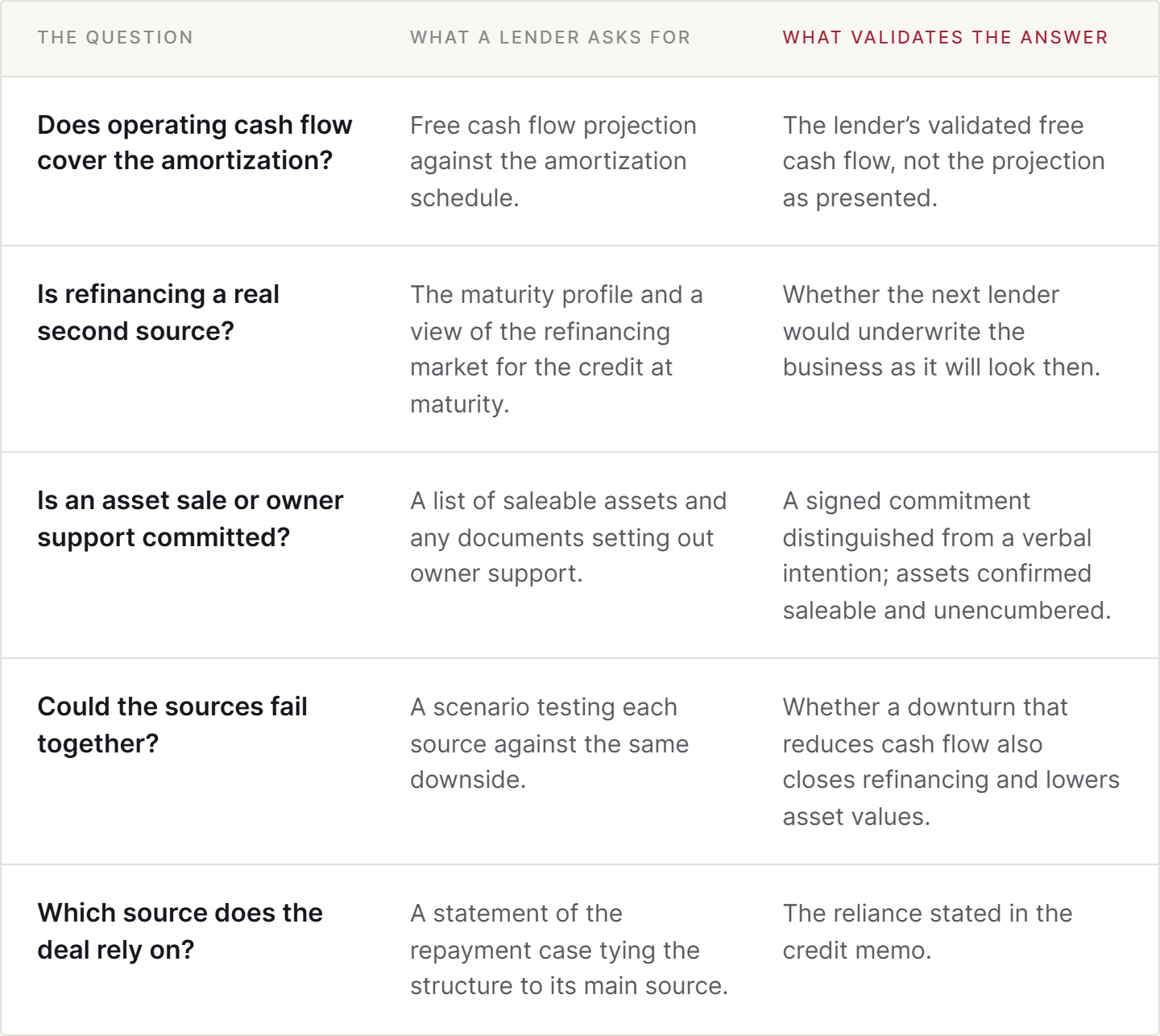
Five probes sit in this component. The first tests whether operating cash flow covers the amortization schedule. The second tests whether refinancing is a real second source. The third establishes whether an asset sale or owner support is committed or only assumed. The fourth tests whether the sources could fail together, and the fifth names the source the deal relies on.
Management’s projection usually shows the debt being paid down from the business’s own cash flow. A lender splits the facility into the part its own free cash flow repays before maturity and the part left outstanding at maturity. That lets the lender establish how much of the loan the borrower can repay from cash it generates, and how much depends on a future lender or a sale, instead of accepting management’s version of the repayment case.
The five probes, and what validates the answer
Operating cash flow
The first probe tests whether operating cash flow covers the amortization schedule. Operating cash flow is the only source fully under the borrower’s control. A lender compares the scheduled principal payments with the free cash flow it validated in the lesson on cash flow and coverage, not with the projection management presented. Any cash left after scheduled principal can repay more of the loan, if the documents require it and the owners do not distribute it.
An illustrative schedule
The schedule below continues the specialty distributor from the numbers layer. Its new senior facility is $33.0mm with a five-year term and $2.0mm of scheduled principal a year. Both columns assume all free cash flow after scheduled principal goes to repaying the facility, which is the assumption behind the leverage paths in the lesson on leverage.
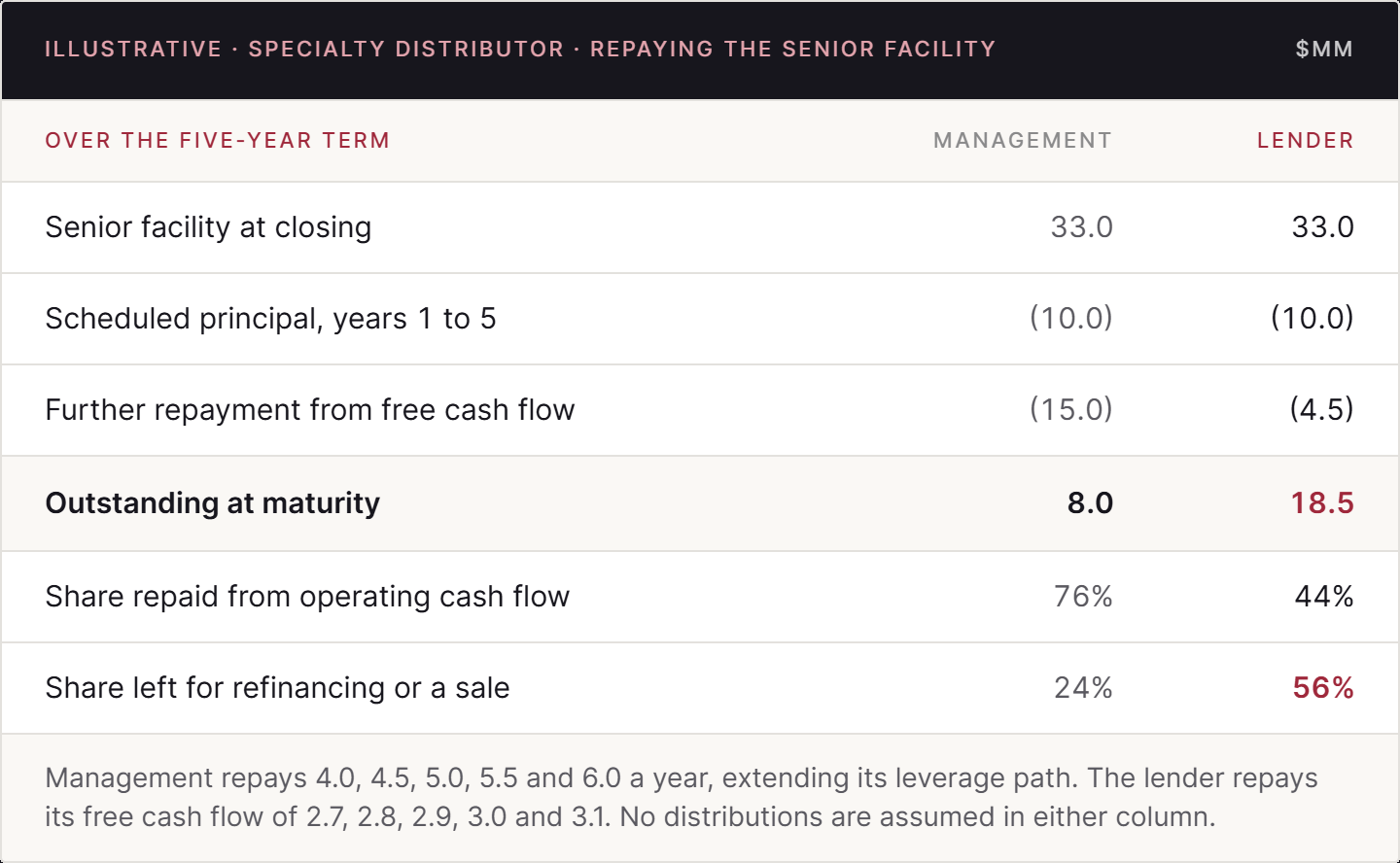
On the lender’s free cash flow, the borrower meets its scheduled principal every year and repays a further $4.5mm over the term. That leaves $18.5mm, or 56 percent of the facility, outstanding at maturity. Management’s projection leaves $8.0mm. In both cases the loan is not repaid in full from operating cash flow, and on the lender’s figures most of it is repaid by whatever comes after. The lesson on financial policy showed the owners taking distributions once leverage falls, and any distribution increases the amount outstanding at maturity.
Refinancing
The second probe tests whether refinancing is a real second source. Most debt is repaid by refinancing rather than amortization, so the $18.5mm in the lender’s column is expected to be repaid by a new lender at maturity. A lender asks for the maturity profile across the capital structure and forms a view of the refinancing market for this credit at that date. The test is whether the next lender would underwrite the business as it will look in five years, not whether today’s lender would. That work is the refinance horizon component, the last in this layer.
Asset sales and owner support
The third probe establishes whether the last source, an asset sale or support from the owners, is committed or assumed. A lender asks for a list of assets that could be sold and any documents that set out owner support, such as an equity commitment letter, a guarantee or a sponsor’s written undertaking to fund. A documented commitment that the lender can call on is different from an owner’s stated intention to support the business. For assets, a lender confirms that each one could be sold and is not already pledged to another creditor.
The distributor’s saleable assets are mainly receivables of $17.3mm and inventory of $17.3mm, both pledged to the senior facility. The founder and his family have not signed any commitment to put more equity into the business. The founder’s plan to sell the business within three to five years would repay the facility from the proceeds, but it is an intention and not a commitment.
Whether the sources fail together
The fourth probe tests whether the sources could fail at the same time. A lender maps each source against a single downside. If a downturn that reduces cash flow also closes the refinancing market and lowers the value of the assets, the borrower has one source of repayment rather than three.
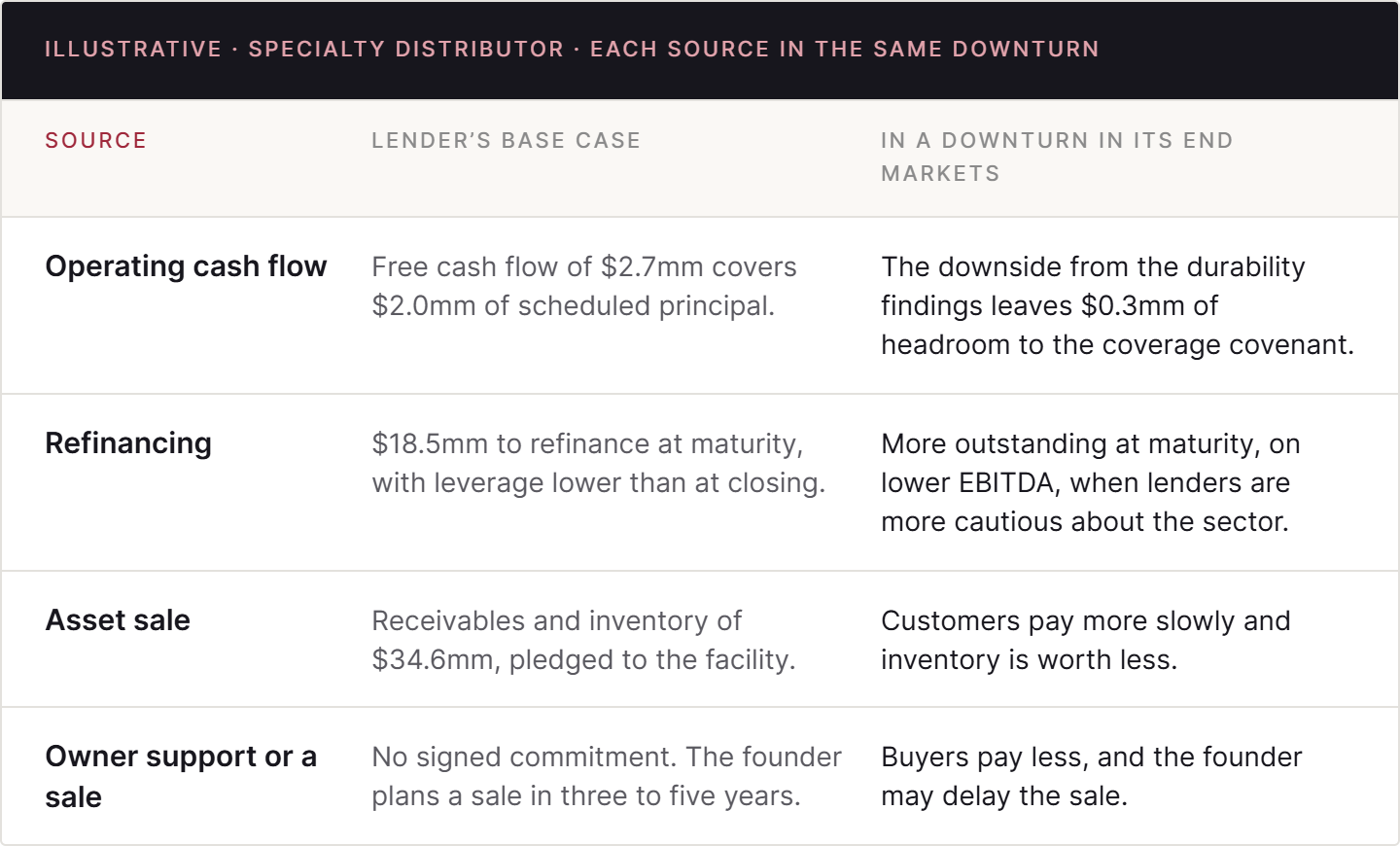
For the distributor, all four sources depend on demand in its end markets. The downturn that uses up the coverage headroom from the lesson on cash flow and coverage would also leave more of the facility outstanding at maturity, reduce what the inventory would sell for, and lower the price a buyer would pay for the business. The lender treats them as sources that are likely to weaken together, and gives more weight to where the loan ranks and what it would recover, which the next two components cover.
Which source the deal relies on
The fifth probe names the source the deal relies on. A lender writes a statement of the repayment case that ties the structure to its main source. For the distributor, on the lender’s figures, the case is scheduled amortization from operating cash flow followed by refinancing of $18.5mm at the end of year five. That makes the refinance horizon work central to the credit, and the lender states that reliance in the credit memo.
For a borrower that is consuming cash, operating cash flow is not yet a source of repayment. The lesson on the cash-consuming borrower replaced the three sources with four: cash on the balance sheet, the next equity raise, a sale of the company, and reaching breakeven. The same probes apply to each: whether it is committed, whether it fails in the same downside as the others, and which one the loan relies on.
What the sources of repayment read produces
At the end of this component a lender has five builds: amortization coverage on its own free cash flow, a refinancing assessment for the amount outstanding at maturity, confirmation of which asset sales and owner support are committed, a scenario testing all the sources against one downside, and a statement of the repayment case.
The analysis draws on the validated cash flow from the numbers layer and the ownership work from the situation layer. When cash flow is thin, more of the weight moves to claim priority and to downside and recovery. When the repayment case is refinancing, it moves to the refinance horizon.
A borrower can work out how much of its own facility its free cash flow repays before maturity. Which source a particular lender treats as the repayment case, and how much it will accept being left for refinancing, depend on the lender type and on how it has seen similar credits refinanced.
Next in the series
Claim priority: where the new loan ranks, which entities hold the assets, and where they sit
Liens, negative pledge terms, assets held by foreign subsidiaries, and intercreditor agreements.
You can work out how much of your facility your own cash flow repays. Knowing which source the lenders in your process will treat as the repayment case, and how much they will leave to refinancing, is the part I do at Synthase Capital Partners.