


Part of The Underwriter’s Read, a series on the critical questions a credit team works through before they lend.
The nine blocks describe the business as it operates now. A loan is serviced over a term and repaid or refinanced at the end of it, so a lender needs a view on which parts of that description are likely to still hold when the facility matures. This layer takes the blocks already read and asks how much pressure each one is under, and from where.
The tool for the external side is the five forces framework, published by Michael Porter in 1980: rivalry among existing competitors, the bargaining power of buyers, the bargaining power of suppliers, the threat of substitutes, and the threat of new entrants. It was written to explain why some industries earn better returns than others. A lender uses it for a narrower purpose. Each force is a mechanism by which cash flow currently available for debt service could be taken, and the questions are who would take it, how much, and how quickly.
Those five forces sit outside the business. A sixth component in this layer sits inside it: execution. The credit rests on a plan, the plan rests on a management team, and a plan that requires the operation to scale, integrate an acquisition or hold price through a cost increase depends on that team being able to do it. Execution is assessed the same way the external forces are, as something that could reduce the cash flow the projections assume.
Six components, and what each one tests
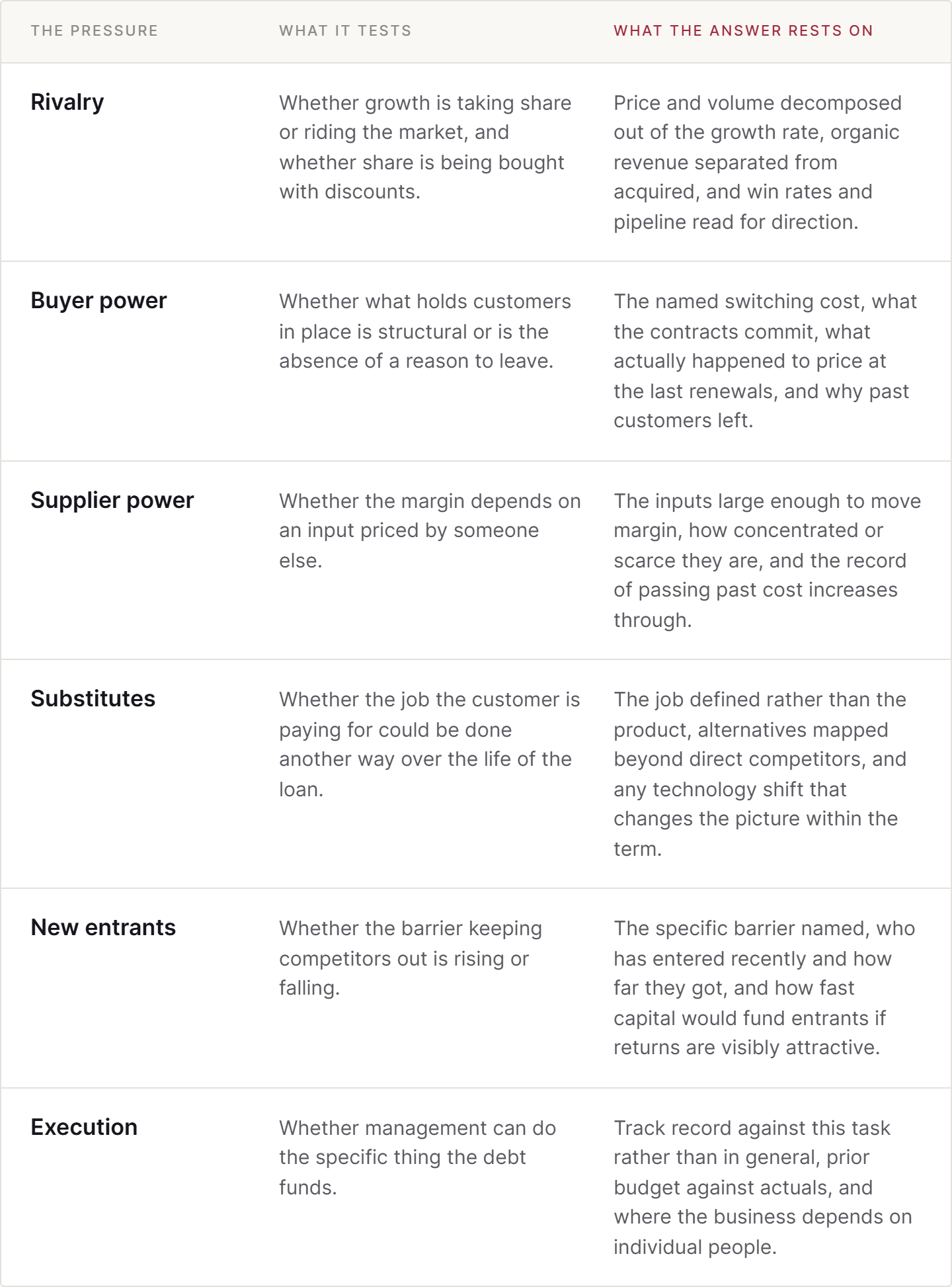
The six are weighted rather than equal. Rivalry and buyer power carry the full treatment for most borrowers, because they act directly on the revenue a lender is being repaid from. Supplier power, substitutes, new entrants and execution are read more lightly unless something in the model layer flagged them: a single-sourced input, a product the customer could build in-house, a sector with visible margins and low capital requirements, a management team that has not run a business at the size the plan describes.
The term sets how far the read has to hold
A revolver renewed annually and a five-year term loan do not carry the same durability question. The facility’s tenor sets how far out the read has to reach, and its amortization profile sets which years matter most. Where the loan amortizes, the early years carry more of the repayment and a decline late in the term is absorbed by a smaller balance. Where it is interest-only with the principal due at maturity, the full balance depends on the business being financeable at that date, and the durability work is carrying most of the credit.
This is also what separates the durability read from a general assessment of competitive position. A barrier to entry eroding over ten years is a strategic issue for the owner and not a credit issue on a three-year facility. A supplier contract expiring in eighteen months on the same facility is both. Each force is assessed against the term, not in the abstract.
Most of the facts are already on the table
This layer runs on the model work rather than on a fresh diligence list. Each component draws its inputs from blocks a credit team has already read, and adds a stress to them.
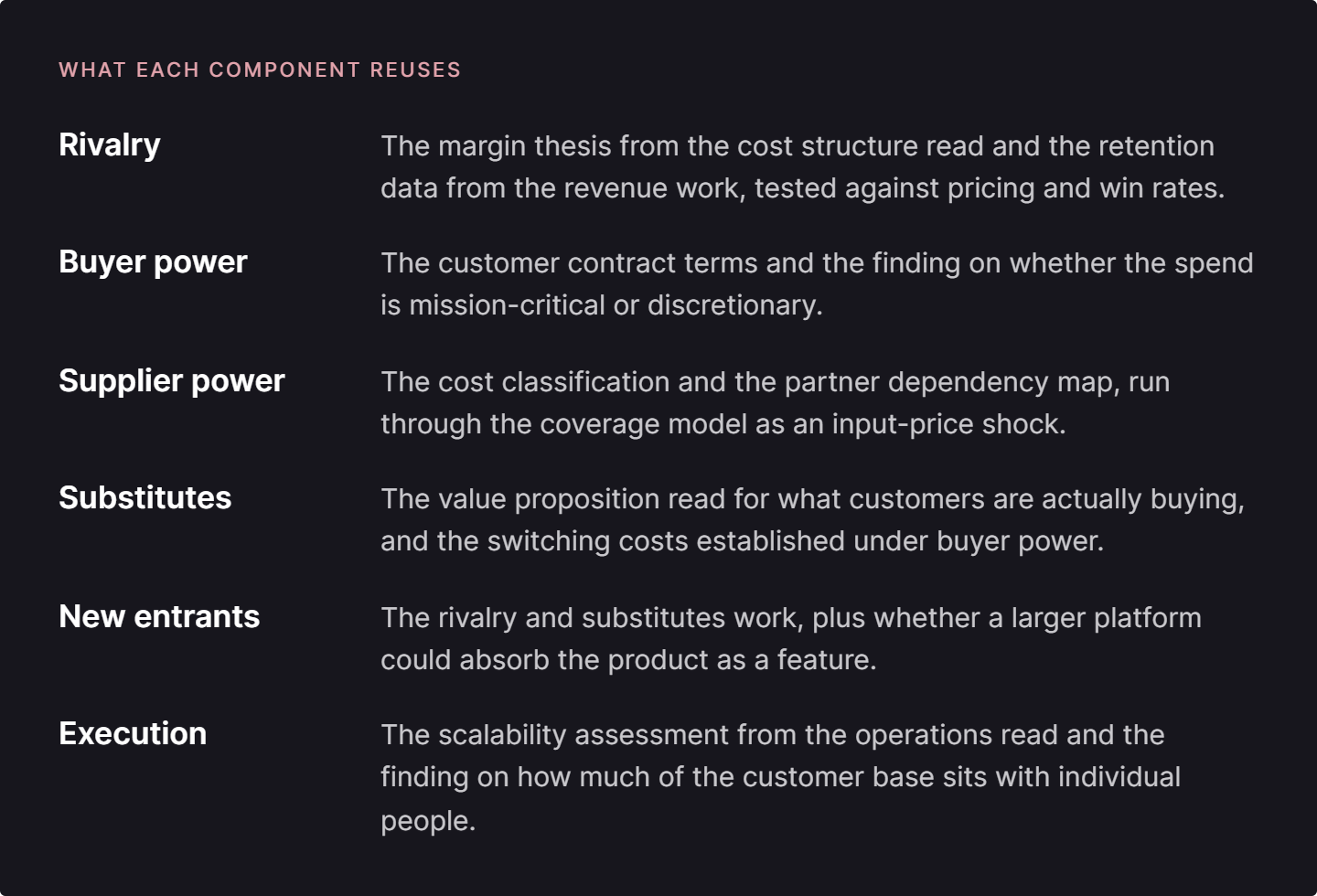
One consequence of that structure is that a weak answer in the model layer costs a borrower twice. The criticality finding is the clearest case: whether customers treat the spend as mission-critical or discretionary is the root input to both buyer power and substitutes, so a thin answer there weakens two durability components at once. That is why lenders return to a block a borrower considers settled.
What the layer produces
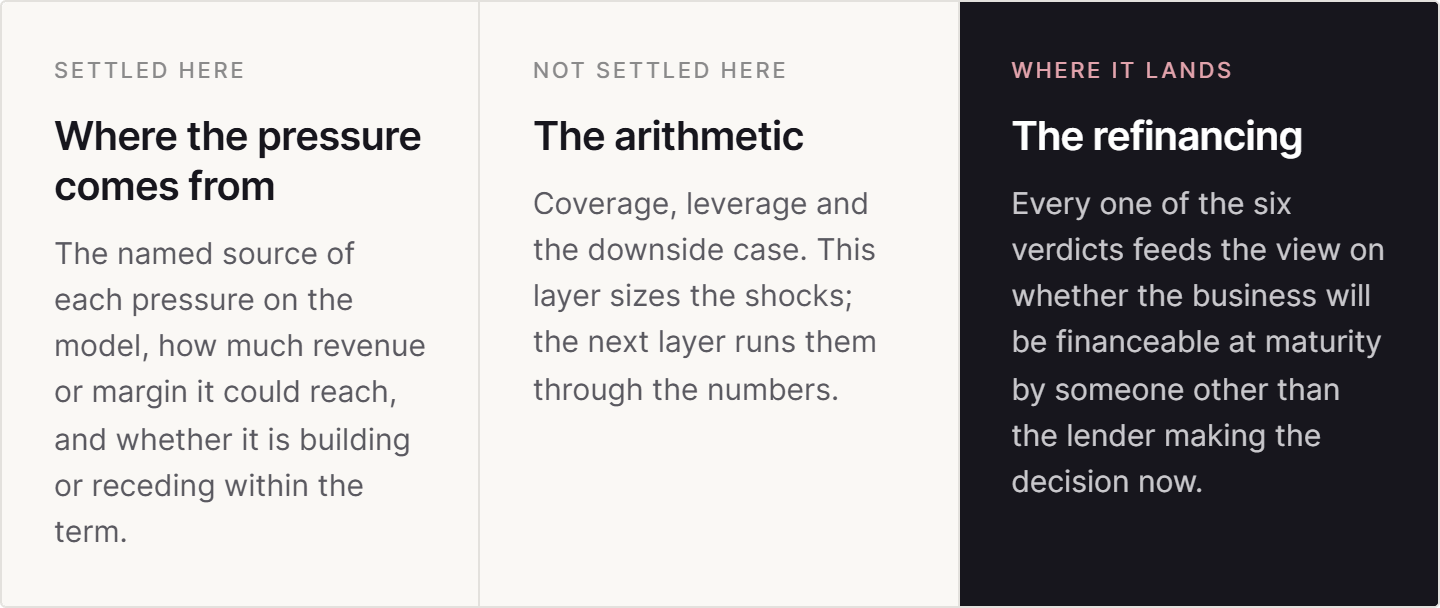
The downside case in the financial model is where this layer becomes a number. A twenty percent revenue decline is an assumption until something explains why it would happen, and the rivalry, buyer power and supplier power findings are what supply that explanation. Two borrowers can be stressed at the same revenue decline and have different probabilities attached to it, and the difference comes out of this layer rather than out of the statements.
How much term to ask for
Most borrowers know where their own durability answer is weakest before a lender finds it: a customer whose contract is at will, an input with one qualified supplier, a plan that requires the business to run at a scale the team has not run before. Because the tenor sets how far the read has to hold, the term requested is one of the few things a borrower controls that changes how heavily that weakness is examined.
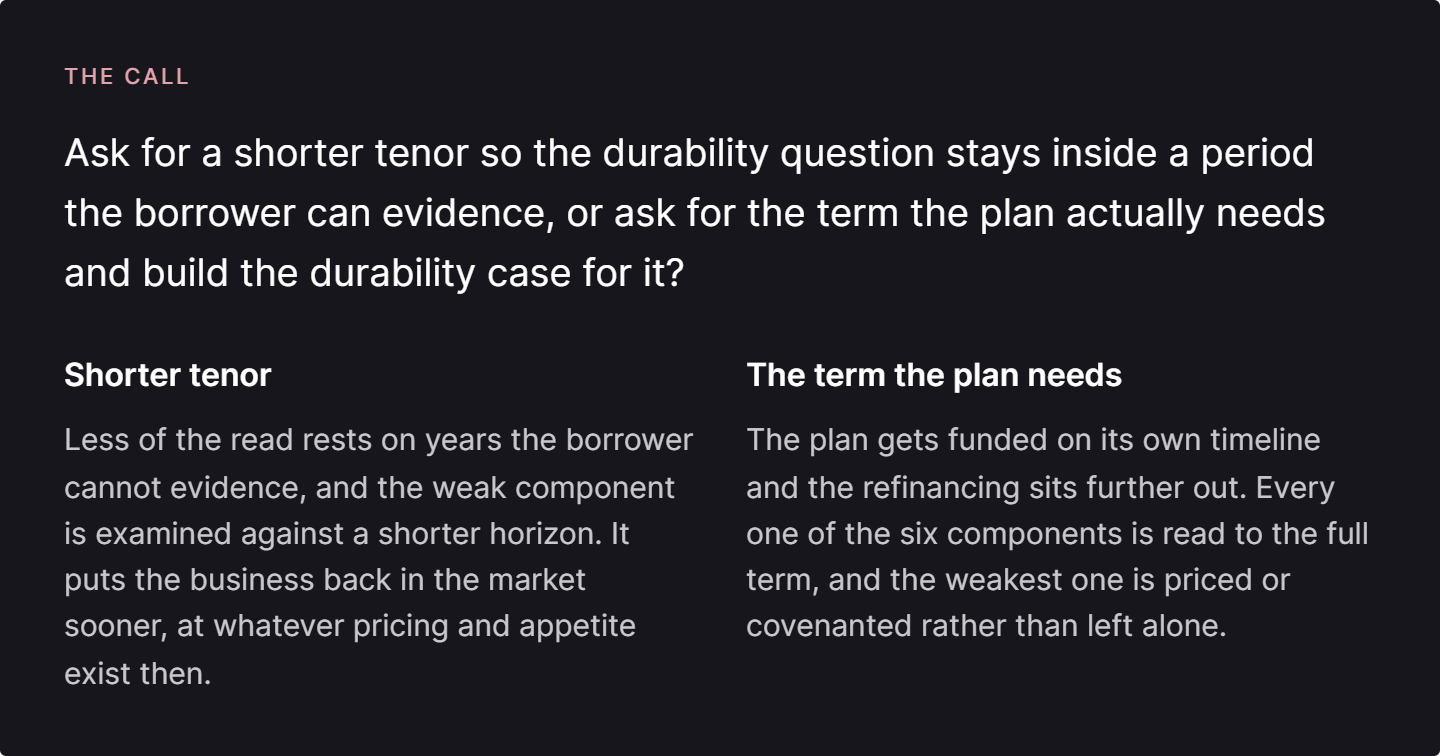
The determining facts sit outside the business: which lender types are in the process and what tenors they write, where pricing sits for each term at the time of the raise, whether any of them has lent into the sector recently enough to hold its own view of how durable it is, and what the existing maturities already force.
Next in the series
Rivalry: whether the growth is taking share or being bought with price
Separating share gains from discounting, organic revenue from acquired, and reading win rates and pipeline for the direction of travel.
You can name the pressure on your own model and the component where the answer is weakest. Which tenor to ask for, and how a particular lender will read that weakness against it, is the part I do at Synthase Capital Partners.