


Part of The Underwriter’s Read, a series on the critical questions a credit team works through before they lend.
The business model canvas does not define key activities on their own terms. It defines them as the things a company must do to make the rest of its model work, read off what it sells, who it sells to, and how the revenue is earned. So this block is a check on the ones already published. If the revenue is contracted, something has to deliver against the contract. If the value proposition rests on turnaround time or on a certification, something has to hold that. If the borrower depends on a partner it does not control, the activity that partner performs is one the borrower does not do.
Four probes sit in this block. The first draws the line between what the company does itself and what it buys. The second finds the capacity constraint that binds first as volume grows. The third tests how dependent the operation is on a specific process or system. The fourth runs the growth plan against what the operation can actually carry. They group together because each one narrows toward the same output: where the business stops being able to do more, and what it costs to move that point.
This is the block that tests whether the forecast volume can physically be produced. Management’s projection carries a revenue growth rate, and the capacity and utilization review says what the current operation runs at today. A lender reads the two together. Where the forecast requires output above the current ceiling, the plan has to name what relieves the constraint, and the cost of relieving it has to appear in the model before the revenue does. Where the constraint is relieved by capex, the spend lands in one period and the revenue arrives later, which is a coverage question in the intervening quarters. Where it is relieved by hiring, the cost is incremental but the lead time to productive headcount is not.
Three kinds of activity, three kinds of ceiling
The canvas sorts key activities into production, problem solving, and platform or network operation. The sort matters for credit because the constraint sits in a different place in each, and the cost of moving it is a different shape.
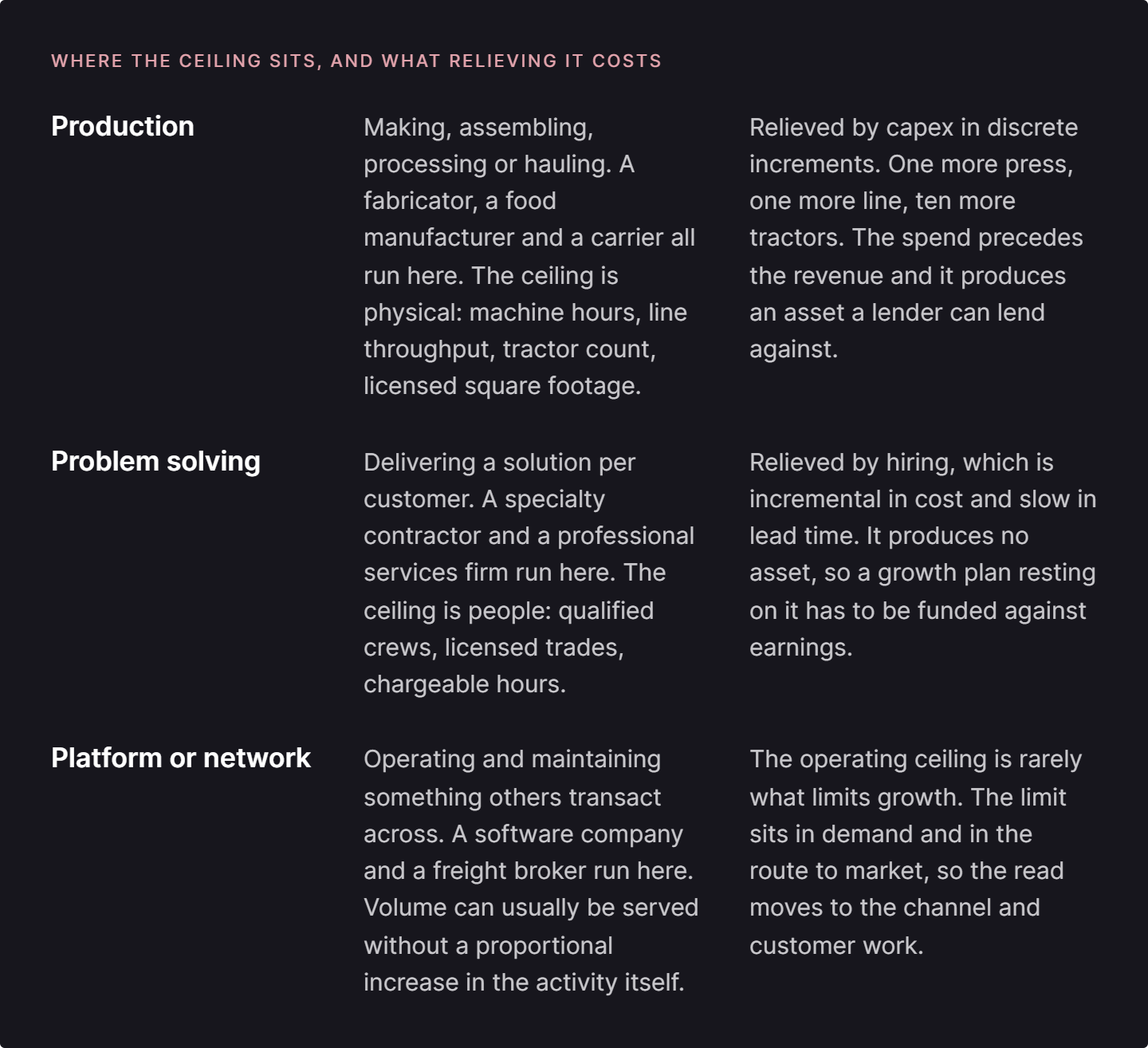
Most borrowers run more than one. A food manufacturer producing its own branded line and also co-packing to customer specification is doing production in both cases, but the second carries a problem-solving activity alongside it in qualification and changeover work. A software company that installs and configures for each customer has a problem-solving activity attached to a platform, and the installation capacity is the constraint rather than the software. The first probe exists to establish which activities are actually present before the second one looks for the bottleneck.
The four probes, and what validates the answer
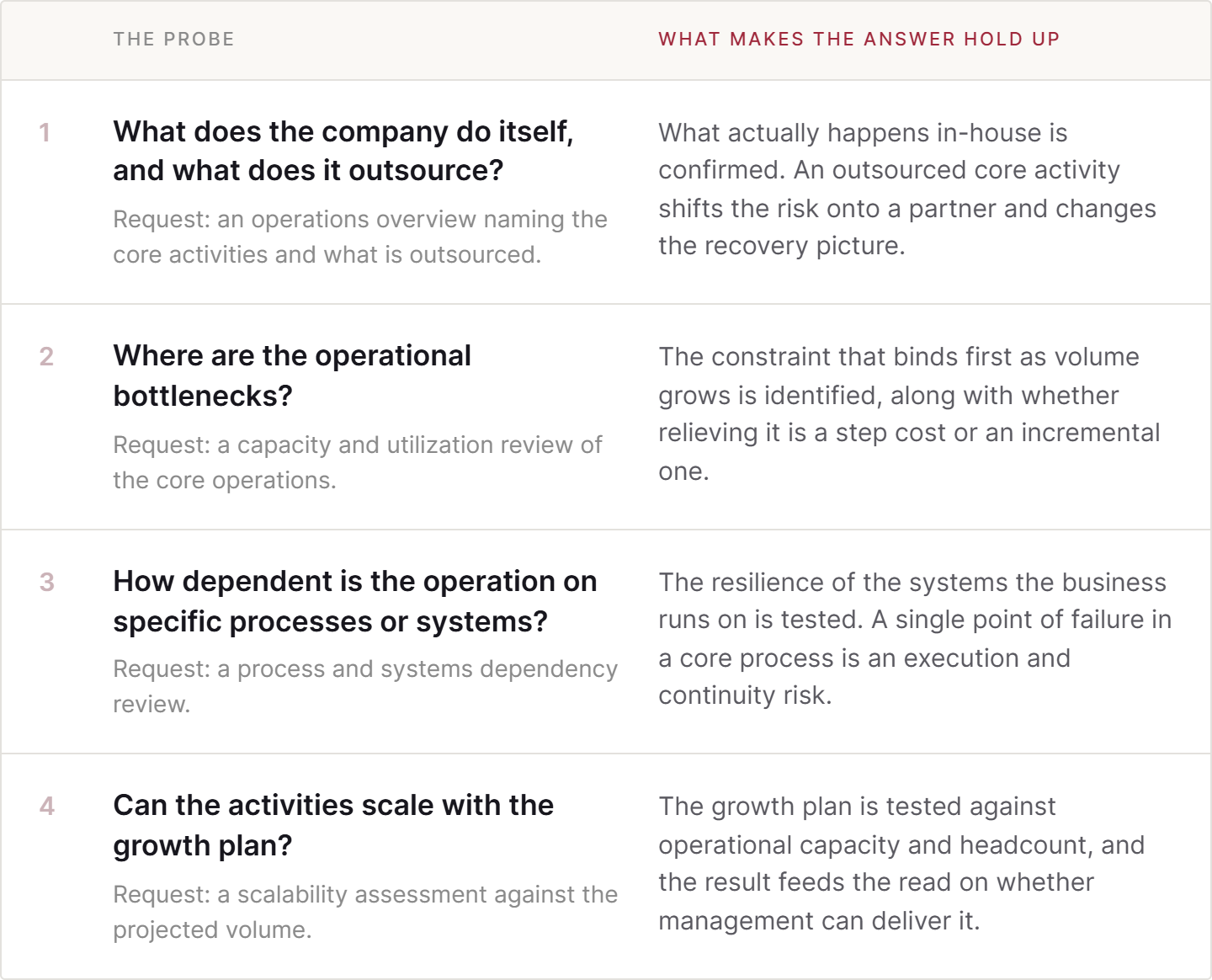
The second probe produces the number the rest of the block turns on: current utilization against available capacity. A fabricator running one shift has headroom that costs wages to access. A fabricator running three shifts has none, and its next unit of volume requires a machine. The same revenue growth rate in a forecast means something different for each, and the difference is not visible in the financial statements.
The make-or-buy line and what it moves
The first probe has a consequence past describing the operation. An activity performed in-house is a cost the borrower controls, an asset base a lender can reach, and a capacity it can expand on its own decision. The same activity bought from a partner is a cost set by someone else, no collateral, and capacity subject to an agreement.
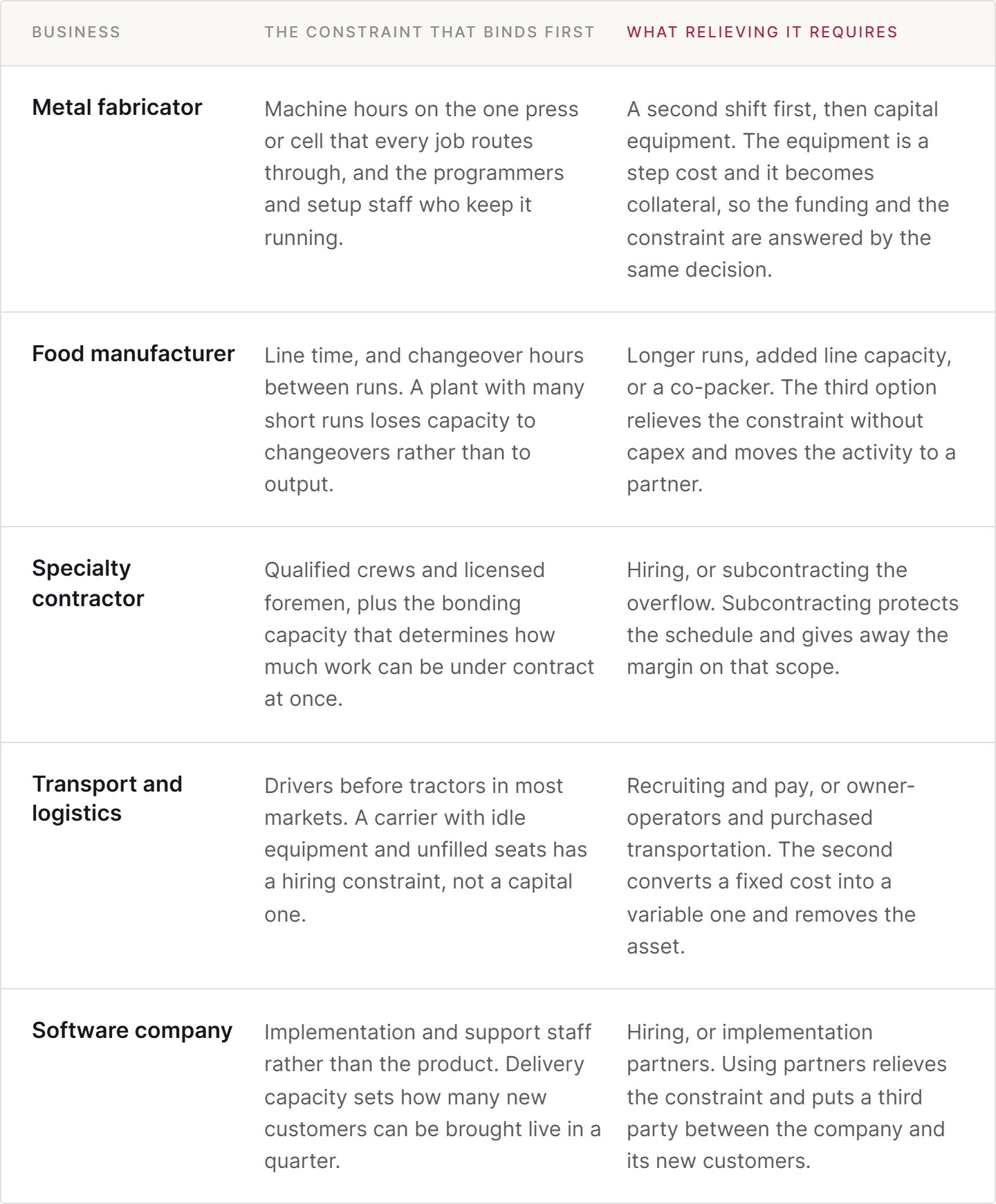
In four of those five the fastest relief moves the activity outside the company. That is usually the right operating decision and it has a credit consequence: the capacity is now governed by an agreement, and the dependency work applies to it. A borrower that grows by outsourcing has a growth plan resting on partner terms rather than on its own assets.
The activity mix also determines where the working capital sits, which matters because the facility is often sized against it. A production business holds inventory and work in progress, and a lender advancing against inventory is lending against the activity. A problem-solving business holds unbilled work and receivables instead, and how quickly work in progress converts to an invoice is a term of the customer contract rather than a function of the operation. A platform business holds little of either. Two borrowers with the same revenue and the same margin can have different working capital cycles because they do different things, and the borrowing base follows the activity.
The third probe covers the case where the constraint is neither capacity nor people. A single instance of an unsupported system that runs scheduling, pricing or dispatch, one person who holds the process knowledge, a certification held by a single facility. These do not limit growth in the ordinary course. They stop the operation when they fail, and the questions are how long a recovery takes and whether anyone has tested it.
Running the plan against the operation
The fourth probe takes the first three and applies them to the projection. The constraint is named, the utilization level it binds at is measured, and the relief cost and lead time are priced. The scalability assessment sets the forecast volume against those, period by period, and establishes whether the operation as it exists can produce what the plan says it will sell.
Three outcomes come out of that. The plan stays inside the current capacity, in which case the growth is fundable without the operation changing. The plan requires relief that management has already identified and costed, and the question becomes whether the spend and the lead time are in the model in the right periods. Or the plan requires output above the ceiling with nothing in the projection that relieves it, and the revenue line is describing a volume the operation cannot produce.
Headcount is assessed the same way as capacity here, because for a problem-solving business it is the capacity. A plan that requires forty percent more billable crews carries a hiring schedule, a ramp period before new hires are productive, and an assumption about the labor market. The scalability assessment is where those get stated as requirements of the plan rather than left as an implication of the revenue line.
What the key activities read produces
At the end of this block a lender has the named constraint, the utilization level it binds at, and the cost and lead time of relieving it. Set against the forecast volume, that gives the quarter in which the current operation runs out and what the plan requires before then.
That output is reused in three places. It feeds the execution read, which asks whether this management team can deliver the plan they have presented. Step costs identified here revise the cost structure work, because a fixed-cost floor that rises at a known volume is a different floor than a flat one. And an outsourced core activity routes into the partner dependency work.
A borrower can produce the operations overview, measure its own utilization, and price what relief costs. How much of the operating headroom a particular lender requires before it will fund growth, whether it treats an outsourced core activity as prudent or as a weakness in the collateral, and how much it discounts a plan that depends on hiring into a tight labor market depends on what they have funded before.
Next in the series
Channels: the route to market, and who sits between the borrower and the cash
Reading the channel mix, and establishing who holds the customer relationship when a third party sits in the middle.
You can measure your own utilization and price what relieving the constraint costs. Reading how much operating headroom a particular lender wants to see before it funds the growth, and which structure that points to, is the part I do at Synthase Capital Partners.