


Part of The Underwriter’s Read, a series on the critical questions a credit team works through before they lend.
This is the last of the five situation questions. The first four covered the request itself and the balance sheet it lands on. This one covers the owners, and it works differently from the others. A lender is not underwriting the shareholders. They are establishing the composition of the ownership and the financial capacity of the owners: whether anyone with an equity stake could support the business if performance does not trend to plan, and whether any of them would fund a refinancing or repayment of debt that sits senior to their own position.
Three items come out of it.
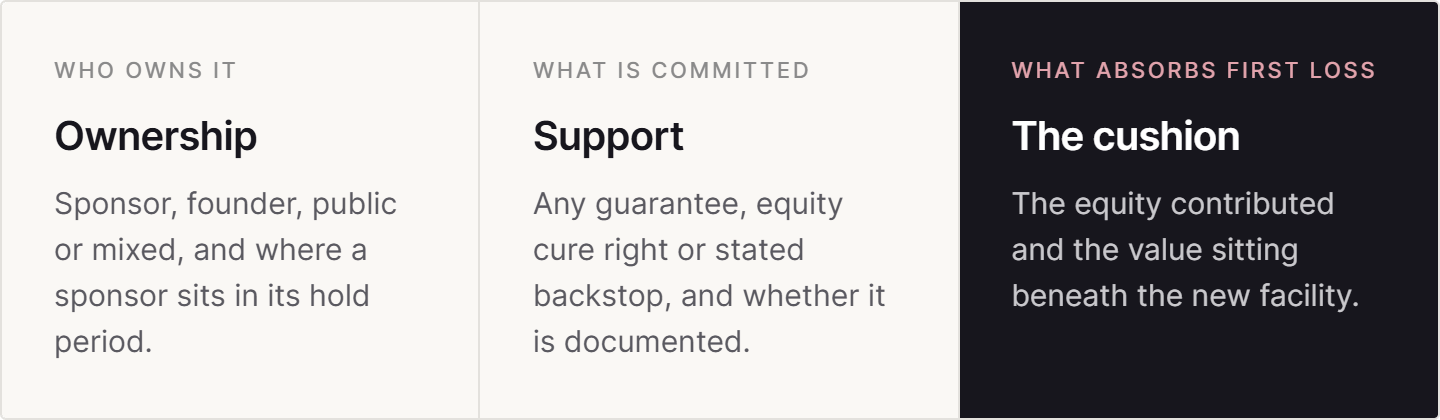
Ownership composition and the capacity behind it
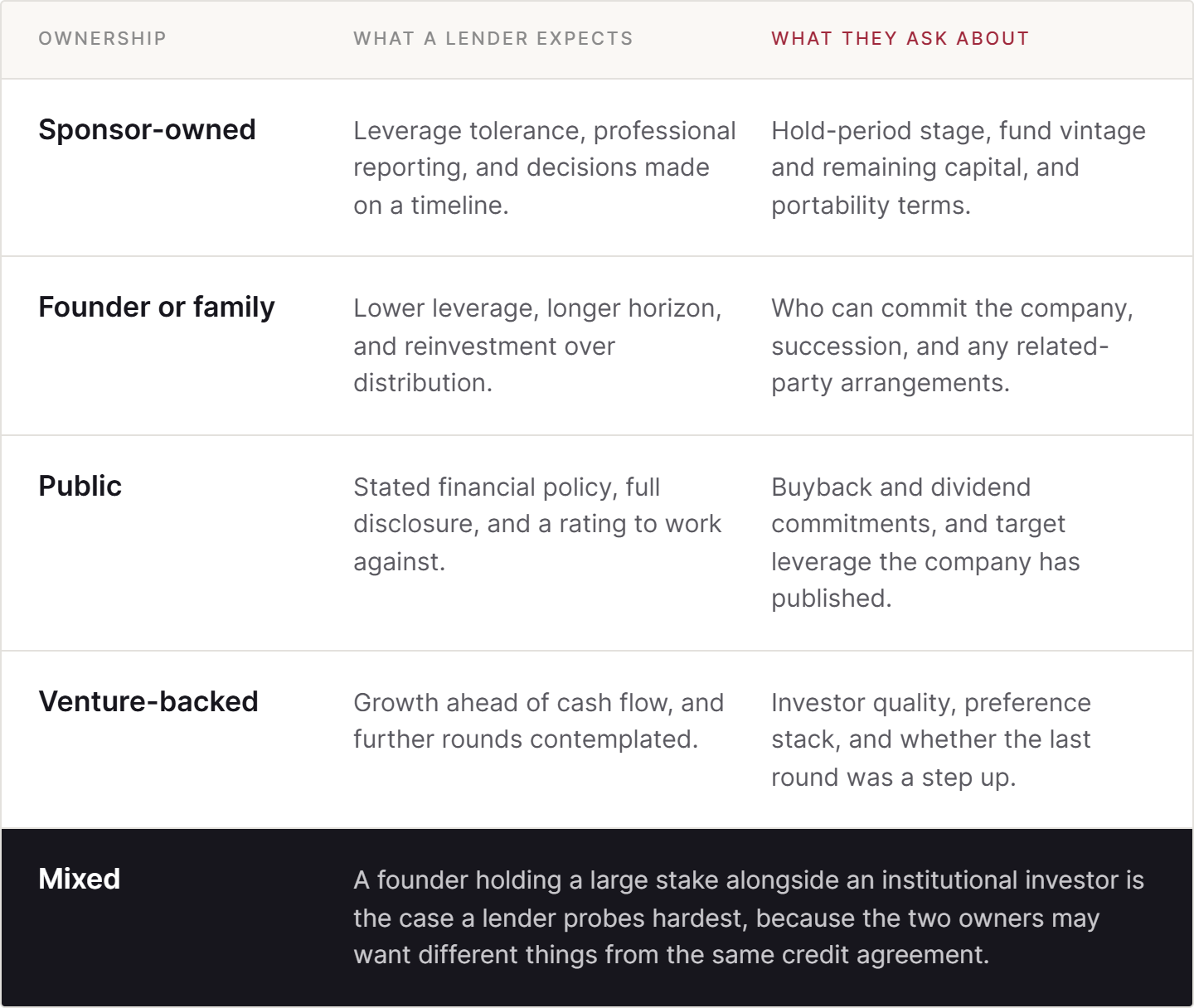
A lender reads the cap table to establish who could put more capital into the business, and how much. Two facts do the work: the composition of the ownership, and the financial capacity of each owner relative to the size of the facility. An owner with no capacity to contribute is not a source of support regardless of intent, and an owner with substantial capacity is relevant whether or not they have committed anything.
There is a second reason a lender works through this. Equity sits behind every lender in the order of payment, which gives the owners a direct interest in protecting their position. An owner with capacity has a reason to fund a refinancing or a repayment of senior debt rather than see the business default on it. That is not a commitment a lender can rely on, but it is a factor in how they assess the credit, and it is the reason the identity and capacity of the owners are established at intake rather than late in diligence.
Capacity looks different by owner type. A sponsor’s capacity is a function of fund vintage, undrawn capital and whatever has been reserved for follow-on investment. A founder’s or family’s capacity is personal, often concentrated in the business itself, and a lender will want to know what liquidity exists outside it. A venture syndicate’s capacity depends on reserves and on whether the insiders would lead a further round. A public company’s capacity is the equity market rather than a named owner.
Support counts when it is documented
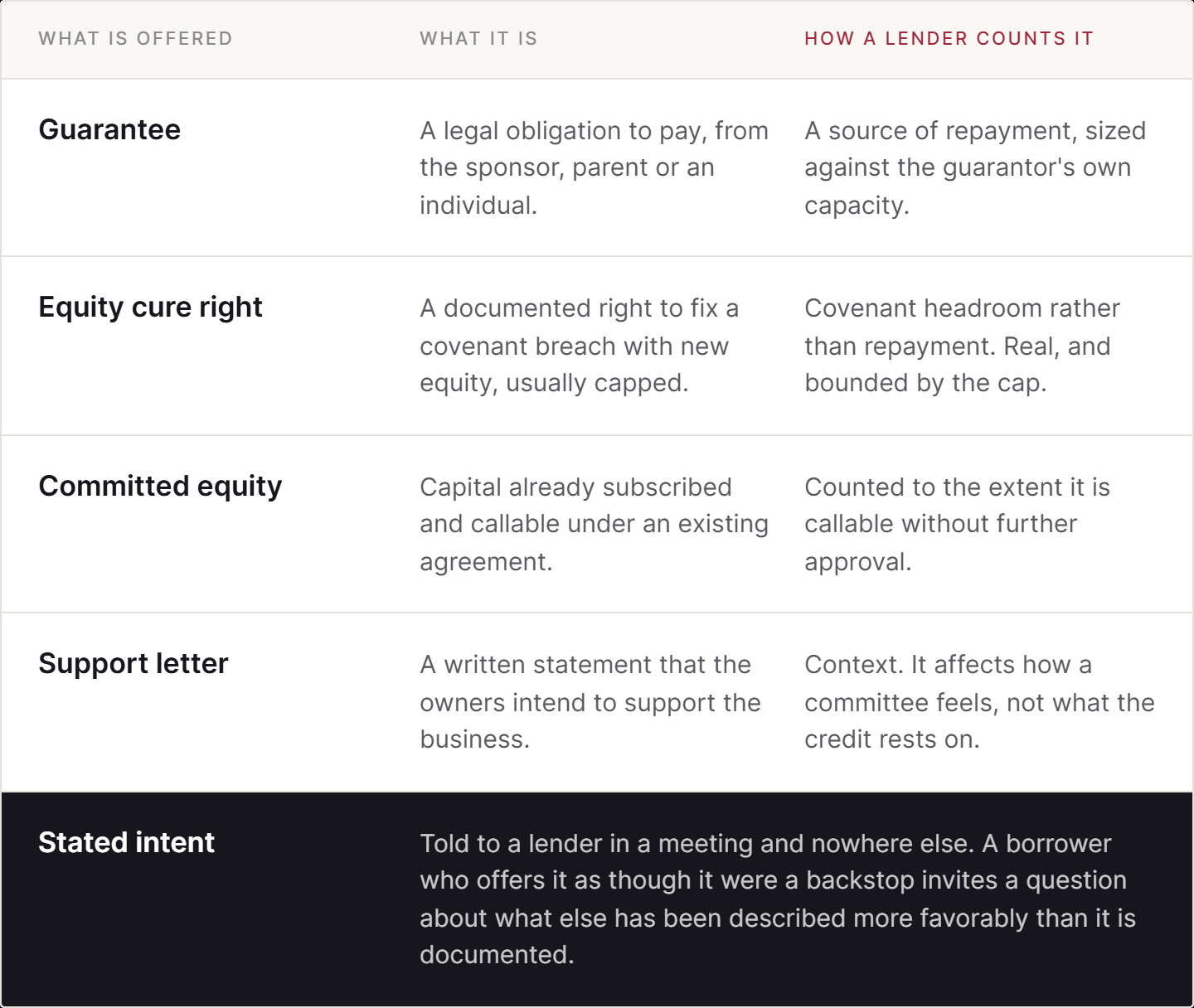
Borrowers frequently tell lenders that their sponsor or their owners would put more money in if it were needed. That statement is often true. It is also, as offered, worth nothing to the credit, because a lender cannot enforce an intention.
The distinction a credit team draws is between support that is documented and callable and support that is stated. A guarantee is a legal obligation and can be sized as a source of repayment. An equity cure right lets the owners fix a covenant breach by contributing capital, and it is written into the credit agreement with a cap and a limit on how often it can be used. A support letter is a statement of intent, and most credit committees treat it as context rather than credit.
Sponsors are usually reluctant to give guarantees, and that reluctance is not a signal about the business. Fund documents often restrict them, and a sponsor providing a guarantee on one portfolio company creates expectations across the rest. The equity cure is the common middle position, which is why it appears in most sponsor-backed credit agreements.
The equity cushion beneath the debt
The third item is arithmetic rather than judgement. Equity absorbs loss before any lender does, so a lender wants to know how much value sits beneath their exposure and what it is based on.
In an acquisition financing this is straightforward: the sponsor is contributing a stated amount of equity against a stated purchase price, and the cushion is the difference between the two. In a business that has been held for years, the cushion is an estimate, and the estimate depends on a valuation the lender will form independently. A borrower quoting the valuation from their last equity round as the cushion is quoting a number set under different conditions, by parties with a different interest in the answer.
What matters to the lender is how much of that value would survive a downside. Cushion supported by contracted revenue and hard assets holds up in a stress case. Cushion supported by a growth multiple compresses at exactly the moment it would be needed, which is why lenders discount it heavily rather than take it at face value.
When support would improve the terms
The decision in this layer is one a borrower faces with their own owners rather than with a lender, and it comes up whenever a lender indicates that documented support would change what they can offer.
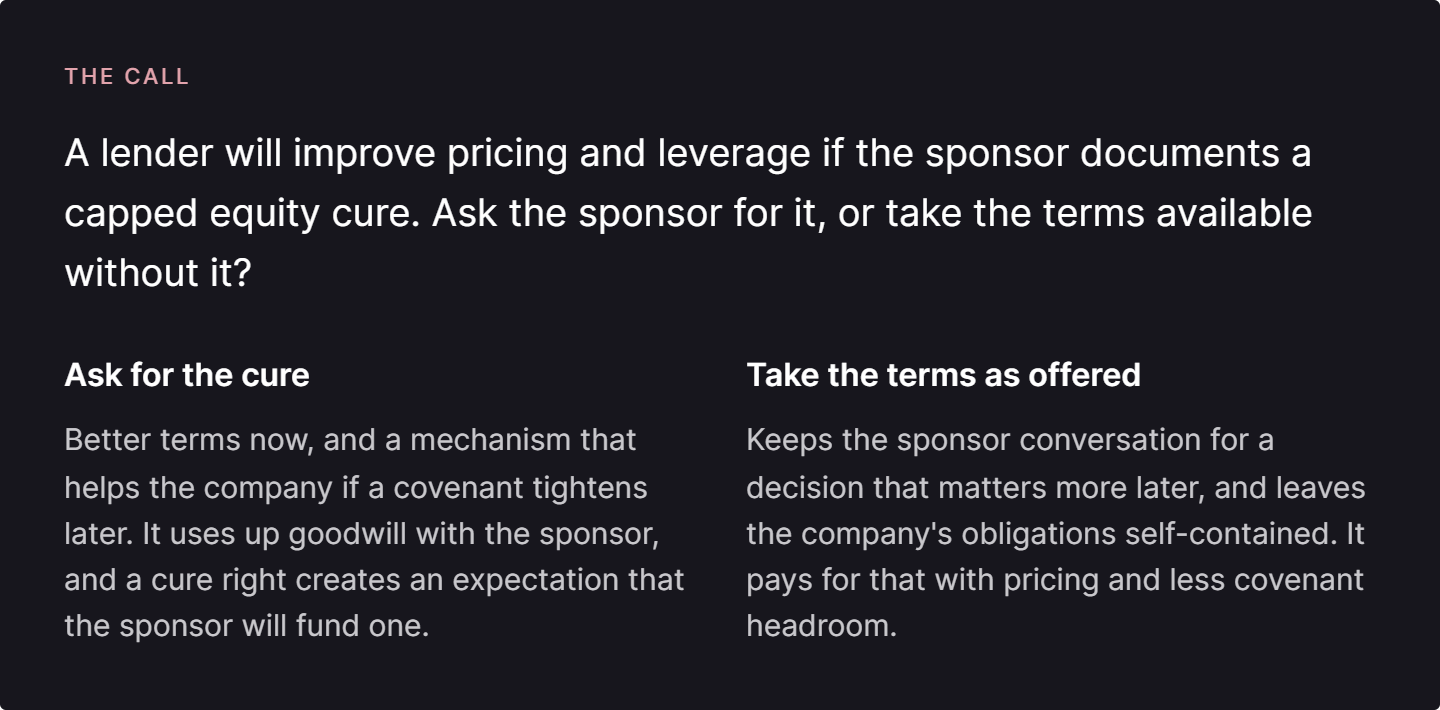
What decides it is how much the terms actually improve, whether the sponsor has provided cures elsewhere in the portfolio, how tight the covenant looks against the plan, and whether the same request is likely to be needed for a larger purpose in the next year. Those are facts about the sponsor and about what other lenders in the market are asking for.
That completes the situation layer. Five questions, and none of them about the business itself. What the money is for, what the borrower is asking for, what is already on the balance sheet, why now and by when, and who is behind it. A credit team establishes all five before they look at how the company makes money, because the answers determine which lenders can participate and what structure is available. The next layer is where the underwriting proper begins.
Next in the series
The model layer: how the business makes money
Nine questions about the operating business, read for credit rather than for growth. The first one is the revenue itself: what is contracted, and what has to be re-won each period.
Knowing what your owners have committed on paper is work you can do. Knowing what a lender will actually give you for it, and what to ask your sponsor for, is the part I do at Synthase Capital Partners.