


Part of The Underwriter’s Read, a series on the critical questions a credit team works through before they lend.
Porter’s fifth force is the threat of entry. New entrants bring capacity and a need to win share, which puts pressure on prices, costs and the investment incumbents need to make to compete. Porter’s point is that the threat of entry, rather than entry itself, is what limits an industry’s profitability. Where entry is easy, incumbents have to hold prices low enough, or invest enough, to deter it. The threat depends on two things: the barriers to entry, and the reaction an entrant can expect from the companies already in the market.
This lesson reads the borrower’s market against Porter’s barriers and his conditions for retaliation, then uses four probes to test the finding: which barrier actually protects the borrower, whether it is rising or falling, whether a company in an adjacent market could enter using what it already has, and how quickly capital would fund new entrants if the market’s returns are visibly attractive.
Management’s plan usually holds the current margin, and sometimes expands it. Where barriers are low and the borrower’s margins are above what an entrant would need to earn, Porter’s framework says new capacity will arrive and bring prices down, and a plan that holds margin is assuming no one enters. The new entrants read lets a lender set the margin assumption in the downside case from the height of the barriers and the record of recent entry, rather than from the borrower’s current margin.
The barriers to entry
Porter identified seven sources of barriers to entry. Each is an advantage incumbents hold that an entrant would have to overcome or pay for.
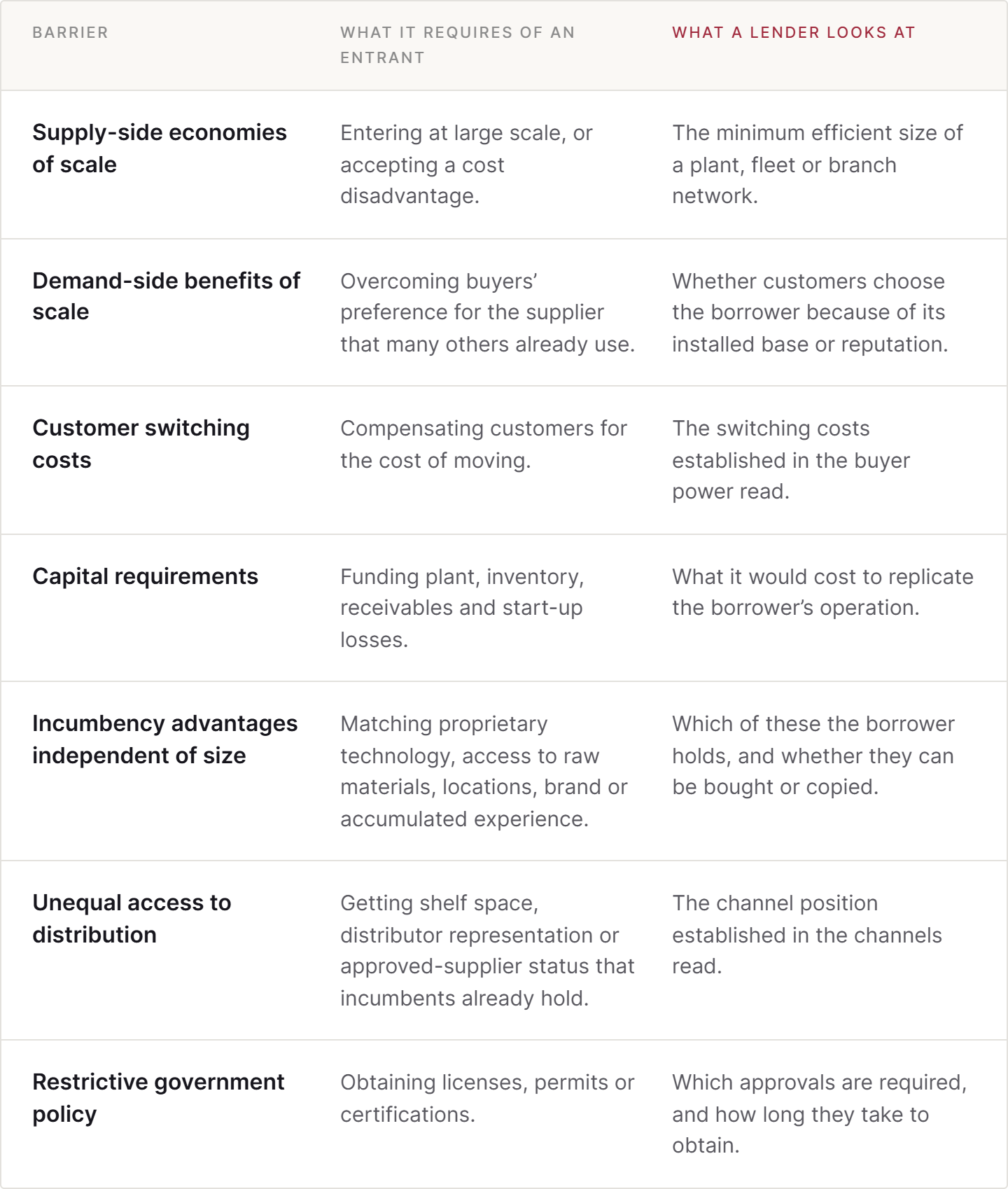
Several of these carry over from earlier work. Switching costs were established in the lesson on what lets customers set the price, and access to distribution in the channels read. The key resources read identified the assets that produce the cash flow, and Porter’s incumbency advantages ask which of those an entrant could not easily acquire. A distributor with a warehouse network sited near its customers, a food manufacturer with shelf space at national retailers, and a contractor holding licenses that take years to obtain each have a barrier that can be named.
The reaction an entrant expects
Porter’s second element is expected retaliation. A potential entrant weighs how the incumbents are likely to respond, and a strong expected response deters entry as effectively as a barrier.
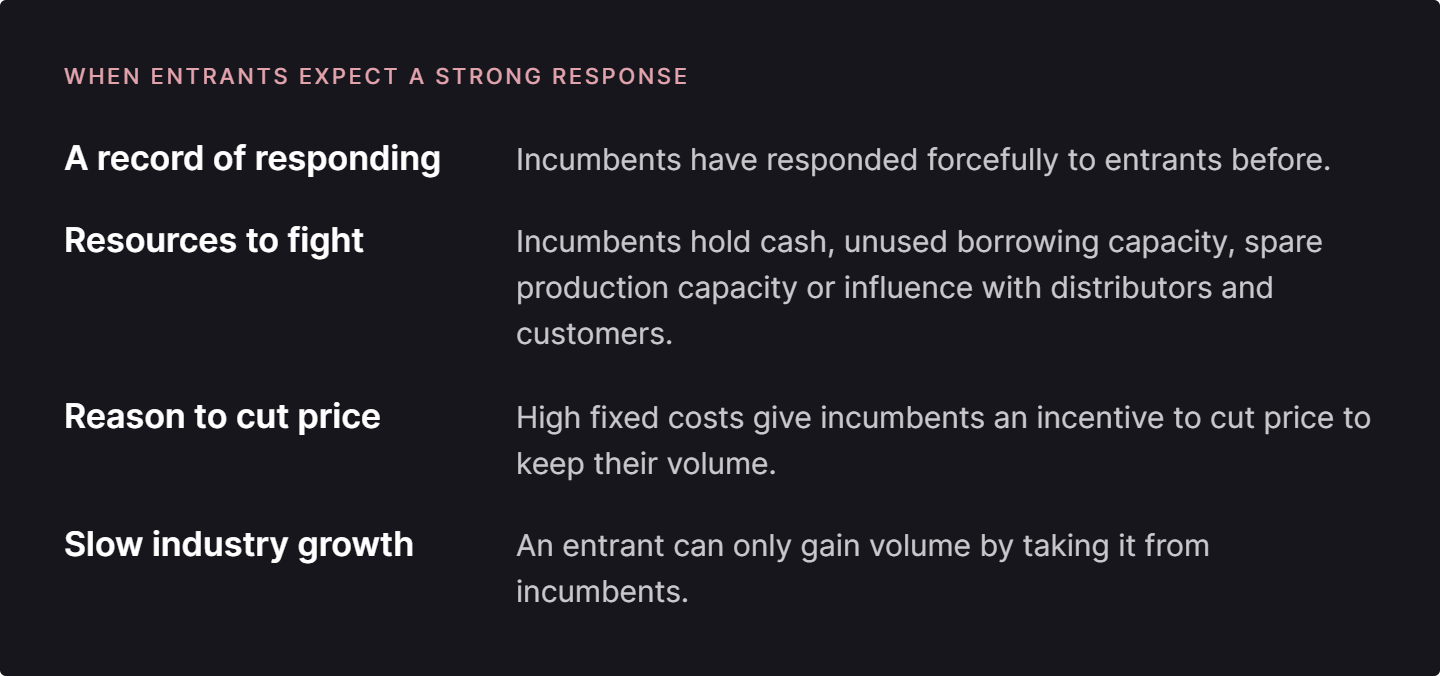
These conditions overlap with the rivalry lesson, and the overlap cuts two ways for a lender. An industry where incumbents retaliate hard deters entry, which protects the borrower. The same retaliation, once an entrant does come in, takes the form of a price response that the borrower is part of. The borrower’s capacity to take part is its own balance sheet, including the facility being underwritten.
Testing the barrier over the term
Four probes establish which barrier protects the borrower and whether it will still hold at maturity.
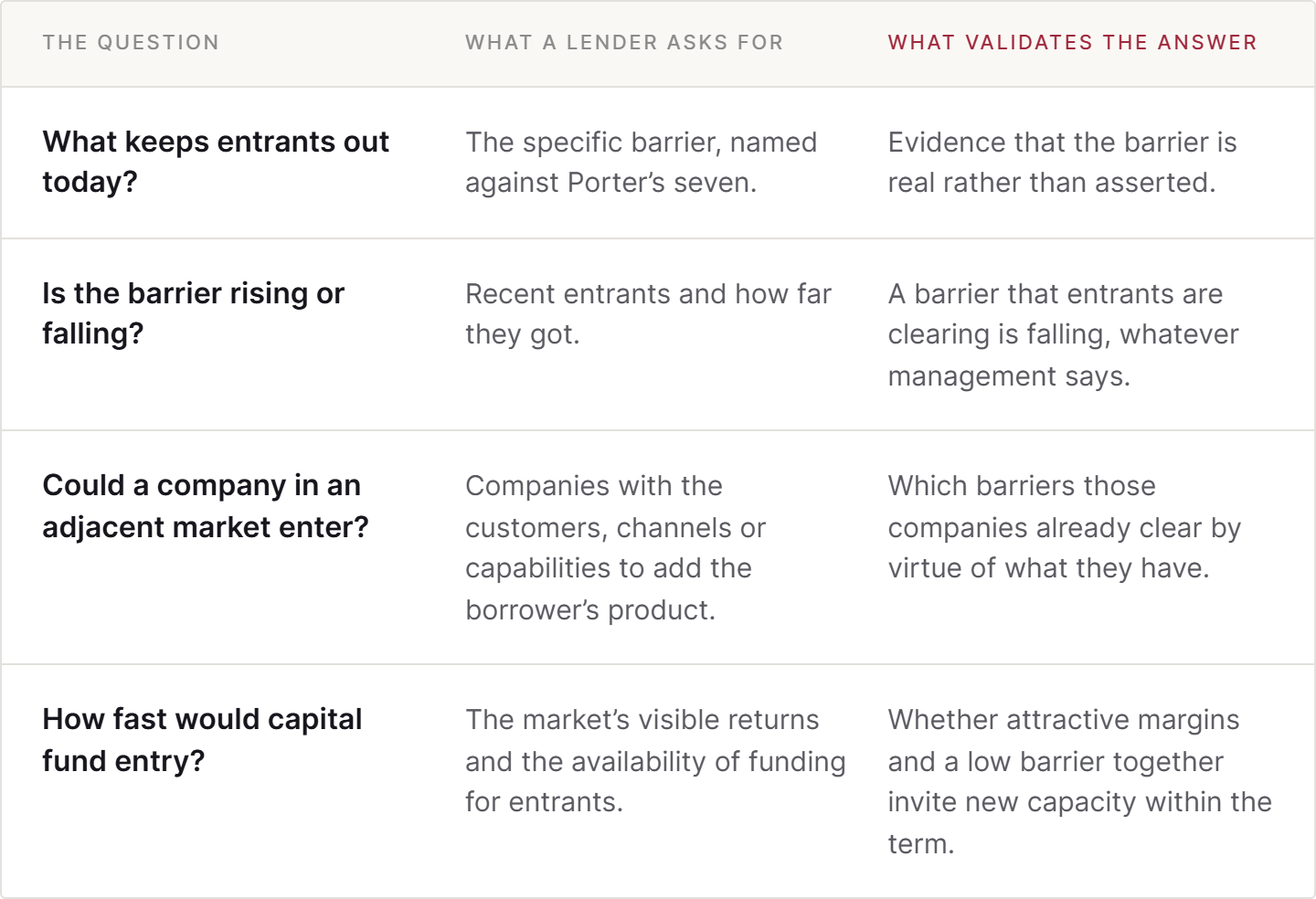
The first probe asks the borrower to name its barrier in Porter’s terms and then tests it. Many borrowers describe their barrier as relationships or expertise, which are not on Porter’s list and are hard to verify. A lender presses for the specific form: a license that took four years to obtain, a plant an entrant would need $40mm to build, a position on a national retailer’s approved vendor list. The test is whether an entrant would have to spend money or time to get past it, and how much.
The second probe uses the record of recent entry as the evidence. A lender asks who has entered the market in the last several years, what they came in with, and how much share they took. A barrier that several entrants have cleared is lower than described, and one that entrants have tried and failed to clear has been tested. Porter’s barriers can also change over time: a patent expires, a regulation is relaxed, a technology lowers the minimum efficient scale. The direction over the term of the loan matters more than the height today.
The third probe addresses the entrant Porter considered the most dangerous: a company diversifying from another market that can use its existing capabilities and cash flow to enter. A building products distributor adding a product line that the borrower specializes in, a customer’s existing supplier offering the borrower’s service alongside its own, or a larger manufacturer extending into an adjacent category each arrives with some of Porter’s barriers already cleared. In software this threat usually takes the form of a larger product adding the capability as a feature, and that version is specific to software.
The fourth probe asks how quickly entry could happen. Where the borrower’s margins are visibly high and the barrier is low, capital will fund entrants, and the speed depends on the funding available. A sponsor-backed consolidator can enter a fragmented market through acquisitions in a year or two. This probe sets the timing of the margin pressure against the loan’s maturity.
What the new entrants read produces
At the end of this component a lender has the barrier that protects the borrower, named and tested, a view on whether incumbents would retaliate against an entrant, the record of recent entry and the direction the barrier is moving, the adjacent companies best placed to enter, and a view on how quickly entry could be funded.
That output is used in three places. The height and direction of the barrier set the margin assumption in the downside case. The timing of possible entry is compared with the loan’s maturity and amortization. And the finding feeds the view on whether the business will be financeable at maturity, since a lender refinancing the borrower then will ask how much of the current margin an entrant has already taken.
A borrower can name its barrier in Porter’s terms and produce the record of recent entry. Whether a particular lender treats a falling barrier as a reason to price the credit higher, shorten the tenor, or accept it in a market it knows well depends on what they have lent against before.
Next in the series
Execution: whether management can deliver the plan and handle what the other forces bring
The team’s record at the task the loan funds, and at responding when competitors, customers or suppliers move against the business.
You can name the barrier that protects your market and show who has tried to enter it. Reading how a particular lender will weigh that barrier against the term you are asking for is the part I do at Synthase Capital Partners.