


Part of The Underwriter’s Read, a series on the critical questions a credit team works through before they lend.
In the last piece, two companies asked for $10mm and turned out to be entirely different credits because the money was doing different work. This time, hold the use constant and change only the shape of the request.
A borrower needs $10mm of working capital. They can ask for a $10mm five-year term loan, or a $10mm revolving line they draw and repay as receivables turn. Same amount, same purpose. But the term loan sits on the balance sheet whether it is needed or not, accrues interest on the full balance for five years, and creates a maturity in year five. The revolver costs a fraction of that in a normal year, flexes with the business, and renews.
One of those requests reads as though the borrower understands their own cash cycle. The other does not.
The ask has three parts, and each one is doing work well beyond the number attached to it.

How much: sizing the amount
Borrowers tend to worry that asking for too much will scare a lender off. In practice, asking for too little is the more common error and the more damaging one.
An undersized facility means the borrower is back at the table in eighteen months, and that second conversation happens from a weaker position. Something did not go to plan, the original thesis needs revisiting, and the lender now has evidence that the borrower’s forecasting runs optimistic. Meanwhile the first loan is already outstanding, so the negotiation is no longer a clean sheet.
Asking for too much has real costs too. It raises leverage, which raises pricing and tightens covenants. It can push the request past what the cash flow visibly supports, which forces the lender to lean on collateral or a sponsor. And an amount that does not tie back to a specific plan invites the question of whether the plan exists.
The defensible position is an amount built from the bottom up, with a stated cushion. Not “we would like $15mm” but “the plan requires $11mm, and we are asking for $13mm because collections could run thirty days slower than modeled.” The second version tells a lender the borrower has already worked through the downside.
An amount built from the bottom up can be tested. A round number chosen for comfort cannot.
Sizing the cushion is a judgement call
Naming the plan requirement is arithmetic. Deciding how much to add on top of it is not, and this is where two experienced people will give a borrower different advice.
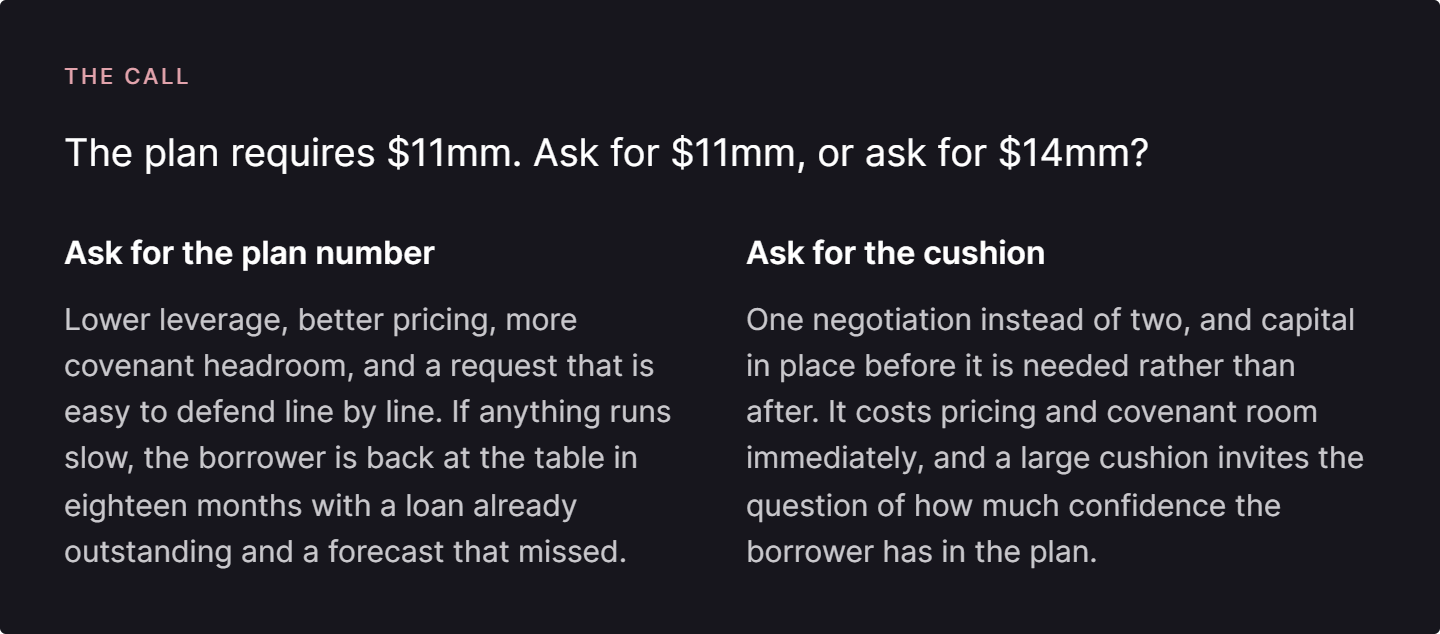
What decides it is how this borrower’s last three forecasts actually performed, whether the lender will treat the cushion as prudence or as doubt, whether pricing is likely to be tighter or looser in eighteen months, and how much covenant headroom the larger amount consumes. None of that is in the model.
For how long: tenor and the shape of repayment
Tenor is where mismatches show up most often, and they are read as a sign of inexperience rather than as a negotiating position.
The money should be outstanding for roughly as long as the thing it funded takes to pay for itself. Equipment with a ten-year life supports a five-year term loan comfortably. A receivables cycle that turns every sixty days does not need five-year money; it needs a revolver. Funding a short cycle with long money means paying for capital the borrower is not using, and funding a long asset with short money means a refinancing risk that has nothing to do with performance.
Alongside tenor sits the repayment shape. An amortizing loan pays down steadily, which reduces the lender’s exposure over time and forces discipline on the borrower. A bullet or balloon defers everything to maturity, which preserves cash in the near term but concentrates all the risk on a single date, and pushes the whole credit onto the refinancing market being open when that date arrives. Neither is right or wrong. But a bullet structure moves the conversation squarely onto whether a future lender will want this business, which is a much harder question to answer today.
On what terms: security, seniority, recourse
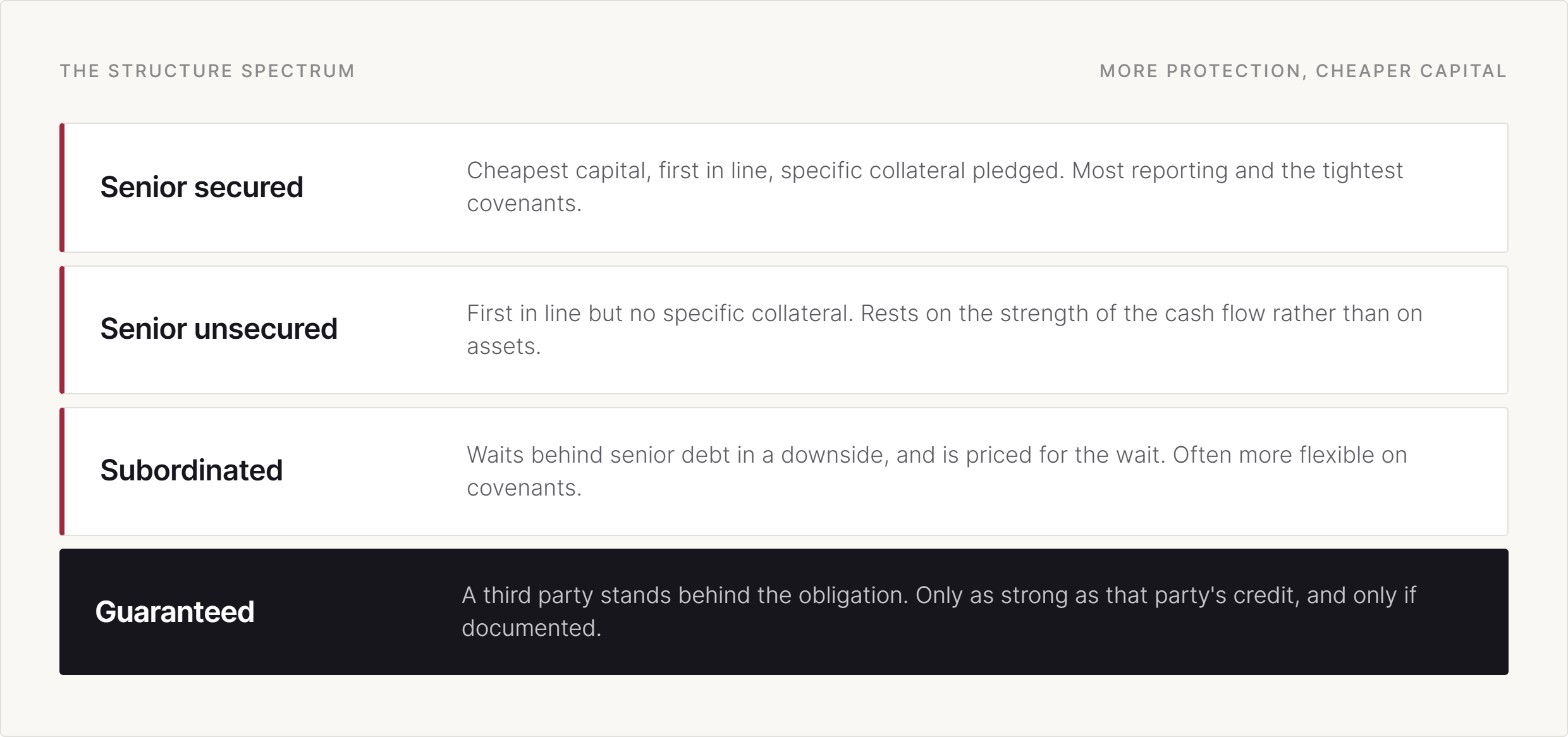
This is the part borrowers give the least thought to and lenders give the most. Three words determine what a claim is actually worth if the business stops performing.
Security is whether specific assets stand behind the loan. A secured lender has a claim on identified collateral. An unsecured lender has a claim on the business generally, which in a downside is worth whatever is left after the secured lenders are satisfied.
Seniority is where the claim sits in line. Senior debt is paid first. Subordinated debt waits, and is compensated for waiting with a higher rate. A borrower who already has senior debt outstanding is not offering a senior position to the next lender, whatever the term sheet says, and that changes the pool of interested parties immediately.
Recourse is who else stands behind the obligation. A parent guarantee, a sponsor support letter, or a personal guarantee extends the claim beyond the borrowing entity. Its value depends entirely on the credit of whoever is giving it, and on whether it is documented and callable rather than merely intended.
Each of these moves along the same axis: the more protection the structure gives the lender, the cheaper the capital and the tighter the constraints on the borrower. The trade is real in both directions.
The fourth part: covenants
Borrowers describe the ask in three parts and stop. Lenders hear a fourth, whether it is stated or not: what rules will govern the borrower’s behavior once the money is drawn?
Covenants exist because a lender’s protection cannot rest on good intentions. Financial covenants set tests the business must keep passing, typically a minimum coverage ratio or a maximum leverage multiple, checked quarterly. Restricted payment provisions limit distributions to shareholders, so cash cannot leave the business while the debt is outstanding. Debt incurrence provisions limit what else can be borrowed, and whether any of it can rank ahead of this claim.
The reason to think about this at the ask stage rather than at documentation is that covenants and pricing trade against each other. A borrower who wants maximum operating freedom will pay for it. A borrower who can live with tighter tests and tighter reporting gets cheaper capital. Neither position is wrong, but the choice should be deliberate rather than discovered in a term sheet.
One related question is worth working out early: how much headroom does the plan leave against the covenants the borrower is likely to be offered? Projected coverage sitting barely above a customary minimum puts the business one soft quarter from a technical default, and a lender will see that in the model whether or not the borrower has looked.
The shape decides which lenders can look at it
Lenders are not a single market. Each type operates under a mandate that dictates what it can hold, and a request falling outside a mandate is a decline rather than a negotiation.
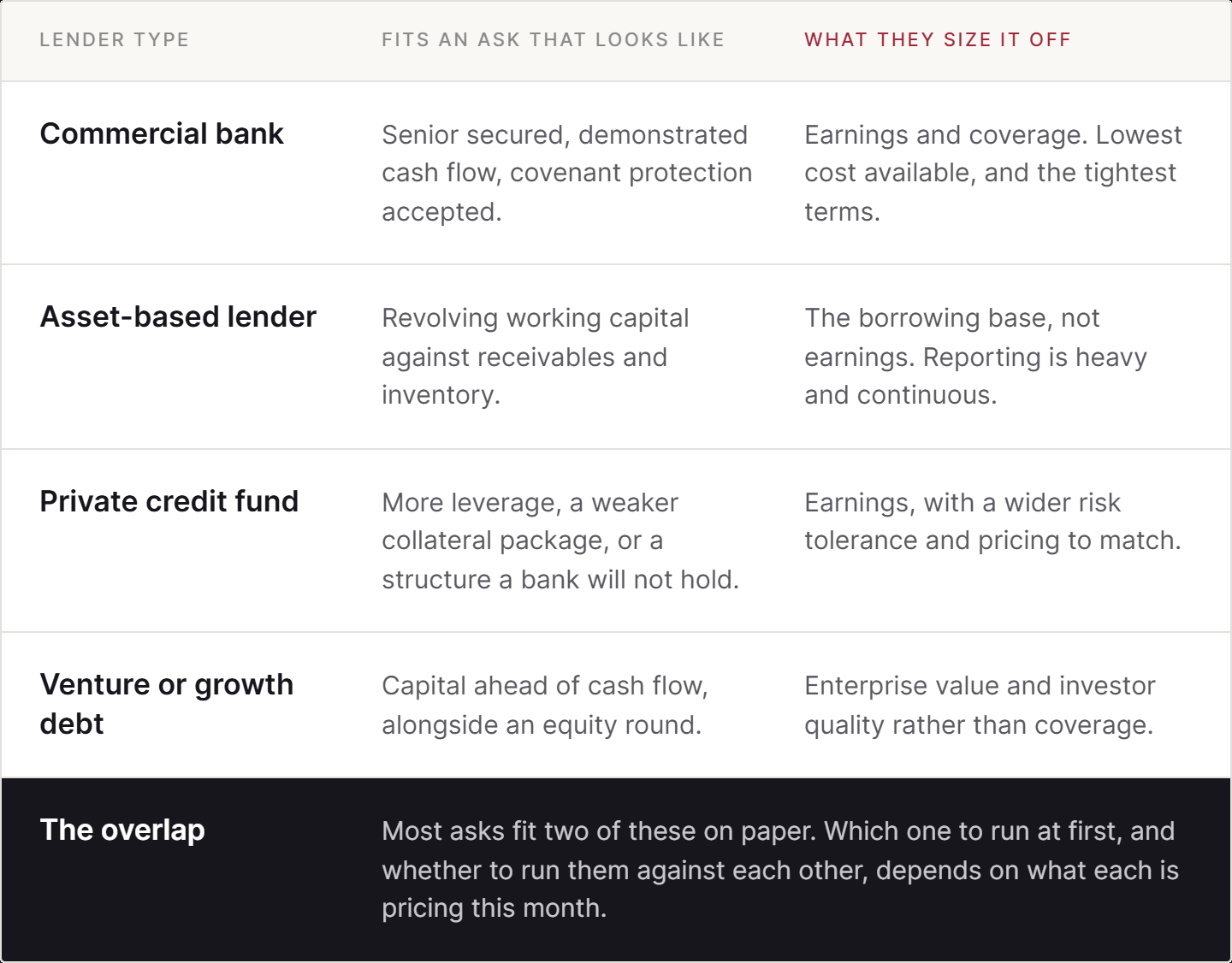
An ask defined carelessly puts the borrower in front of the wrong lenders, collecting declines that say nothing about the business. Defined well, it puts them in front of the few parties whose mandate actually fits.
The ask is the first thing a lender sees, and it is read as a proxy for how well the borrower understands their own business. Getting the three parts internally consistent is work a borrower can do alone. Choosing where to sit on each one, and which lender type to take it to, depends on what the market is paying now and how a specific lender has behaved recently.
Next in the series
Existing capital: who is already in line
Most borrowers already have debt. What sits ahead of the new dollar, what is already pledged, and when it all comes due sets the limits on what any new lender can offer.
Defining the ask is work you can do. Knowing what the market will actually pay for it, and which lenders will look at it, is the part I do at Synthase Capital Partners.