


Part of The Underwriter’s Read, a series on the critical questions a credit team works through before they lend.
The five forces describe pressure from outside the business. Execution is the sixth component in this layer and the only one inside it. It is not part of Porter’s framework. It is included because a credit rests on a plan, the plan rests on a management team, and the five forces lessons each end with a finding that the team will have to act on at some point during the term.
A lender asks two things of management. The first is whether the team can carry out the specific plan the debt funds: an acquisition, a plant expansion, a new territory, a scale-up in volume. The second is whether the team can respond when one of the forces moves against the business during the term: a large customer rebids, an input price rises, a competitor cuts price, an entrant arrives. The first is about delivering a known plan. The second is about handling events that are not in the plan.
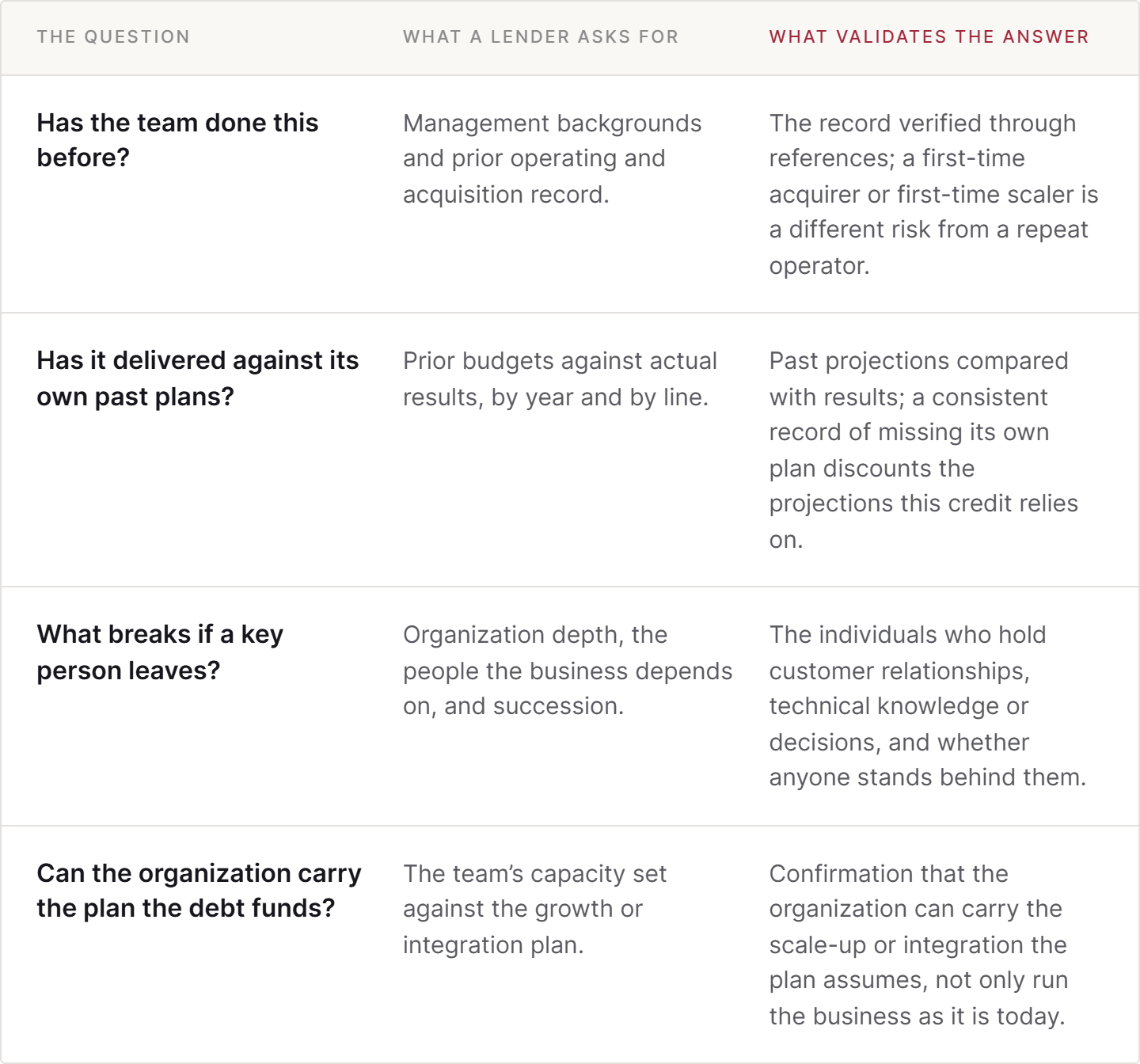
Four probes sit in this component. The first asks whether the team has done this before. The second compares management’s past budgets with actual results. The third identifies what depends on individual people. The fourth assesses whether the organization can carry the specific plan the debt funds. They group together because each tests a different part of the same question: whether the cash flow the projections assume will be produced by the people running the business.
This component bears on the projections more directly than any of the five forces. The forecast is management’s own work, and the budget-against-actuals record shows how close management’s past forecasts came to what happened. A team that has consistently reached its budget earns a base case close to the one it presents. A team that has missed by fifteen percent in each of the last three years has shown a lender how much to discount the next forecast, and in which lines.
The four probes, and what validates the answer
The record against the task
The first probe matches the team’s experience to what the plan now requires. A lender is not assessing whether management is capable in general. A family-owned distributor run well for twenty years by the same team may be making its first acquisition, and running an integration is a different task from running a stable business. A contractor that has grown steadily by adding crews may be proposing to open a second region, which requires managing people it does not see every day. The record that matters is the one that matches the task, and references from lenders, customers or former colleagues are how a lender verifies it.
The same probe covers how the team has handled pressure. The five forces lessons each produced a record of an event the business has already been through: the renewal pricing history in the lesson on what lets customers set the price, the pass-through record in the lesson on what lets suppliers raise the borrower’s costs, the price and volume split in the rivalry lesson. Each of those records also shows what management did. A team that raised prices within a quarter of an input increase, or replaced a lost account within a year, has shown it responds. A team whose margin fell for a year before it acted has shown how long it takes. That timing is what a lender carries into the downside case for the forces the earlier lessons found to be strong.
Past budgets against results
The second probe is the most objective of the four. Management’s budgets for the last three to five years are set beside the actual results, line by line. The comparison shows the size of any gap and where it sits.
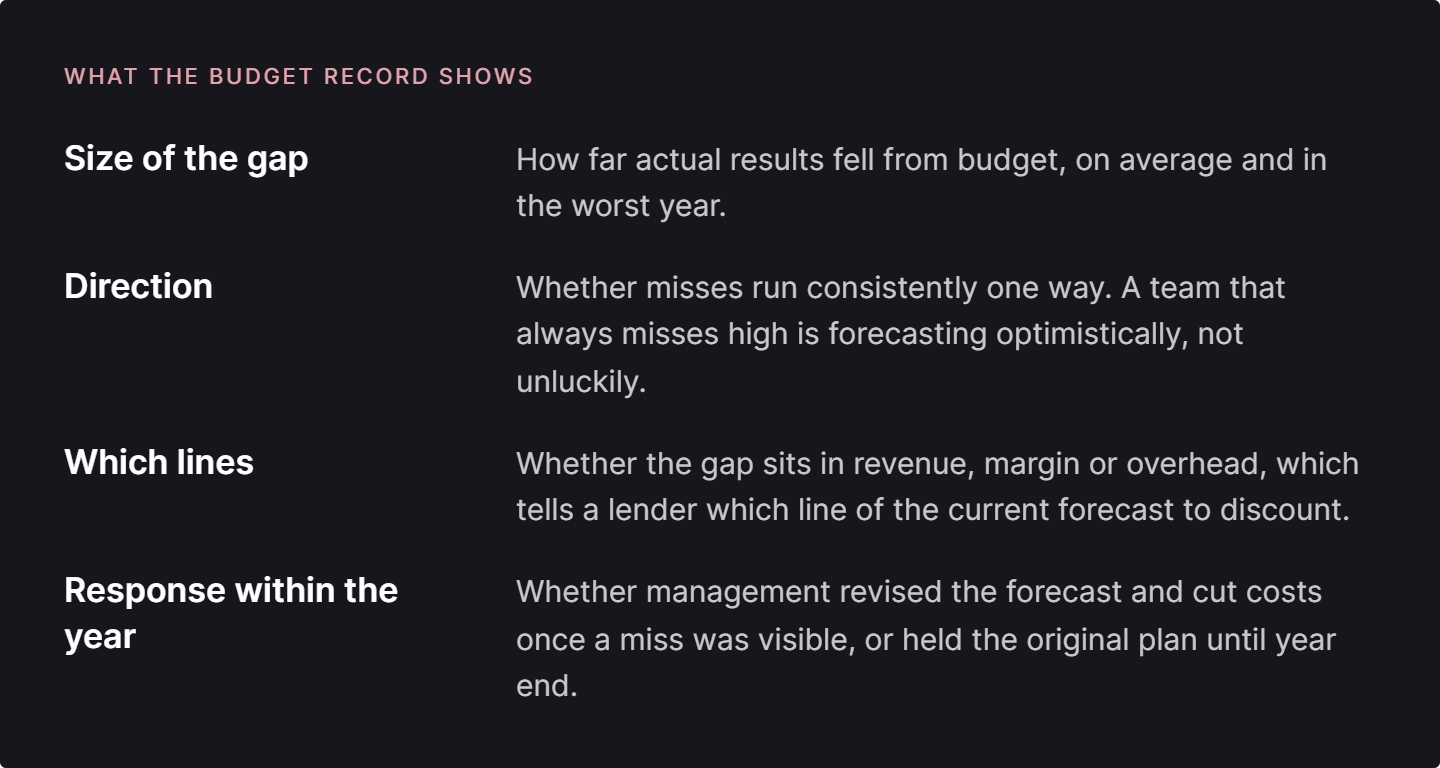
The last row connects the budget record to the second part of the execution question. A year in which revenue came in under budget because a customer was lost or a price was conceded is also a record of how the team responded to that event. A team that revised the forecast in the second quarter and brought overhead down to protect coverage is a different credit from one that held the plan and reported the miss at year end.
Depth behind the individuals
The third probe identifies the individuals the business depends on and whether anyone stands behind them. In many mid-market businesses, the owner or one senior salesperson holds the largest customer relationships, one engineer holds the knowledge of how a key process runs, and the chief executive makes most decisions. The read on what keeps customers established how much of the customer base sits with individual people. This probe asks what happens to the business if one of them leaves during the term, and whether there is a second person who could step in.
Key-person dependence also affects how the team handles pressure from the other forces. A business where one person negotiates every major renewal and supply contract can respond to a rebid or an input increase only as fast as that person can, and cannot respond at all if that person is unavailable.
Capacity for the specific plan
The fourth probe sets the organization’s capacity against the plan the debt funds. It reuses the scalability assessment from the key activities read, which established whether the operation can produce at the volume the plan requires. This probe adds the people: whether the team has the finance function to integrate an acquired company’s reporting, the supervisors to run a second shift, the sales capacity to open a new territory while serving the existing one. A plan that doubles the business while the management team stays the same size is asking the same people to carry twice the load.
This probe also sets the plan against the rest of the term. A team fully occupied by an integration in the first two years has less capacity to respond to a customer loss or a competitor’s move in the same period. A lender reads the timing of the plan’s demands on management alongside the timing of the pressures the five forces lessons identified.
What the execution read produces
At the end of this component a lender has the team’s record matched to the plan’s task, a record of how management responded to past pressure from customers, suppliers and competitors, the size and direction of past budget misses, the people the business depends on, and an assessment of whether the organization can carry the plan during the term.
That output is used in three places. The budget record sets how far to discount management’s base case. The response timing sets how long the downside case assumes pressure lasts before management acts. And the finding feeds the view on whether the business will be financeable at maturity, since a lender refinancing the borrower then will be lending to the same team, or to whoever replaced it.
This completes the durability layer. Each of the six components produces a finding on pressure the business will face during the term, and each finding feeds an assumption in the downside case. A borrower can produce its budget record and name the people it depends on. Whether a particular lender treats a first-time acquirer as a reason for tighter covenants, a larger equity contribution, or key-person provisions in the credit agreement depends on what they have lent against before.
Next in the series
The numbers layer: turning the model and durability work into coverage and leverage
How the findings from the first three layers become the base case, the downside case and the ratios a lender underwrites to.
You can produce your budget record and name the people your business depends on. Reading how a particular lender will weigh that record against the plan you are asking them to fund is the part I do at Synthase Capital Partners.