


Part of The Underwriter’s Read, a series on the critical questions a credit team works through before they lend.
The last block established what the operation can physically produce. This one covers how that output reaches a buyer. A channel carries two flows in opposite directions: the product or service travels out to the customer, and the order and the payment travel back. Where a borrower sells direct, it knows the customer and holds the receivable on the customer. Where a distributor, a broker, a general contractor or a marketplace sits in the middle, the goods go out through that party and the receivable is on that party. This block establishes which of those applies, to how much of the revenue, and what the borrower is left with if the route closes.
Four probes sit in this block. The first establishes the channel mix by revenue and how it has moved. The second finds whether one route carries enough of the revenue to be a single point of failure. The third asks who holds the customer data and the billing relationship. The fourth models the loss or repricing of the dominant channel. They group together because a route to market the borrower does not control can change on terms the borrower does not set, and the first three probes establish how much that would matter.
This block tests where the forecast revenue is supposed to come from. Management’s projection carries a growth number, and the trailing channel mix says which route produced the revenue up to now. Where the plan holds the current mix, the growth rests on routes that already work at the volumes they already run. Where the plan assumes growth through a channel that is small today, or through one being built, the forecast depends on a route with no track record at that scale, and the cost of building it has to sit in the model. A lender reads the projected mix against the trailing one, and the gap between them is the part of the plan that is an intention rather than a run rate.
The four probes, and what validates the answer
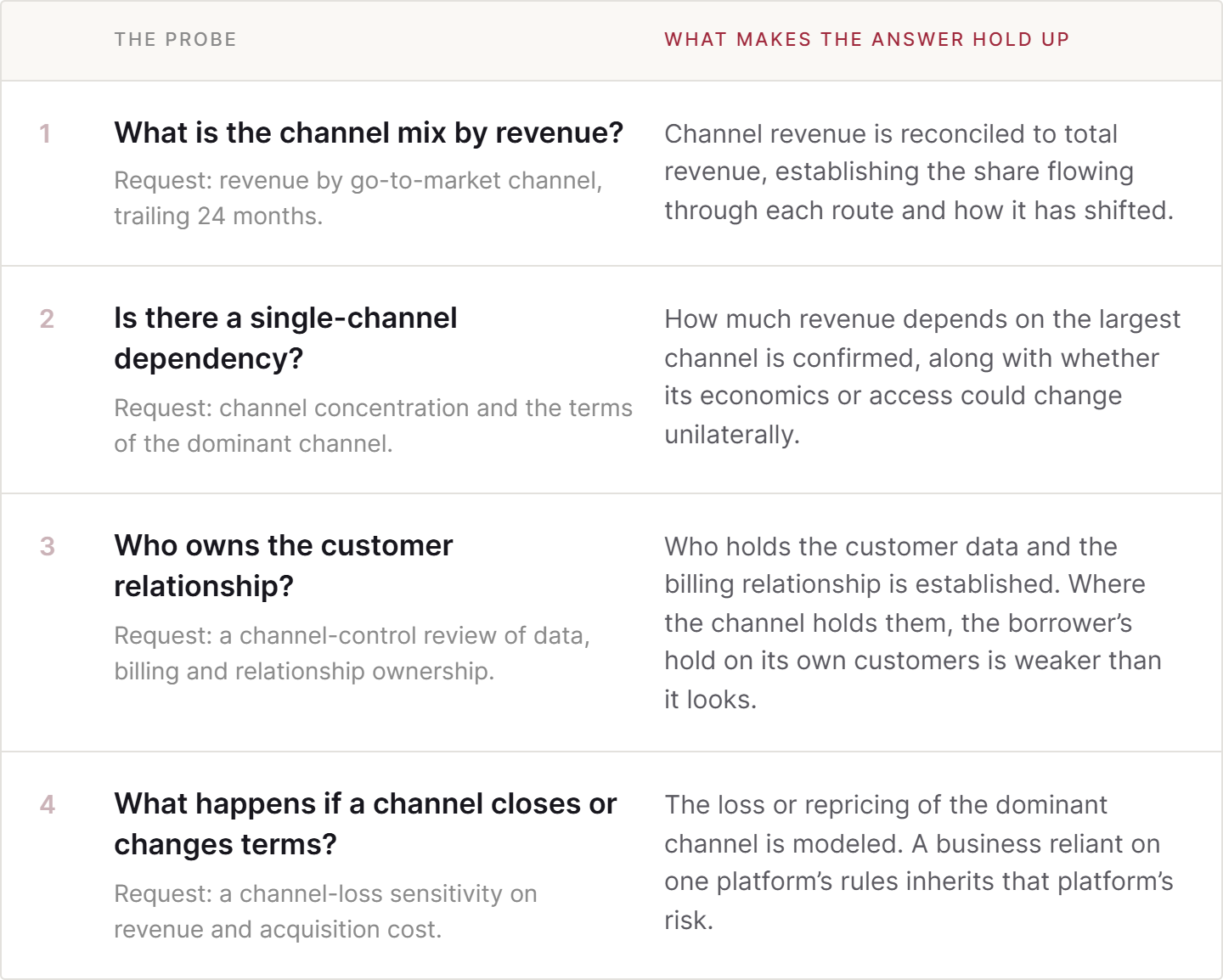
The first probe asks for two years rather than one because the direction of the shift carries the information. A manufacturer whose direct share has fallen from sixty percent to thirty over eight quarters is a different credit than one that has always sold through distribution. The second has a stable structure a lender can underwrite. The first is mid-transition, and the reasons matter: a deliberate decision to cut selling cost, or direct accounts that were lost and picked up by distributors.
Who holds the customer
The third probe is the hardest of the four to answer honestly, because most borrowers describe the end user as their customer regardless of who stands in between. The business model canvas breaks a channel into five stages: making the customer aware of the offering, helping them evaluate it, letting them purchase, delivering, and supporting them after the sale. Those stages can be split between the borrower and the channel in any combination, and the split is what determines the answer.
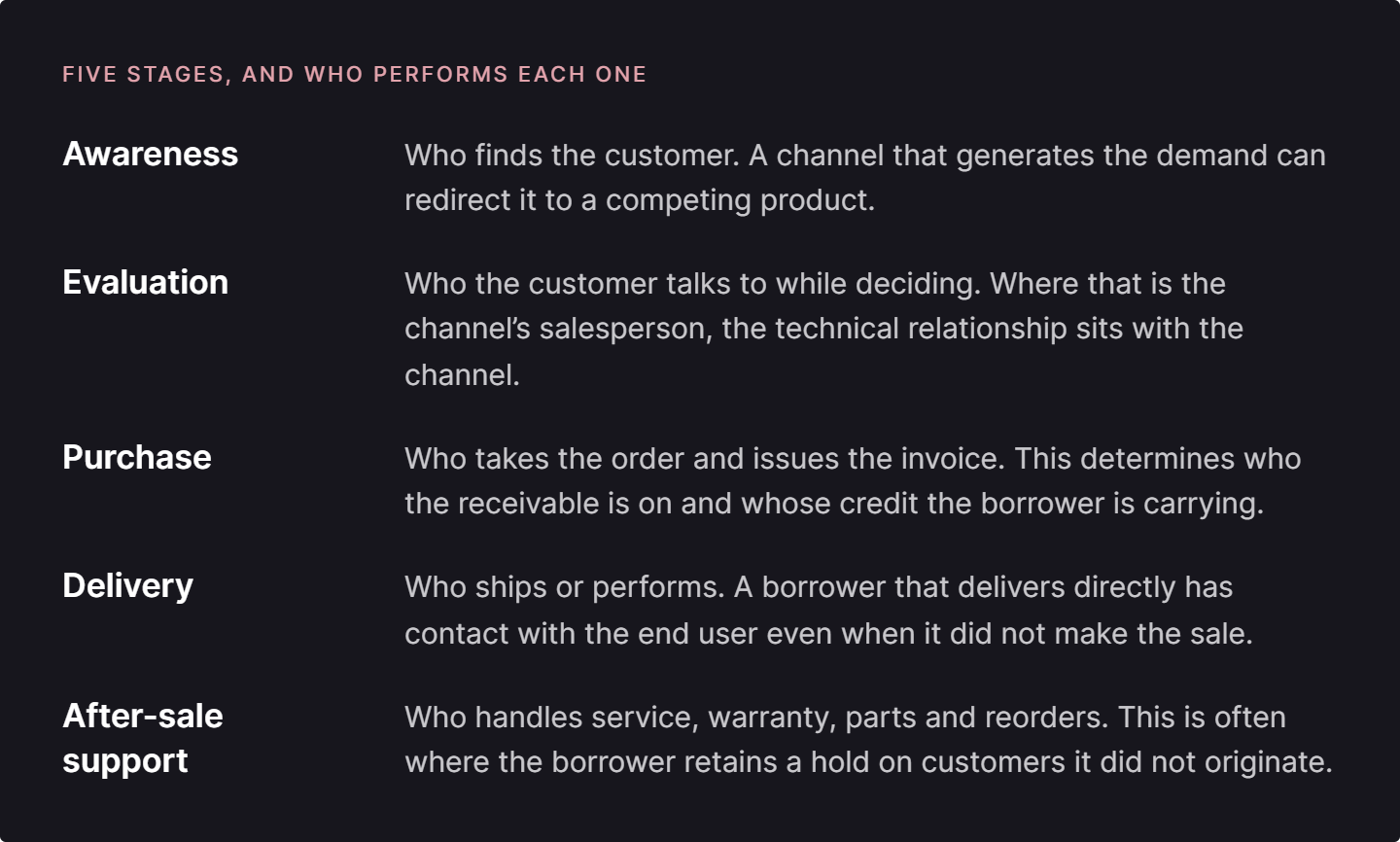
The stages that matter most for credit are purchase and after-sale support. Purchase sets who owes the money. Support sets whether the borrower has a reason to speak to the end user at all. A food manufacturer selling through a retailer performs none of the five, and the retailer’s buyer is the entire relationship. A fabricator whose parts are specified into a customer’s product performs delivery and support even when a distributor takes the order, and it knows what the customer runs and when they reorder.
This is also where the block connects to the read on what keeps a customer from leaving. A borrower that holds the specification, the service history and the reorder data has something a channel cannot take with it. A borrower that has only a distributor’s purchase orders has the distributor as its customer, whatever the pitch deck says.
What a channel controls, and what it costs to lose
The second and fourth probes work as a pair. Concentration establishes how much is exposed, and the sensitivity establishes what the exposure is worth. What a channel can do unilaterally differs by channel type, so the same concentration number means different things.
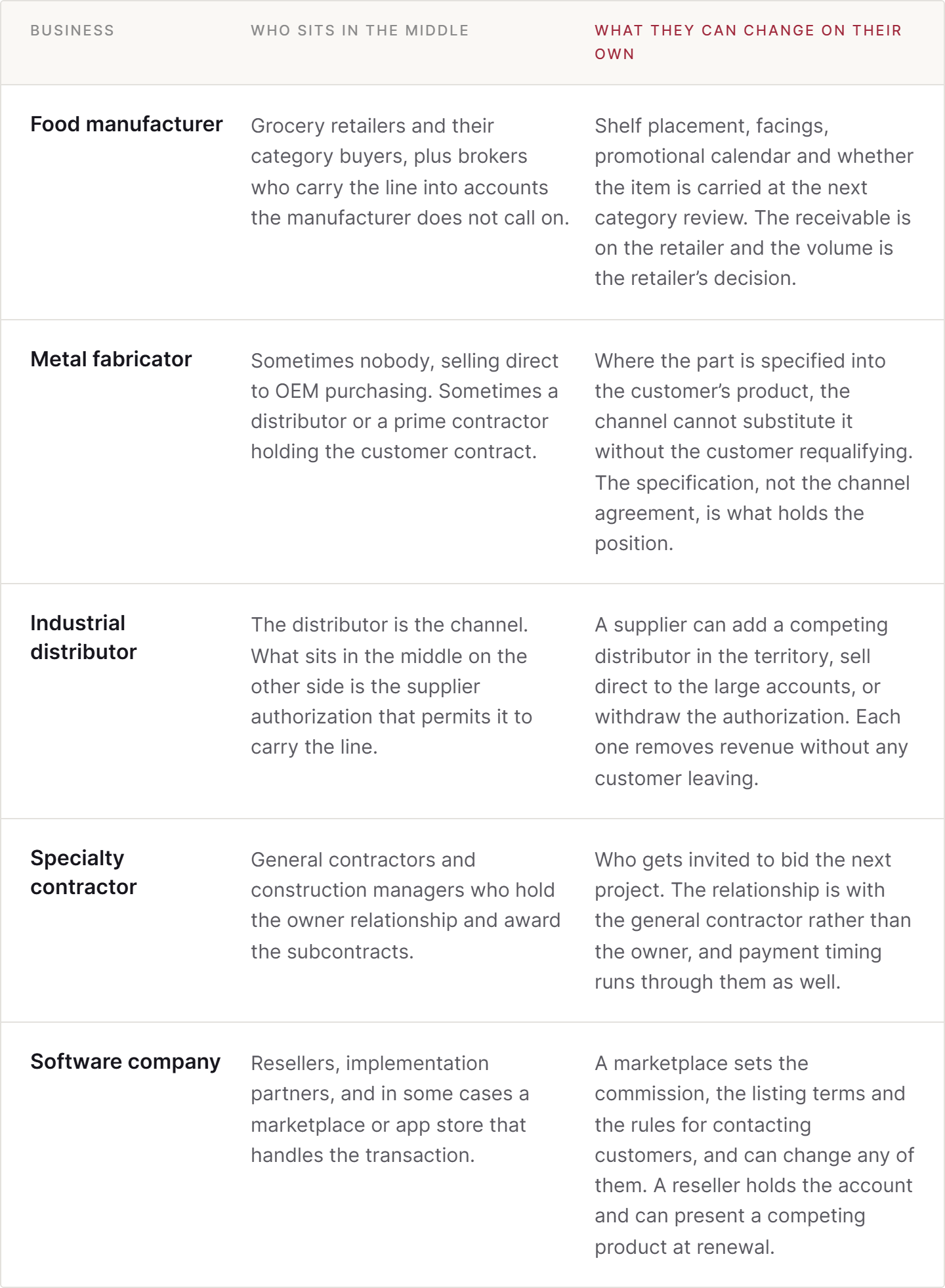
Two things run through those. The channel’s control is usually exercised through a decision that is routine on its side and material on the borrower’s: a category review, a territory appointment, a bid list, a commission change. And in four of the five the receivable is on the channel rather than on the end user, which means the borrower’s credit exposure and its customer concentration are measured against different parties.
That last point bears on the borrowing base directly. A manufacturer with a thousand end users and three retail customers has receivables concentrated in three names, and an advance rate against those receivables reflects the three. The fourth probe then sizes what happens if the largest one goes: the revenue that leaves, the inventory built for it, and what reaching those end users another way would cost.
What the channels read produces
At the end of this block a lender has the revenue split by route with the trend behind it, a named dependency where one route dominates, a finding on who holds the customer, and a sized loss for the largest channel.
That output is reused in three places. A dominant third-party channel is a partner dependency, and the agreement behind it gets read the same way as a supply agreement. Where the channel holds the customer data and the billing, the finding revises the read on what keeps customers from leaving. And the receivable-versus-end-user distinction carries into the collateral work, because the borrowing base is built on who owes the money.
A borrower can produce the channel mix, name its concentration and say who holds the billing relationship. Whether a particular lender treats a single dominant channel as a concentration to be covenanted, priced, or accepted as the structure of the industry, and how much of the channel-loss case they build into the downside, depends on what they have lent against before.
Next in the series
The durability layer: testing the resilience of the business model against internal and external pressure.
That completes the nine blocks. The next layer stresses them against competitors, customers, suppliers, substitutes, new entrants and management itself.
You can split your revenue by route and name who holds the billing relationship. Reading how a particular lender will treat a dominant channel, and what it does to the advance rate you are offered, is the part I do at Synthase Capital Partners.