


Part of The Underwriter’s Read, a series on the critical questions a credit team works through before they lend.
Most loans are repaid by a refinancing rather than from operating cash flow over the term. The lesson on sources of repayment found that on the lender’s figures, 56 percent of the distributor’s senior facility is left for a refinancing or a sale at maturity. This component models the business as it will look when the loan comes due and tests whether a new lender would refinance it then.
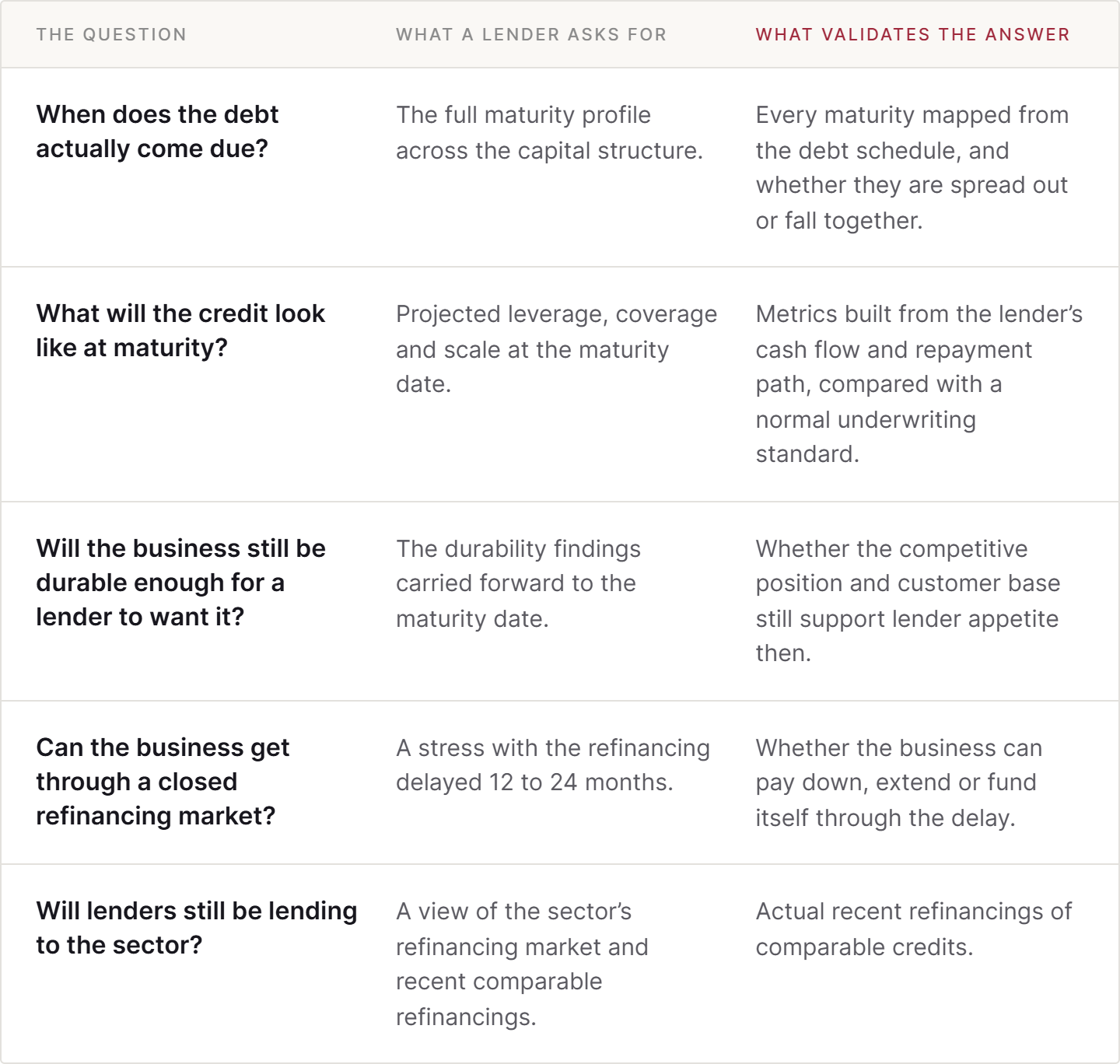
Five probes sit in this component. The first maps when each piece of debt comes due. The second projects the credit metrics at the maturity date. The third tests whether the business will still be durable enough at that date for a lender to want it. The fourth tests whether the business can get through a period when the refinancing market is closed, and the fifth tests whether lenders will still be lending to the sector.
Management’s projection usually shows the loan repaid or reduced to a small balance by maturity, with leverage well below where it started. A lender projects the credit to the maturity date using its own cash flow and repayment figures from earlier components, and compares the amount left to refinance and the leverage at that date with what lenders accept for comparable credits. That lets the lender establish whether the business could raise the debt it will need at maturity, instead of assuming management’s repayment path leaves nothing to refinance.
The five probes, and what validates the answer
When the debt comes due
The first probe maps when each piece of debt comes due. A lender uses the debt schedule from the lesson on leverage and the ranking from the lesson on claim priority, and adds the maturity date of every claim. It then checks whether the maturities are spread across several years or fall in the same year. When several pieces of debt mature together, the borrower has to refinance all of them in one transaction, in whatever market conditions apply that year.
For the distributor, the senior facility matures at the end of year five. The earnout and the deferred purchase price are paid well before then. The $3.0mm seller note is assumed here to mature after the senior facility, which is common for subordinated debt, so a lender confirms from the note itself that it does not fall due first.
The credit at maturity
The second probe projects the credit metrics at the maturity date. A lender carries its own cash flow from the lesson on cash flow and coverage and its repayment path from sources of repayment forward to maturity. It then compares the amount to refinance and the leverage at that date with the terms lenders are accepting for comparable credits. The new lender will underwrite the business as it is at maturity, so the projection is of that business, not of the business at closing.
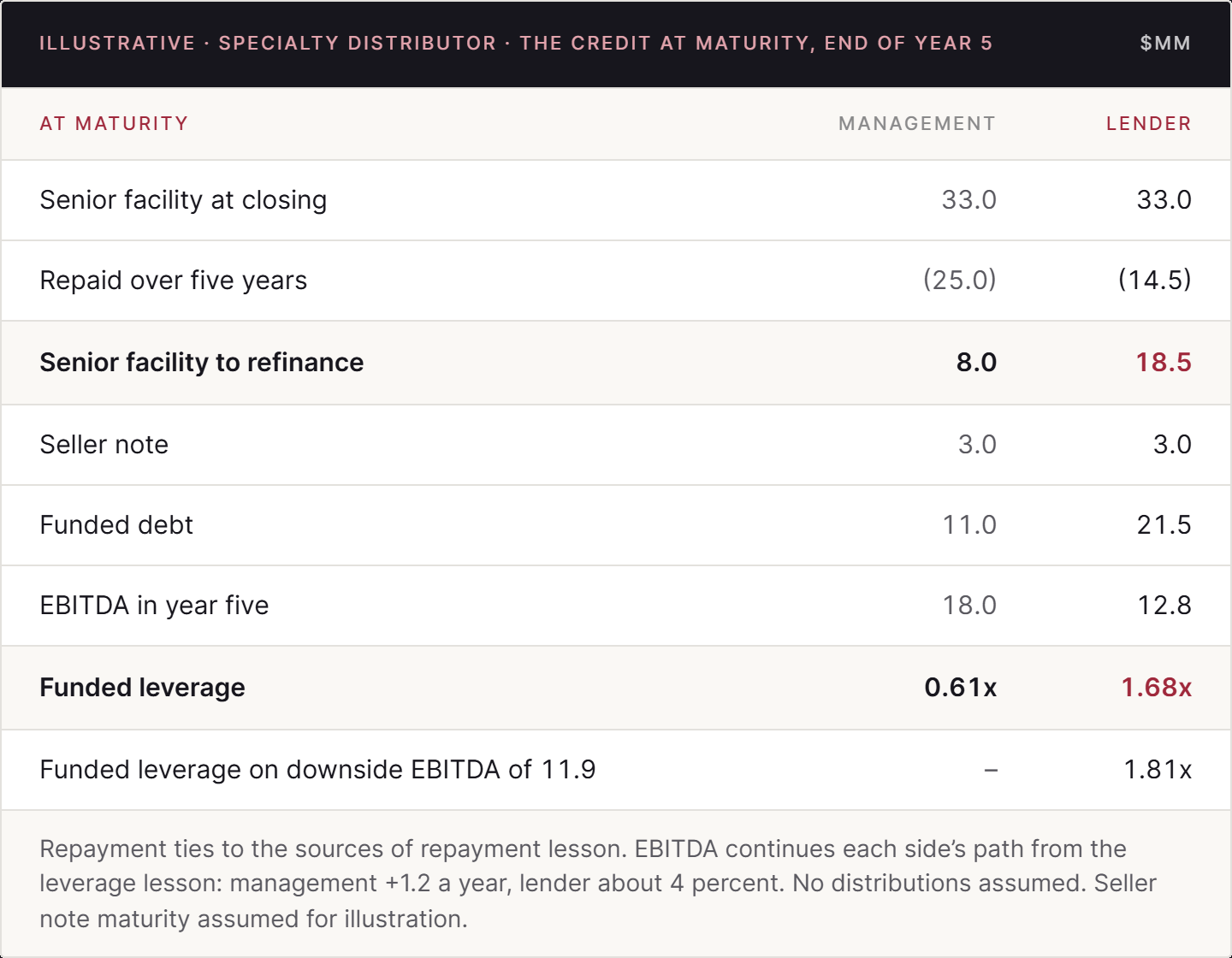
On management’s figures the distributor refinances $8.0mm at 0.61x. On the lender’s figures it refinances $18.5mm of senior debt, with funded leverage of 1.68x, or 1.81x if EBITDA is $0.9mm lower as in the downside case. Both are well below the 3.40x funded leverage at closing. The lender’s figure is the one it compares with the market, and the refinancing lender will set its own coverage test on the interest rate that applies at maturity.
These figures assume no distributions. The lesson on financial policy showed distributions becoming permitted in year three on the lender’s figures. Each $1.0mm distributed from then on adds $1.0mm to the amount to refinance. The founder also plans a sale within three to five years, which would repay the facility from the proceeds if it happened before maturity.
Durability at maturity
The third probe tests whether the business will still be durable enough at maturity for a lender to want it. The metrics in the schedule assume the competitive position and the customer base are intact five years out. A lender carries the findings from the durability layer forward to the maturity date: whether rivals are taking share, whether large customers or purchasing groups can push prices down, whether suppliers can raise costs or sell direct, and whether the business still has the management to run it.
For the distributor, the durability findings produced the $0.9mm downside used in the schedule. A lender asks whether the pressures behind that figure are likely to grow over five years, because the refinancing lender will read the business on its competitive position at that date. For a business with little hard collateral, this is the same customer base the lesson on downside and recovery relied on for its going concern value, so one finding affects both the recovery case and the refinancing case.
A closed refinancing market
The fourth probe tests whether the business can get through a period when the refinancing market is closed. A lender models the refinancing delayed by 12 to 24 months and asks whether the business can pay the loan down from its own cash flow, agree an extension with the existing lender, or fund itself through the delay. If it can do none of these, the delay becomes a payment default at maturity.
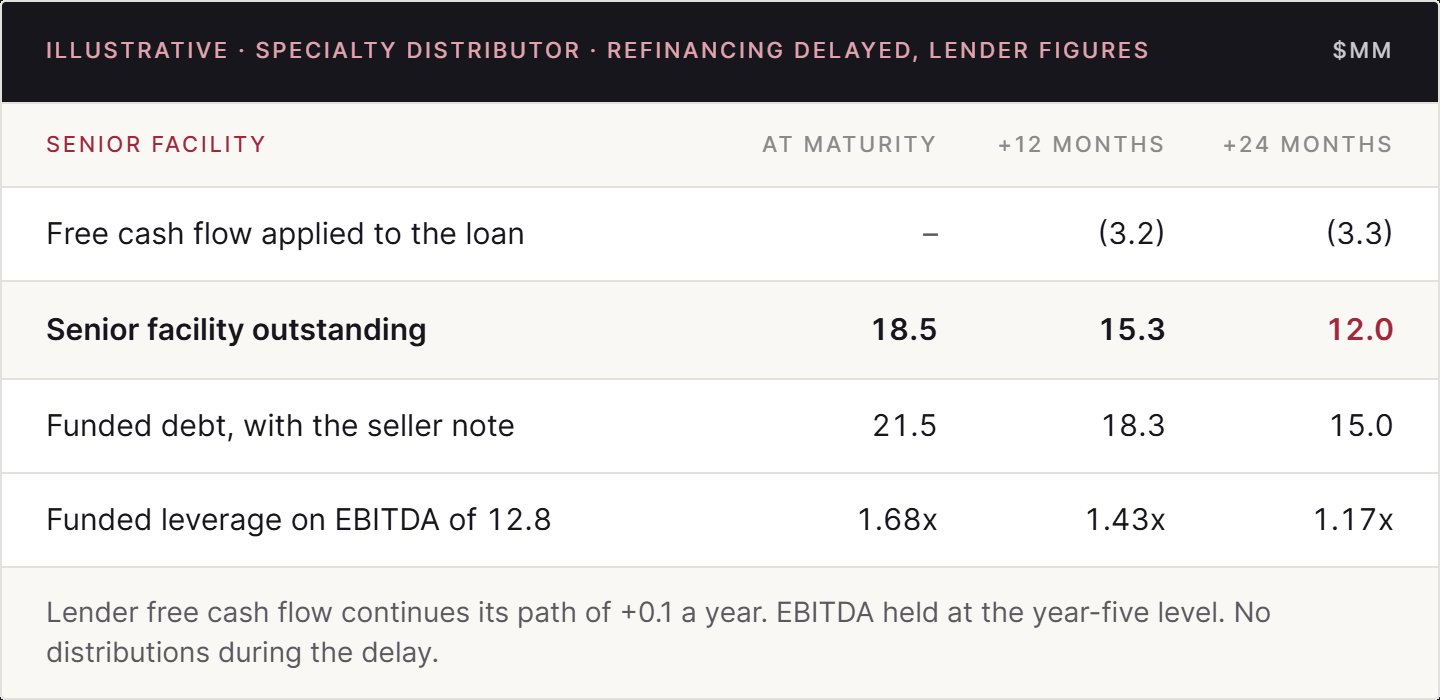
On the lender’s figures, the distributor’s free cash flow would reduce the senior facility from $18.5mm to $12.0mm over a two-year delay, provided the existing lender agrees to extend and the business performs as projected. The lender also runs the delay on the downside case, because the conditions that close a refinancing market often weaken the business at the same time, as the sources of repayment lesson found for the distributor’s other sources.
Lender appetite for the sector
The fifth probe tests whether lenders will still be lending to the sector at maturity. Lender appetite changes with the credit cycle and with each lender type’s view of a sector. A lender bases its view on actual recent refinancings of comparable credits, such as other specialty distributors of similar size, rather than on general statements about the market. A sector that lenders have stopped lending to can leave a borrower with sound metrics unable to refinance.
For a borrower that is consuming cash, the refinancing test is usually replaced by the next equity round. The lesson on the cash-consuming borrower set out runway against the next funding milestone. At maturity the same probes apply: when the loan comes due relative to that milestone, and whether investors and lenders will still fund the sector then.
What the refinance horizon read produces
At the end of this component a lender has five builds: a maturity profile, a model of the credit at maturity, the durability findings carried forward to that date, a refinancing delay stress, and a view of lender appetite for the sector.
Almost none of it requires new information from the borrower. The component reuses the cash flow and coverage, leverage and durability work and projects it to the maturity date, which makes it the component that draws on every earlier layer of the framework.
A borrower can project its own debt and leverage to the maturity date and map when each piece of debt comes due. Whether lenders will refinance it at that date depends on facts outside the business: which lender types are active in the sector, the terms comparable credits are refinancing on, and how the existing lender has handled extensions before.
You can project your own debt to the date it comes due. Knowing which lenders will be refinancing credits like yours at that date, and on what terms, is the part I do at Synthase Capital Partners.