


Part of The Underwriter’s Read, a series on the critical questions a credit team works through before they lend.
The lesson on sources of repayment found that the distributor’s sources are likely to weaken together, which gives more weight to where the new loan ranks. This component maps the capital structure from senior to junior, confirms which assets are already pledged, and tests what could rank ahead of the loan later through unencumbered assets, permitted future debt, the group’s legal structure or an intercreditor agreement.
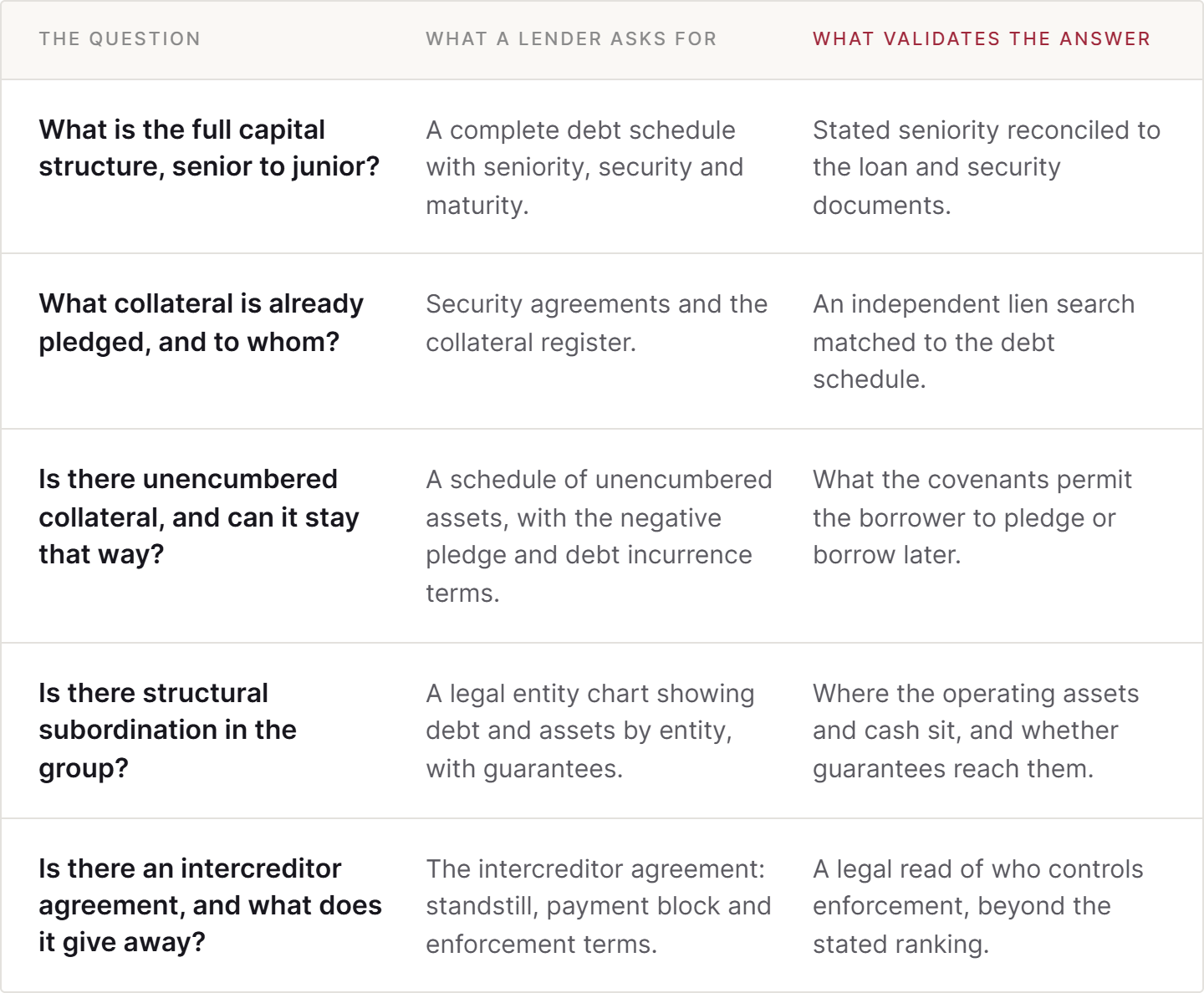
Five probes sit in this component. The first maps the full capital structure. The second confirms what collateral is pledged and to whom. The third tests whether unencumbered assets can stay unencumbered. The fourth tests whether the group’s legal structure puts the loan behind other creditors, and the fifth reads any intercreditor agreement for the enforcement rights behind the stated ranking.
Management and the term sheet usually describe a new facility as senior secured. A lender establishes from the loan documents, the security agreements and a lien search which assets the claim actually reaches, at which entities, and what the documents allow to rank ahead of it during the term. That tells the lender how much of the borrower’s asset base stands behind the amount left outstanding at maturity, instead of accepting the label on the term sheet.
The five probes, and what validates the answer
The full capital structure
The first probe maps every claim on the business from senior to junior. A lender starts from the debt schedule built in the lesson on leverage and adds the seniority, security and maturity of each line. It then reconciles each line to the loan and security documents, because a summary table prepared by management can describe a claim as subordinated or unsecured when the documents say otherwise.
The schedule below continues the specialty distributor. After closing it has the $33.0mm senior facility and three obligations to the sellers of the business it acquired two years ago: a $3.0mm seller note, a $1.5mm earnout and $1.0mm of deferred purchase price.
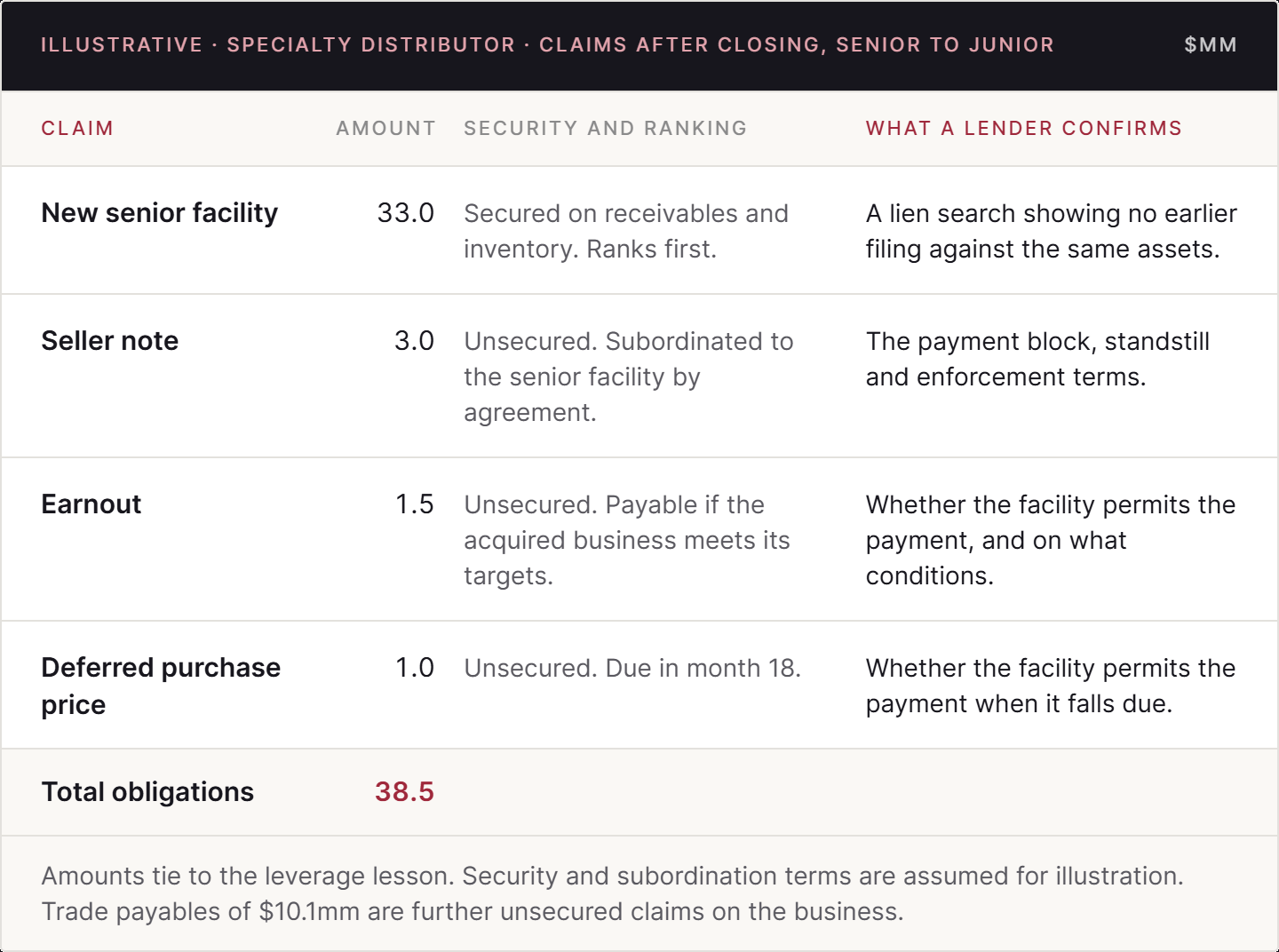
The senior facility is $33.0mm of the $38.5mm total. The earnout and the deferred purchase price do not appear in funded debt, but they are claims on the same cash. A lender confirms whether the facility permits each payment to the sellers, because a payment to a junior creditor while the senior loan is outstanding reduces the cash available to it.
Pledged collateral
The second probe confirms which assets are already pledged, and to whom. A lender asks for the security agreements and the collateral register, then runs its own lien search, such as a UCC search in the United States, against each borrowing entity. It matches every recorded filing to a line on the debt schedule. A filing with no matching line, such as an equipment lessor’s filing against trucks or a supplier’s filing against inventory it delivered, is an obligation management did not disclose.
For the distributor, the lien search should show the new facility’s filing against receivables and inventory, and the filings of the existing revolver and term loan released at closing. The lender relies on the recorded filings rather than on management’s description of the security.
Unencumbered assets and future debt
The third probe tests whether unencumbered assets can stay unencumbered. A lender asks for a schedule of assets that no creditor holds security over, and reads the negative pledge and debt incurrence terms alongside it. A negative pledge restricts the borrower from granting security over its assets to another creditor. The debt incurrence covenant limits how much further debt the borrower can raise. Together they determine whether the borrower can later raise secured debt that ranks ahead of the loan on assets the lender is counting on.
The distributor’s facility is secured on receivables and inventory. The truck fleet, forklifts, warehouse equipment and systems sit outside that security package unless the security agreement covers them. The lesson on financial policy set debt incurrence at funded leverage below 2.50x, which the lender’s figures reach in year three. From then on the borrower can add debt, and the lender reads the negative pledge and the list of permitted liens to establish whether that debt could be secured on the fleet or on the facility’s own collateral.
Structural subordination
The fourth probe tests whether the group’s legal structure puts the loan behind other creditors. A lender asks for a legal entity chart showing which entity borrows, which entities hold the operating assets and cash, and which entities guarantee the loan. If the loan sits at a parent company and the assets sit in a subsidiary that does not guarantee it, the subsidiary’s own creditors, including its trade creditors, are paid from those assets first. The lender reaches them only through the parent’s ownership of the subsidiary. A guarantee from the subsidiary to the parent’s lender, called an upstream guarantee, gives the lender a direct claim on the subsidiary.
For the distributor, the lender asks whether the business acquired two years ago is held in a separate subsidiary. If it is, the lender confirms that the subsidiary guarantees the facility and that its receivables and inventory are pledged.
Assets held by a foreign subsidiary raise the same question. A lender asks which foreign subsidiaries hold inventory, receivables or cash, whether each one guarantees the facility, and whether its assets are pledged. Where they are not, those assets sit behind the foreign subsidiary’s own creditors, and the lender treats them as outside the collateral that supports the loan.
Intercreditor agreements
The fifth probe reads any intercreditor or subordination agreement for the rights behind the stated ranking. A lender reads three sets of terms. A payment block lets the senior lender stop payments on the junior debt while the borrower is in default. A standstill period stops the junior creditor from enforcing for a set time. The enforcement terms set out which creditor controls the decision to enforce against the collateral. A legal read of these terms establishes what the ranking means when the borrower is in difficulty.
For the distributor, the relevant agreement is the one subordinating the $3.0mm seller note to the senior facility. The lender confirms that it can block payments on the note while the borrower is in default and that the sellers cannot enforce during the standstill period. The same read applies to an existing lender that stays in the structure, using the existing credit agreement reviewed in the lesson on existing capital for any limits it places on a new lender.
For a borrower that is consuming cash, the capital structure is usually short and receivables and inventory are small. Most of what stands behind the loan is the value of the company to a buyer, which the lesson on the cash-consuming borrower measured as loan-to-value against the last round. The same probes apply: what is pledged, what the documents let the company pledge or borrow later, and which entities hold the assets.
What the claim priority read produces
At the end of this component a lender has the debt schedule reconciled to the documents and four further builds: a lien search, a review of the negative pledge and debt incurrence terms, a structural map of debt and assets by entity, and a review of the intercreditor terms.
The collateral map sets out where the loan ranks, where the collateral is located and what it consists of. It feeds the downside and recovery work, which tests how easily that collateral could be sold or converted to cash to repay the loan. The negative pledge finding feeds back into the structure terms the borrower negotiates for the facility.
A borrower can map its own capital structure, entities and recorded liens. What security package a particular lender requires, and how much room it leaves to pledge assets or add debt later, depend on the lender type, on what terms the market is accepting, and on what existing creditors will agree to.
Next in the series
Downside and recovery: what the collateral is, where it sits, and how easily it converts to cash to repay the loan
Going concern and liquidation values, recovery rates by type of asset, what reaches the loan after the claims ahead of it, and how long a recovery takes.
You can map your own capital structure and the liens recorded against it. Knowing what security the lenders in your process will require, and how much room they will leave you to pledge assets or add debt later, is the part I do at Synthase Capital Partners.