


Part of The Underwriter’s Read, a series on the critical questions a credit team works through before they lend.
Coverage and leverage both use EBITDA, so neither gives a usable figure for a borrower whose EBITDA is negative. The introduction to this layer set out the alternative: a loan to a cash-consuming borrower is repaid from cash on the balance sheet, the next equity raise, a sale of the company, or the business reaching breakeven before maturity. This lesson takes each of those four sources in turn and shows the build a lender uses to test it.
Most of the work carries over from the five lessons before this one. The monthly sources and uses from the lesson on liquidity and working capital becomes the main schedule. The add-back review from the lesson on cash flow and coverage applies to the burn figure, the debt schedule from the lesson on leverage still sets what ranks ahead of the lender, and committed capex from the lesson on capital intensity is counted in the burn.
Management’s forecast for a cash-consuming borrower usually shows monthly burn falling to breakeven and the next equity raise closing on schedule. A lender rebuilds the burn from the monthly trend the borrower has actually reported, then tests how many months the raise can slip before cash falls to the minimum the covenants require. That lets the lender establish how long the borrower can service the debt from the cash it holds, and how much of the repayment depends on an event the borrower does not control, instead of accepting management’s timetable.
The earlier lessons in this layer followed a specialty distributor with $12.0mm of EBITDA, whose facility was sized on a leverage multiple and tested on coverage. This lesson uses a different borrower: a venture-backed company that makes and sells its own product, with revenue growing and EBITDA still negative. Cash-consuming borrowers are a minority of deals, and the same approach applies to other cases, such as a business partway through a large build-out.
The four sources of repayment
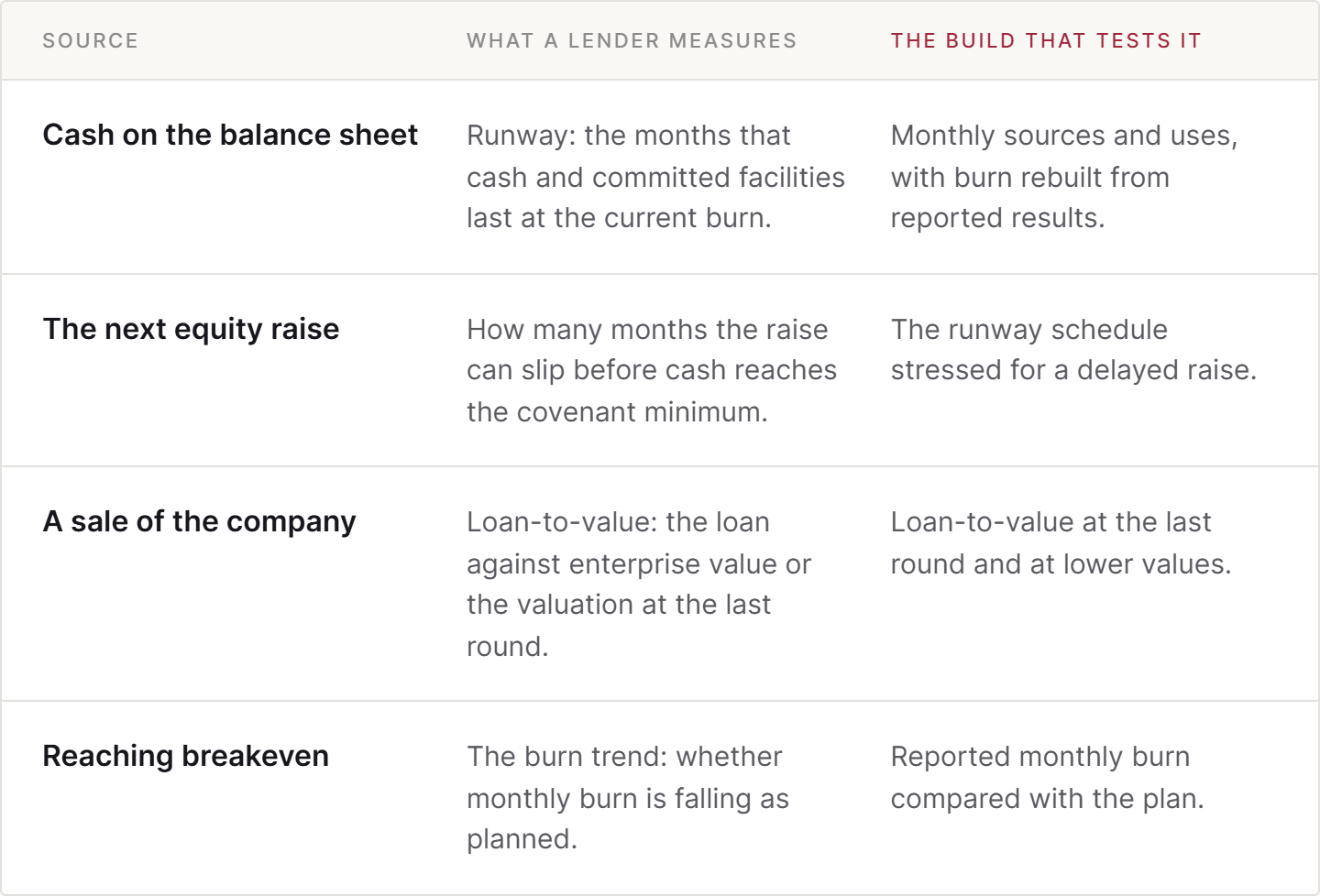
Cash on the balance sheet
Runway is the number of months that cash and committed facilities last at the current rate of burn. The illustrative borrower holds $15.0mm of cash and is borrowing $15.0mm, so it has $30.0mm at closing. At a burn of $1.5mm a month, that is 20 months of runway, against 10 months without the loan. The loan extends runway by the number of months its proceeds cover, and a lender sizes it with that in mind.
A lender builds the burn figure the same way it builds EBITDA for a profitable borrower. It tests each cost that management excludes, because a burn figure with costs left out understates how fast the cash is being used. It adds the working capital a growing product needs, since receivables and inventory use cash on top of operating losses, and it adds the capex that has to be spent before the next milestone. Interest on the new facility is part of the burn.
The next equity raise
For most venture-backed borrowers, the next equity raise is the source a lender expects to extend runway. A lender sets runway against the date of the next funding milestone, such as a product launch, a contract award or the raise itself, and tests how long the raise can be delayed. The schedule below shows the borrower’s cash over 24 months with no raise, on management’s burn and on the lender’s. Management plans to raise $25.0mm in month 12. The proposed facility carries a minimum cash covenant of $5.0mm.
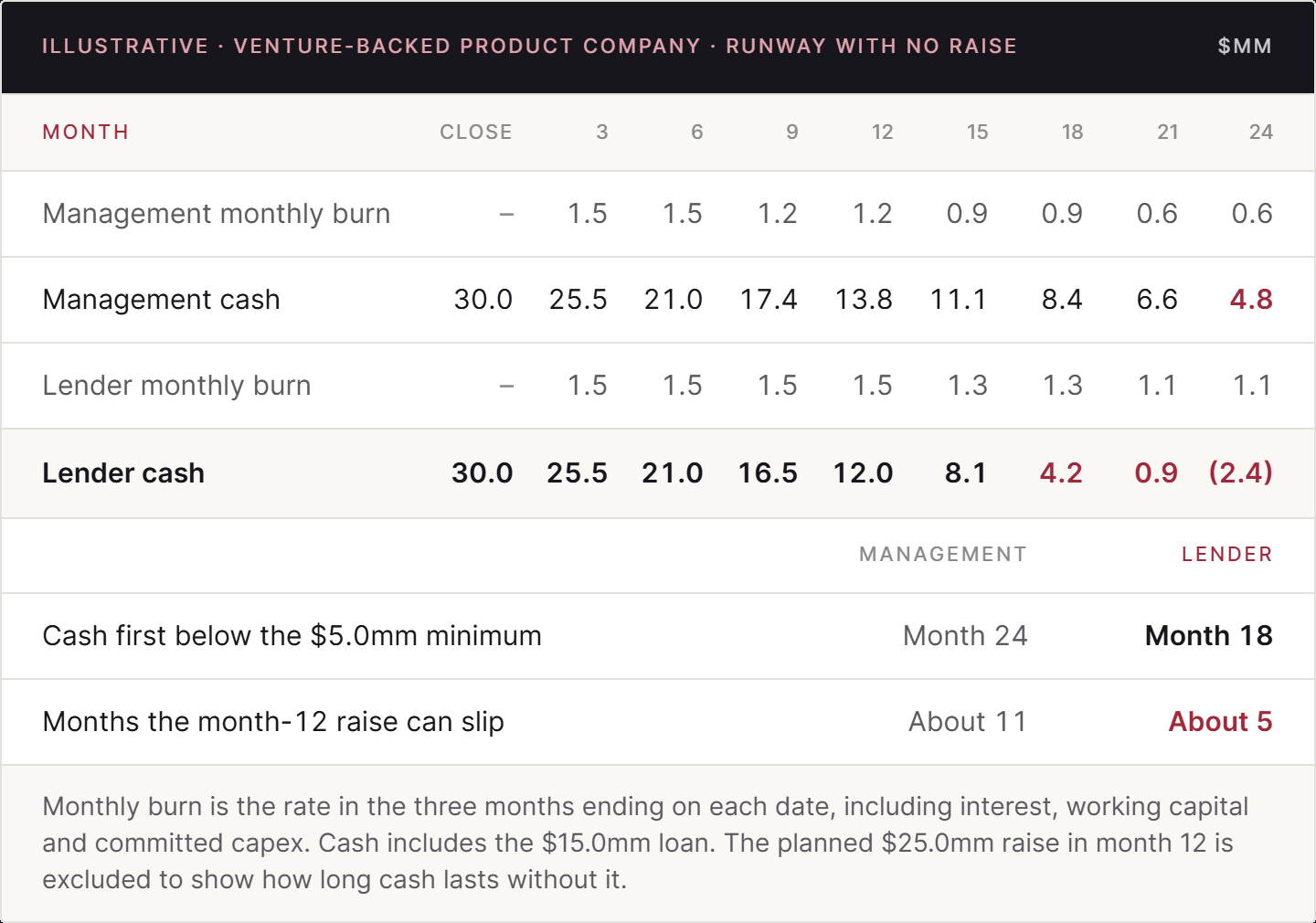
Management’s plan has monthly burn falling from $1.5mm to $0.6mm over two years. The lender’s case holds burn at $1.5mm for the first year, because that is the rate the borrower has reported over the last twelve months, and then lets it fall more slowly. With no raise, management’s cash reaches the $5.0mm minimum in month 24, so the raise can slip by about 11 months. On the lender’s burn, cash reaches the minimum in month 18, which leaves about 5 months.
The raise depends on the investors. A lender reuses the ownership work from the situation layer: how much capital the existing investors have left to deploy, whether they have funded the company through earlier delays, and whether a new investor is expected to lead. The monthly schedule shows how much time the borrower has, and the ownership work indicates whether the investors are likely to fund within that time.
A sale of the company
If the raise does not happen, the loan may be repaid from a sale of the company. A lender sizes the loan against the value of the company using loan-to-value: the loan divided by enterprise value or by the valuation at the last equity round. The borrower’s last round valued it at $150mm, so the $15.0mm loan is 10 percent loan-to-value.
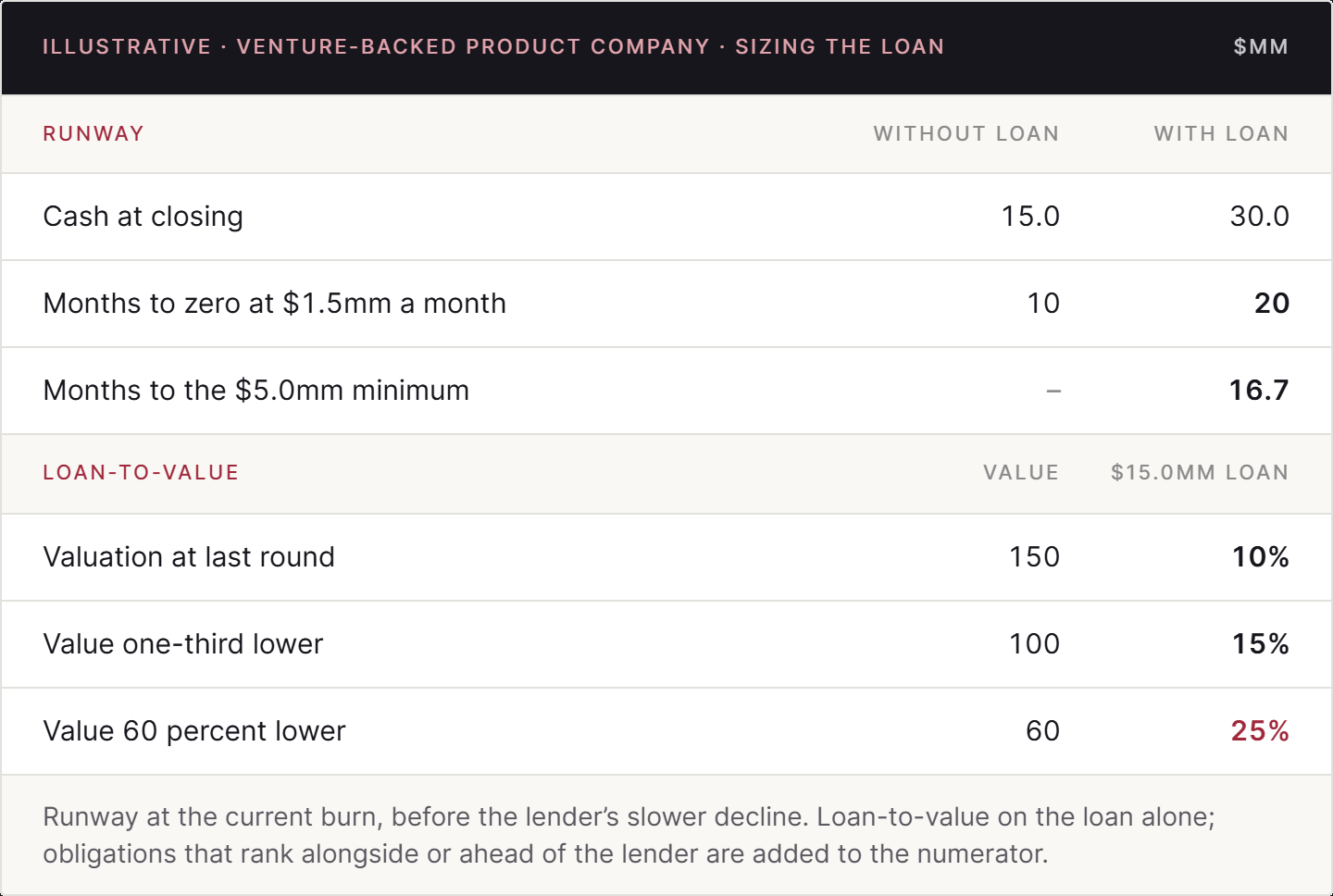
The valuation at the last round was set when investors expected the plan to be met. A sale that follows a missed raise may happen at a lower value, so a lender also reads loan-to-value at lower figures. At $100mm the loan is 15 percent of value, and at $60mm it is 25 percent. The debt schedule still applies: earnouts, deferred payments and other obligations that rank alongside or ahead of the lender are added to the loan before the ratio is read.
Reaching breakeven
The fourth source is the business reaching breakeven before the loan matures, so that operating cash flow repays the debt. The plan to reach breakeven replaces the deleveraging path a lender would build for a profitable borrower. A lender tests it against the burn trend: whether the cash consumed each month has been falling as planned over the months already reported. Management’s plan here reaches breakeven in about month 30. The borrower’s reported burn has held at about $1.5mm a month for a year, which is why the lender’s case assumes a slower decline and does not treat breakeven as a source of repayment within the first two years.
The covenants
The covenants replace the leverage and coverage tests. A minimum cash covenant requires the borrower to hold a set amount of cash at all times, and a lender sets the level so that it is reached while there is still time to act, such as raising equity or selling the company. A performance-to-plan covenant measures results and spending against the plan the lender underwrote, and it is how a lender tracks burn or capex that runs ahead of plan. Lenders to these borrowers often also take warrants, which give the lender a share of any increase in the value of the equity.
What the read produces
At the end of this read a lender has a burn figure rebuilt from reported results, runway to zero and to the minimum cash level, the number of months the next raise can slip in its own case, loan-to-value at the last round and at lower values, and a comparison of the burn trend with the plan to reach breakeven. Those figures set the loan amount, the minimum cash level and the performance-to-plan terms.
The analysis draws on the ownership work from the situation layer and on the five components of this layer. Its output feeds the repayment layer, which covers the sources of repayment for every borrower, what ranks ahead of the lender, and what a lender recovers if the plan does not work.
A borrower can calculate its own runway and loan-to-value before a lender asks. How much time a particular lender needs to see before the next raise, and where it will set the minimum cash level, depend on how it has lent to similar companies and how it expects the borrower’s investors to behave.
Next in the series
The repayment layer: sources of repayment, claim priority and refinancing
Whether the loan is repaid if the plan does not work, and from what.
You can calculate your own runway and loan-to-value. Knowing where the lenders in your process will set the minimum cash level, and how much time they will want before your next raise, is the part I do at Synthase Capital Partners.