


Part of The Underwriter’s Read, a series on the critical questions a credit team works through before they lend.
The four blocks before this one worked on revenue: what it is composed of, why customers pay, who they are, and what keeps them buying. This block works on what happens to profit when that revenue falls. The share of costs that are fixed determines how far earnings move for every dollar of revenue change, and a lender is underwriting one direction of that movement.
Five probes sit in this block, and they group together because a fixed-cost percentage is not by itself a finding. The first establishes the split between fixed and variable. The second establishes how quickly the fixed part can actually be reduced, which is a question about notice periods and contract terms rather than intent. The third converts the split into the revenue level where coverage breaks. The fourth checks the whole thing against what happened the last time revenue fell. The fifth looks for commitments that do not appear as fixed costs on the income statement at all.
This block is what lets a lender run the borrower’s forecast at a lower revenue number. Management’s projection carries revenue growth and usually margin expansion alongside it. Holding the fixed base where the classification puts it and reducing revenue produces an earnings figure that does not depend on the growth assumption, and the notice periods from the second probe determine how much of the offsetting cost reduction is actually available inside the period a covenant gets tested. That is a capacity to service debt built from the borrower’s own cost ledger rather than from the plan.
The same fixed share, three different businesses
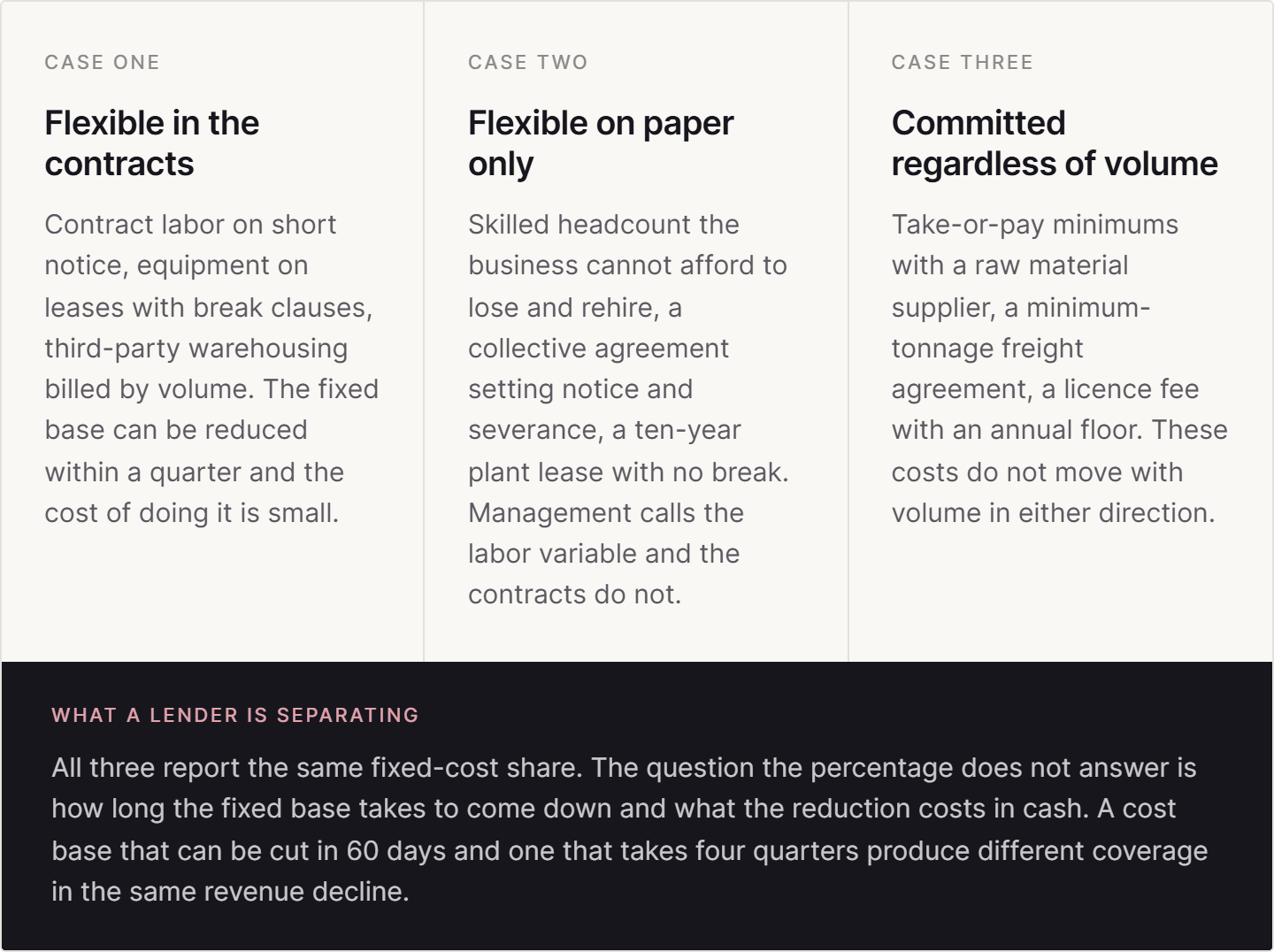
A fixed-heavy cost base is not a defect. Three borrowers can each report that 60% of costs are fixed and hold entirely different positions, because what separates them is how fast the fixed part comes down and what it costs to take it out.
The five probes, and what validates the answer
The first probe collects management’s classification, the next two test it, and the last two look for what it left out. This block runs hot in diligence because the answers determine the downside case, and the downside case determines the amount.
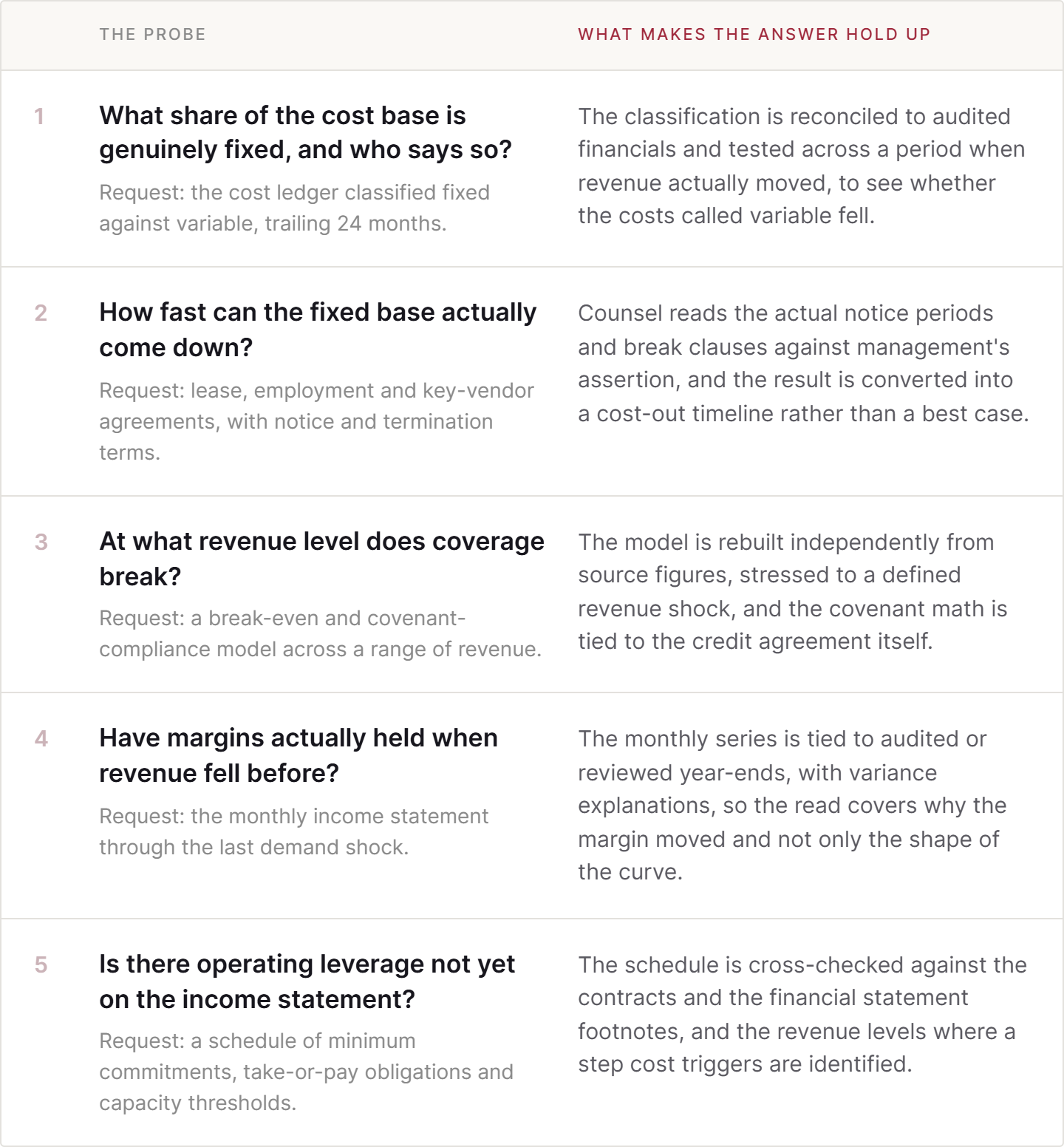
The first probe is a classification exercise that borrowers tend to complete optimistically, and the test for it is historical rather than analytical. If revenue fell 15% in a quarter two years ago and the costs labeled variable fell 4%, the classification is wrong regardless of how the accounts are organized. A lender looks for a period when revenue moved for reasons outside management’s control and reads the cost lines through it.
The second probe is a legal read, not a financial one. Labor is the line most often described as variable and most often governed by terms that make it slow to reduce: notice periods, severance schedules, collective agreements, and in skilled trades the practical reality that laid-off staff do not come back. Property and equipment carry remaining lease terms and break clauses. The output is a timeline that says how much cost can be removed in 90 days, in six months, and in a year.
What sets the speed of a cost reduction
The cost-out timeline is assembled from four sets of documents, and each one sets a floor on how quickly a category of cost can be removed.
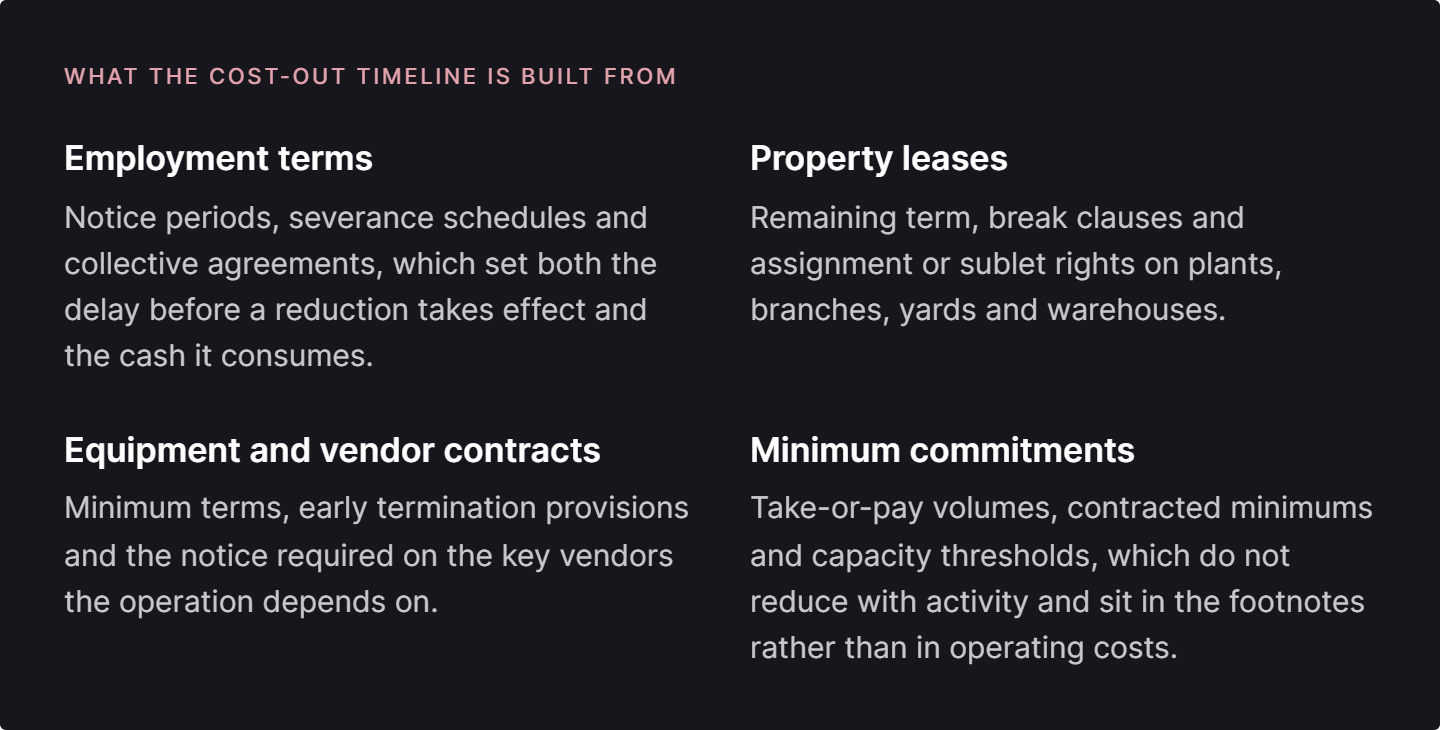
The fifth probe is the one that changes numbers late in a process. Minimum commitments and take-or-pay obligations are contractual fixed costs that the income statement presents inside cost of sales, where they look variable. Capacity thresholds work in the other direction: a business at 85% utilization has a step cost waiting at the point where growth requires another shift, another line, another facility or another route, and that cost arrives in a block rather than a slope. Both of those get located in the contracts and the footnotes, and both change where the break-even sits.
The fourth probe is the check on all of the above, which is why a lender asks for monthly statements through whichever demand shock the business has actually lived through. What happened to gross margin, what happened to overhead, how long the reduction took, and whether it required cash to execute are matters of record for any business that traded through 2009 or 2020. Where no downturn sits in the borrower’s history, the model in probe three is carrying the entire weight of the downside case.
What the cost structure read produces
At the end of this block a lender has the revenue level at which coverage breaks, and a timeline for how much cost can be removed before it does. Those two figures are the downside case. Everything in the structure that depends on a stress scenario, including the covenant levels and the headroom set against them, is calculated from them.
The break-even feeds the coverage analysis, where the downside model is built. The likelihood of the revenue decline that break-even assumes is a separate question, answered by the competitive read rather than by the cost ledger. A fixed-heavy cost base in a business with contracted revenue and a stable end market is a different exposure from the same cost base in a business that rebids its work every year.
A borrower can classify their own cost ledger, pull the notice periods out of their leases and employment agreements, and build the break-even. What revenue decline a particular lender will hold the business against, how much cost reduction they will credit inside a covenant period, and whether they set the covenant off the base case or the downside depends on what they have seen fail to come down before.
Next in the series
Key resources: what produces the cash, and what can be lent against
Sorting what the business owns from what it leases or licenses, and which of it a lender can take security over.
You can classify your cost base and build your own break-even. Reading what revenue decline a particular lender will hold you against, and how much of your cost reduction they will give you credit for, is the part I do at Synthase Capital Partners.