


Part of The Underwriter’s Read, a series on the critical questions a credit team works through before they lend.
What a lender recovers in a default depends on where the loan ranks, where the collateral is located, what the collateral consists of, and how easily it can be sold or converted to cash. The lesson on claim priority established the ranking and which entities hold the assets. This component puts a value on those assets in a stress and runs the ranking against that value.
Five probes sit in this component. The first compares the value of the business sold as a going concern with its value in liquidation. The second values the assets in a stress rather than at book. The third establishes what there is to recover when the business holds few hard assets. The fourth runs the ranking against the recovery value, and the fifth estimates how long a recovery would take and what the delay costs.
Management’s projection does not include a default case, and its balance sheet carries receivables and inventory at book value. A lender applies stressed recovery rates to each category of collateral and compares the result with the amount outstanding at the point a default is modeled. That lets the lender establish how much of the loan the collateral would repay if operating cash flow and refinancing both failed, instead of relying on the book value of the assets.
The five probes, and what validates the answer
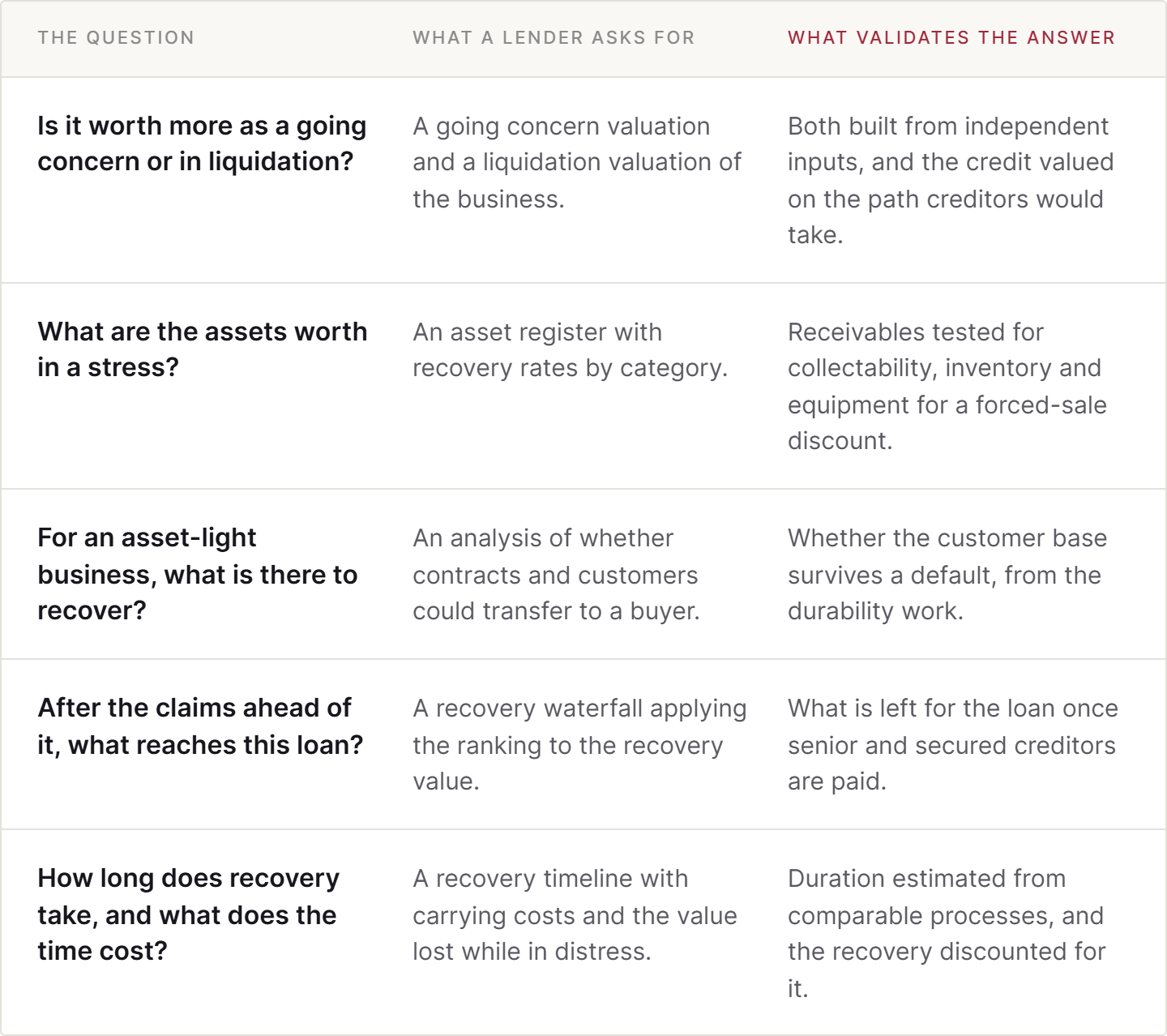
Going concern or liquidation
The first probe compares two ways creditors could recover. In a going concern sale the business is sold as a whole, with its customers, suppliers and employees. In a liquidation the assets are collected or sold one by one. A lender builds both values from its own inputs and values the credit on the path it expects creditors to take, which is not always the one that produces the higher figure. A going concern sale depends on a buyer being available and on the customers staying through the process.
The distributor’s schedules below model a default in year three on the lender’s figures. By then the lender’s free cash flow has repaid $8.4mm of the senior facility, leaving $24.6mm outstanding. The going concern value applies an illustrative 5.0x multiple to $9.7mm of EBITDA, which is the lender’s $10.6mm less the $0.9mm downside from the lesson on cash flow and coverage.
What the assets are worth in a stress
The second probe values each category of asset at what it would realize in a stress, not at book. A lender asks for the asset register and applies a recovery rate to each category. Receivables are tested for collectability: which customers would still pay a distributor that has defaulted, and how much would be lost to disputes and credits. Inventory and equipment are tested for a forced-sale discount, because they have to be sold quickly and often to buyers other than the usual customers.
How easily each category converts to cash sets its rate. The distributor’s receivables turn into cash as customers pay, on the 45-day collection cycle from the lesson on liquidity and working capital. Its inventory sits in the warehouses and the new branch and has to be sold. The trucks and warehouse equipment sit outside the facility’s security package, so their value goes to other creditors.
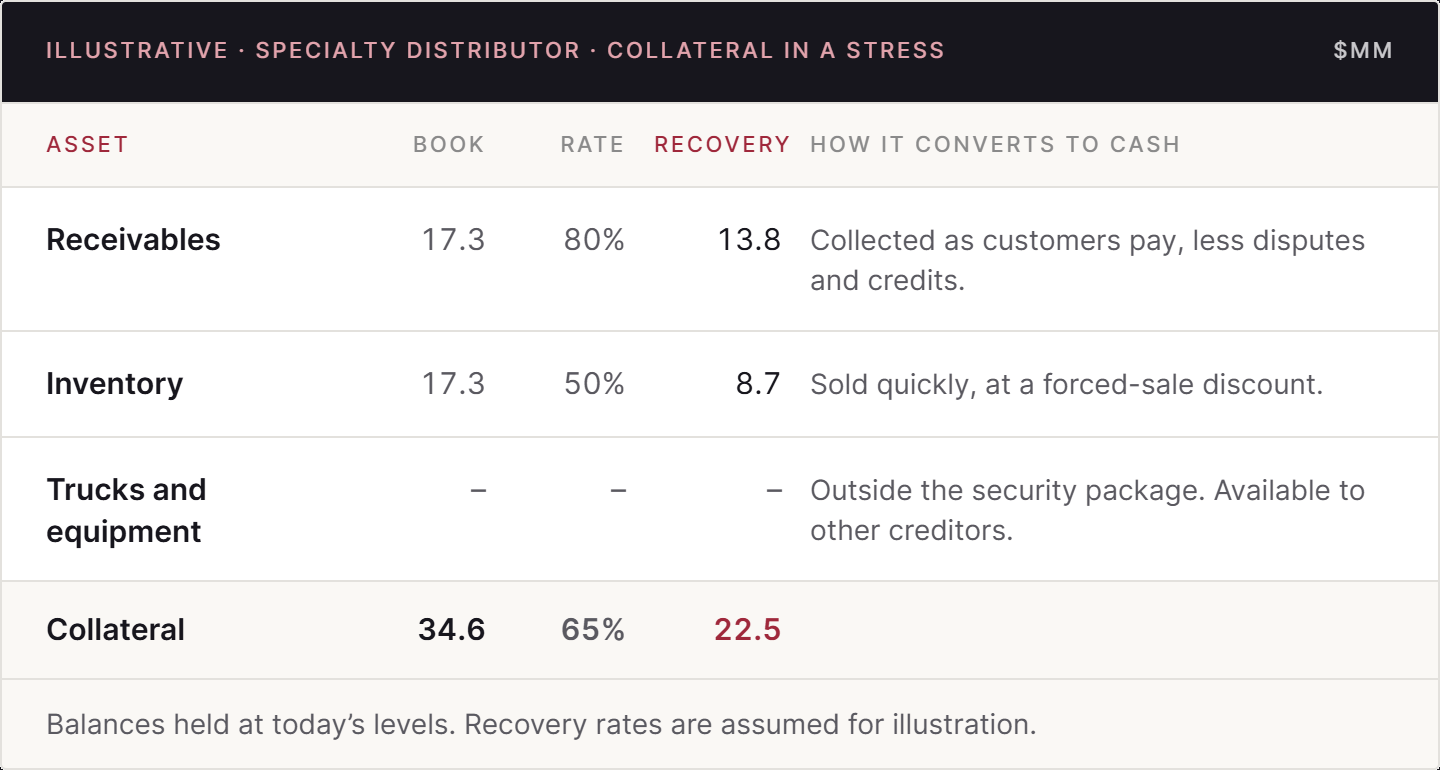
The collateral carried at $34.6mm on the balance sheet recovers $22.5mm, or 65 percent of book. Where the collateral sits also affects the value. Inventory held by a subsidiary that does not guarantee the facility, or by a foreign subsidiary whose assets are not pledged, falls outside this figure, which is why the entity map from claim priority comes before the recovery rates.
When there are few hard assets
The third probe establishes what there is to recover when a business holds few hard assets, such as a services firm or a specialty contractor with little equipment. Most of its value is in its contracts and customers. A lender tests whether the contracts could transfer to a buyer and whether customers would stay through a default. That is the same work as the durability layer, and for these businesses the recovery case and the refinancing case depend on the same customer base.
The distributor has hard collateral, but the gap between its $22.5mm liquidation value and its $48.5mm going concern value is mostly the value of its customer relationships and supply agreements. That part is recovered only if those relationships survive the default and transfer to a buyer.
For a borrower that is consuming cash, there is usually little collateral to liquidate, and recovery depends almost entirely on a sale of the company. The lesson on the cash-consuming borrower measured that as loan-to-value against the last round, and showed how the ratio rises if the next buyer pays less.
What reaches the loan
The fourth probe runs the ranking against the recovery value. A lender takes the capital structure from claim priority and pays each claim in order from the value available on each recovery path, until the value runs out. The result shows what is left for the loan once the creditors ahead of it are paid.
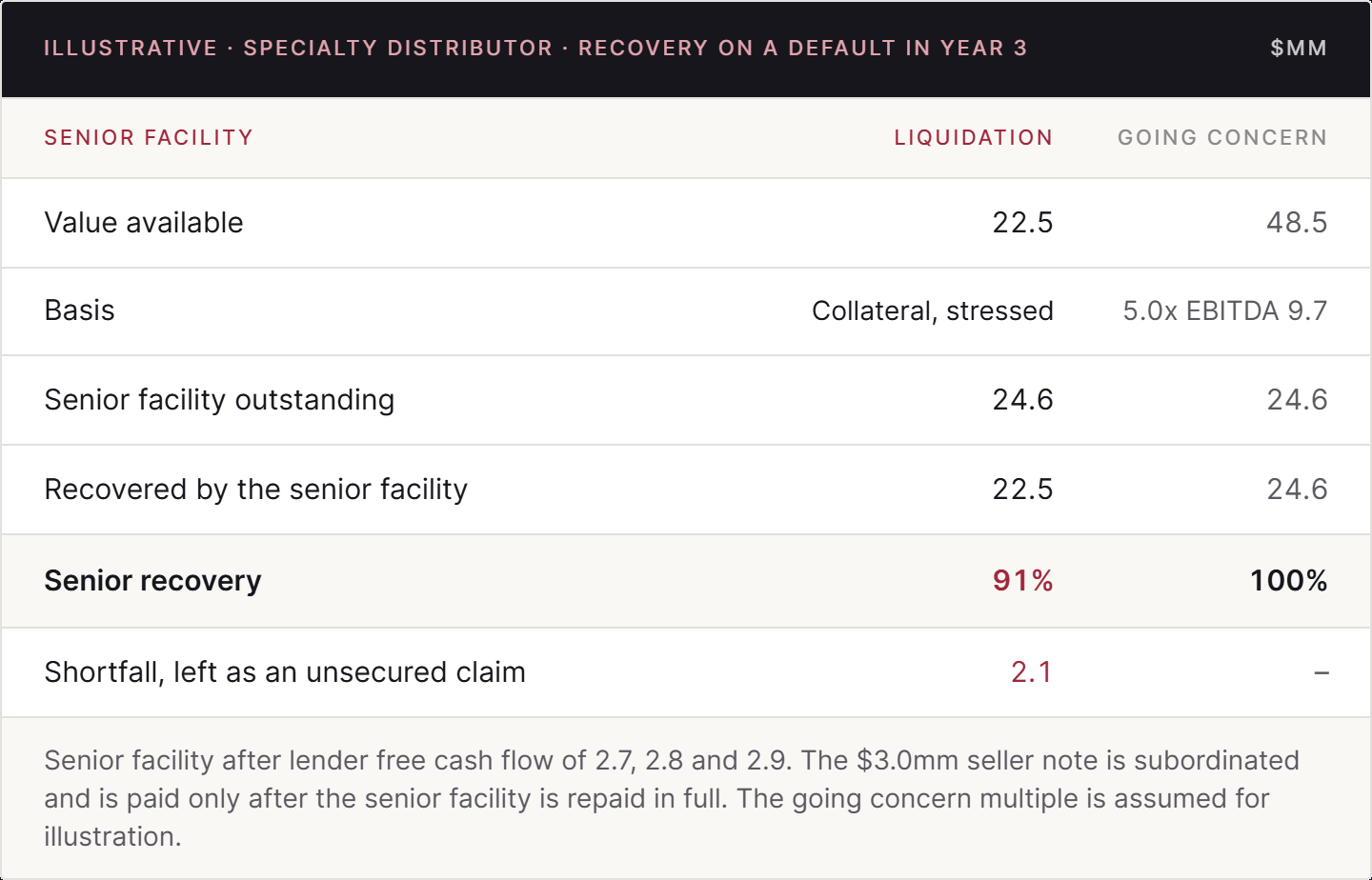
In liquidation, the collateral repays $22.5mm of the $24.6mm outstanding, or 91 percent. The $2.1mm shortfall becomes an unsecured claim and competes with trade creditors and the other unsecured claims for the value of the trucks, the equipment and anything else outside the security package. Under the subordination agreement from claim priority, the seller note receives nothing until the senior facility is repaid in full. In a going concern sale at $48.5mm, the senior facility is repaid in full and the value also covers the $30.1mm of total obligations.
The year of the default also affects the result. The same collateral covers less of the facility in year one, when more of the loan is outstanding, and more of it in year five. Distributions to the owners, which the lesson on financial policy showed becoming permitted as leverage falls, leave more of the facility outstanding at every point.
How long recovery takes
The fifth probe estimates how long a recovery would take and what the delay costs. A lender estimates the duration from comparable processes, then reduces the recovery for the time it takes to receive the cash, for the costs of running the process, and for the value that is lost while the business is in distress, such as customers moving to competitors and inventory ageing in the warehouse.
For the distributor, a recovery is estimated at 12 to 18 months. The categories convert at different speeds: most receivables are collected within the first few months, while inventory takes longer to sell and loses value the longer it sits. The $22.5mm in the schedule is the amount recovered before those reductions.
What the downside and recovery read produces
At the end of this component a lender has five builds: a going concern and a liquidation valuation, a schedule of recovery rates by asset category, an analysis of whether the customer base would transfer to a buyer, a recovery waterfall, and a recovery timeline with its costs.
Most of the inputs already exist. The asset register comes from the lesson on key resources, the ranking and the entity map from claim priority, and the customer analysis from the durability layer. The new work is the valuation, the stress and the waterfall. When there is little hard collateral, the recovery case and the refinancing case rest on the same customer base, which is where the refinance horizon work starts.
A borrower can list its collateral, where it sits and how quickly each category would turn into cash. The recovery rates a particular lender applies, and which recovery path it values the credit on, depend on the lender type, on how it has seen similar collateral realized, and on what buyers are paying for businesses in the sector.
Next in the series
Refinance horizon: whether a new lender would refinance the loan when it matures
The maturity profile, the credit metrics at maturity, and what happens if the refinancing market is closed when the loan comes due.
You can list your collateral and how quickly it would turn into cash. Knowing the recovery rates the lenders in your process will apply, and whether they will value your business as a going concern or on its assets, is the part I do at Synthase Capital Partners.